Your team is working against scaling
🥲Inconsistency in brand is affecting scale, A/B test winners rarely perform equally across all audience segments, and more!
Welcome to a space where every edition delivers insights, strategies, and inspiration to fuel your advertising brilliance. 🤯
🥲 Your Brand Is Scaling. Your Team Is Breaking It
At $1M+, paid social stops being the primary growth lever. Retail diversification becomes the engine. And the brand that wins those conversations isn’t necessarily the one with the best product, it’s the one that shows up with the most consistent, credible presence across every touchpoint a buyer encounters before signing anything.
The compounding cost nobody is calculating
Brand inconsistency at scale isn’t a design problem. It’s a CAC problem in disguise.
When a retail buyer receives an off-brand pitch deck, it raises their subconscious risk assessment of your entire operation. Higher perceived risk means harder negotiations, lower shelf placement, worse payment terms, and slower partnership decisions.
Every inconsistent document leaving your building is quietly inflating the cost of your highest-margin growth channel while your ad account looks completely fine.
What breaks at each stage
- At $500K, the founder reviews most external outputs. Brand stays tight by default.
- At $1M, first hires produce independently. Inconsistencies appear in wholesale and retailer materials first, furthest from the ad account, closest to your highest-value buyers.
- At $3M+, multiple teams build decks simultaneously. Brand standards exist as a PDF nobody reads. Visual identity becomes tribal knowledge that new hires never fully absorb.
The strategies that fix it
Reframe brand consistency as a revenue protection metric. Calculate what a single delayed retail deal costs in margin, then ask whether your current brand infrastructure justifies that risk.
Most brands spend more on a single Meta creative test than on the systems protecting their entire retail pipeline.
Run a quarterly output audit across every non-ad touchpoint.
Pull your last 10 retailer decks, investor updates, agency briefs, and wholesale proposals. Score each on three variables: typography accuracy, color consistency, and messaging alignment. The gaps reveal exactly where tribal knowledge is breaking down and which hires need guardrails first.
Build a tiered template library with locked and editable zones. Locked: logo placement, color palette, approved fonts, core messaging.
Editable: content only. This removes brand decision-making from people who shouldn’t be making it which at $1M+ is everyone except the founder and one designated brand owner.
Enforce guardrails at the point of creation not after. Your team is already prompting AI to build decks inside PowerPoint. Templafy works directly inside PowerPoint brand rules and approved assets set once, applied automatically to every deck built after that. BDO saved $1.65M in a year. Adobe teams recovered 72% of their time. You can try it for free.
Assign a brand output owner at each growth stage. At $1M this is the founder reviewing a weekly sample of non-ad outputs, not every deck, just a representative batch. At $3M it’s a dedicated brand ops hire protecting consistency across everything that isn’t a paid ad.
Track their impact by measuring retail deal velocity before and after the role exists.
Build a brand risk scoring system for outbound materials. Before any deck leaves the building for a retail, wholesale, or investor conversation, score it across five criteria: visual consistency, message accuracy, competitive positioning, social proof inclusion, and CTA clarity.
Anything below a threshold score gets flagged before it reaches a buyer. One bad deck in front of a Target or Whole Foods buyer doesn’t get a second chance.
Separate your two operating modes explicitly in your brand manual. Paid creative is deliberately loose, raw, native, creator-interpreted content outperforms polished on every performance channel.
Every document going to a retailer, investor, or wholesale buyer is locked. Write this distinction into your onboarding so every new hire understands where flexibility lives and where it destroys value.
Retail diversification is the growth engine at $1M+. The brands winning those conversations show up consistently before the meeting even starts.
Together with Insense
You don't have a creator problem. You have a workflow problem.
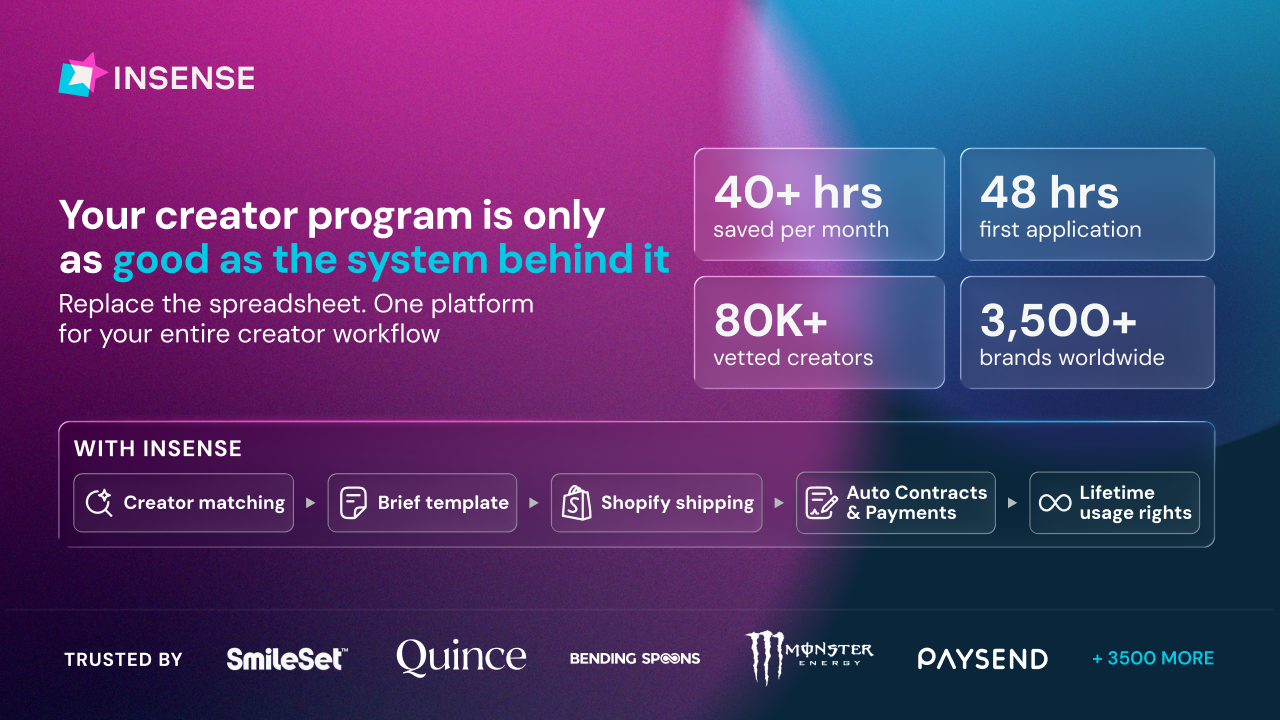
A creator goes quiet. A package gets lost. Someone forgot the contract. You're two weeks behind on the content your paid team is waiting on. The fix isn't hiring another person. It's not doing it manually anymore.
Insense is the self-serve platform built to replace that chaos.
One place to receive creator matches from 80,000+ vetted profiles, run briefs, ship product, automate contracts and payments, and own full lifetime content rights. The results speak for themselves:
- Nurture Life cut turnaround time from 2 months to 2 weeks using just one marketer and Insense
- Solawave received 180+ ad-ready assets in a single month by simply shipping products
- Matys Health achieved 12× reach through Spark Ads on TikTok
Over 3,500+ brands, like Quince, Monster Energy, and Paysend, get first applications in 48 hours and save 40+ hours a month. That's what fixing the workflow looks like.
Book a free strategy call by May 15 and get a $200 platform credit towards your first campaign.
⚡A/B Testing Wins Mean Nothing Without Segmentation
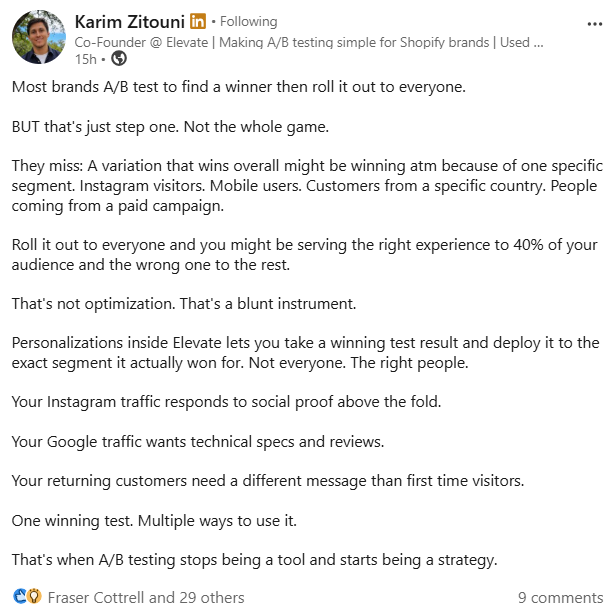
This approach argues that finding a single “winner” in A/B testing is only the starting point. Performance often comes from specific segments, not the entire audience. Instead of rolling out one version universally, the real leverage comes from deploying variations based on where and for whom they actually work.
Why it works: Different segments have different intent and context. Aligning experiences to the traffic source or user type increases relevance. This improves conversion rates by matching the right message to the right audience.
Where it needs balance: Over-personalization can add complexity and strain resources. Smaller teams may lack traffic volume for meaningful segmentation. Without clear data, segmentation risks overfitting and inconsistent user experiences.
🚀 Reel of the Day
What Works:
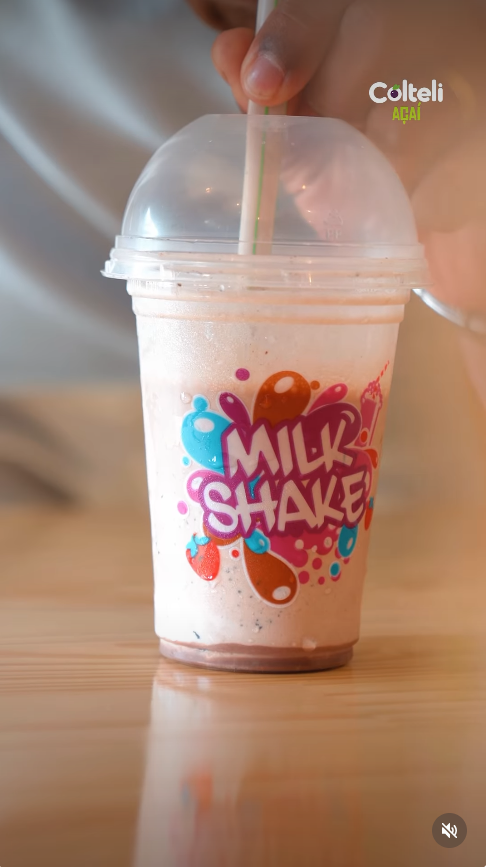
Expectation Flip Hook - You think he’s helping, but he pivots to the drink instantly. That sharp expectation break creates a dopamine spike, making the reel memorable and forcing the viewer to mentally reprocess the scene.
Desire Over Logic - The drink isn’t shown as tasty, it’s shown as irresistible. Choosing it over helping someone exaggerates craving, positioning the product as something people want beyond rational, socially acceptable behavior.
Authenticity Through Simplicity - No heavy edits or artificial polish are needed. The simplicity makes it feel real, and that authenticity builds trust, especially in a feed where overly polished content often feels staged or fake.
Don’t make your product look better. Make it worth choosing over something else, even irrationally. When your product drives a questionable decision, it becomes unforgettable, not just visually appealing.
Thanks for reading this edition! Keep pushing boundaries, testing ideas, and staying inspired. See you in the next edition with more ways to ignite your marketing success. 🥰