Your Cost Per Lead Is A Lie
👀You need to replace CPL with cost per ICP-matched lead, Platform reliance quietly reduces margins and long-term control, and more!
Welcome to a space where every edition delivers insights, strategies, and inspiration to fuel your advertising brilliance. 🤯
Together with Accio Work
Accio Work: Your Agentic Team for Real Business
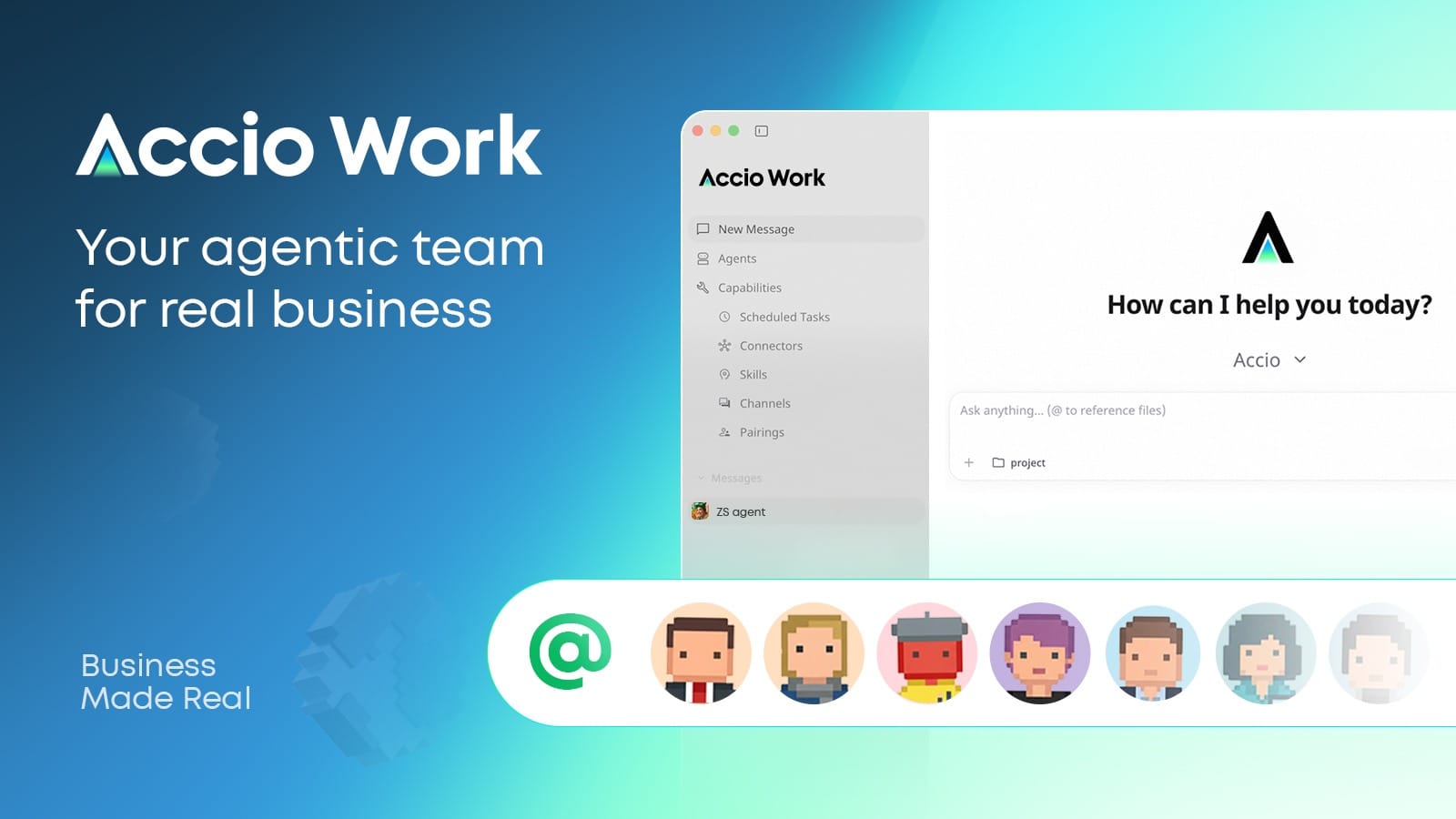
Accio Work is the agentic workspace built to handle what's eating your hours. Product sourcing, supplier negotiation, store management, and marketing execution. It connects strategy directly to action, so nothing sits waiting on you.
- Backed by Alibaba.com's global network and 1B+ products, supplier sourcing is instant and verified
- Deep integrations mean it works inside the tools your business already runs on
- Connects to Gmail, Slack, Notion, and every tool already in your stack
Most AI tools stop at generating ideas. Accio Work goes further. It takes action, tracks execution, and keeps your business moving while you focus on growth.
This is what running lean actually looks like at scale. Try one week free. No commitment. Just results.
Let Accio Work - Try One Week Free
👀 Your Cost Per Lead Is A Lie
CPL is the most-reported metric in Google Ads and the least useful one for making business decisions. It tells you what you paid for someone to raise their hand, not whether that hand belongs to anyone you'd ever want to sell to.
Replace CPL with Cost Per ICP-Matched Lead
The gap between "someone filled in a form" and "someone sales will actually call back" is where most Google Ads budgets bleed. You can halve your CPL by loosening targeting and still watch revenue drop, because the cheaper leads don't close.
The only CPL worth tracking is the cost of leads that match your ideal customer profile, job title, company size, intent signal, whatever your sales team uses to triage. Everything else is activity, not progress.
Implementation
- Build a shared ICP definition with sales before touching campaign settings. If they can't tell you in two sentences who they want to talk to, no targeting strategy will fix that gap.
- Tag leads at the CRM level by ICP match, then pull that data back into Google Ads as a custom conversion event. Now you're optimizing toward real buyers, not form-fillers.
- Run CPL and cost-per-ICP-lead side by side for 30 days. The delta between the two numbers is the size of your targeting problem.
Use Lead Quality as a Feedback Signal for Creative
Ad creative doesn't just drive volume; it pre-qualifies. An ad that speaks to budget, business size, or a specific pain point will self-select for the right leads before the form is ever seen. Most advertisers treat lead quality as a targeting problem when it's equally a messaging problem. The wrong hook attracts the wrong person at scale.
Implementation
- Map your lowest-quality lead cohorts back to the specific ads and keywords that generated them. The pattern will be obvious within two weeks of clean tracking.
- Test headline specificity: "Google Ads for ecommerce brands doing £500k+" will generate fewer but better leads than "Google Ads that get results." Specificity is a quality filter.
- Add a qualifying question to the form: budget range, team size, timeline. It reduces volume, but the leads that convert improve immediately.
Build a Lead Quality Score Before You Scale
Scaling a campaign before you know your lead quality distribution is how agencies burn client budgets. A quality score, even a simple 1-3 rating applied by sales at first contact, gives you the signal to know whether more spend will generate more revenue or just more noise. Without it, every scaling decision is a guess dressed up as strategy.
Implementation
- Have a sales rate for every inbound lead as hot, warm, or cold within 24 hours of contact. That's your quality distribution baseline.
- Don't scale until at least 30% of leads are hot. Scaling a campaign where 5% qualify is scaling a problem, not an opportunity.
- Feed quality scores back into the bid strategy. Smart bidding optimizes toward whatever conversion you give it; give it the right one.
CPL is a vanity metric with a great marketing team. Cost per ICP-matched lead is the number that tells you whether your budget is working or just spending.
⚡Platform Dependency Erodes Margins and Control
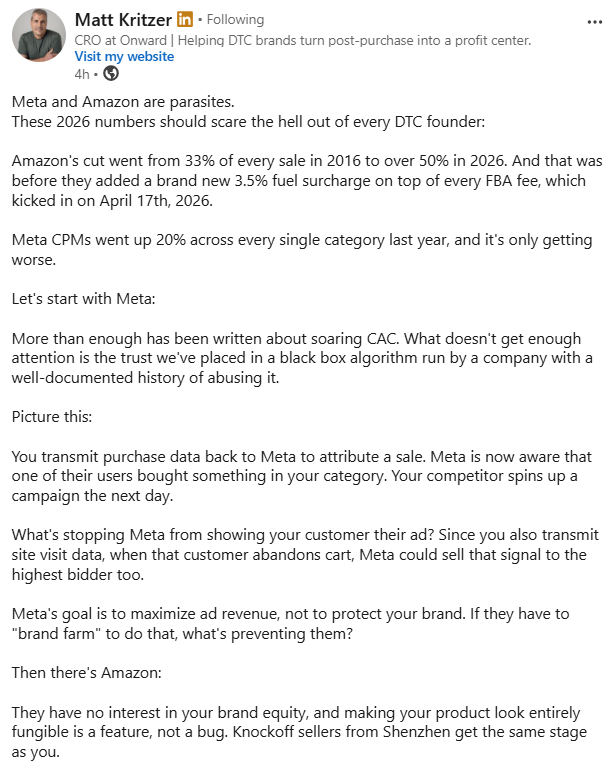
This argument highlights how heavy reliance on Meta and Amazon compresses margins and limits control over customers. Rising fees and ad costs reduce profitability, while a lack of data ownership weakens long-term brand leverage. The core issue is structural dependency, not just rising CAC.
Why it works: Platforms optimize for their own revenue, not brand profitability. As dependence increases, costs rise, and control decreases. Owning customer relationships and demand reduces reliance and protects margins over time.
Where it needs balance: Platforms still offer unmatched scale and demand access. Avoiding them entirely limits growth. The goal is diversification and ownership, not complete exit from high-performing channels.
Together with The Shift
Stop googling AI tools at midnight.
There are over 3,000 of them in The Shift’s vault, already vetted, ready to explore.
Subscribe and get instant access to the tool vault, a 500+ prompt library, and free AI courses built for people with actual work to do.
Plus, the daily newsletter that keeps you sharp on everything moving in AI in under 5 minutes a day.
They’re also giving away a free 1-year Claude Pro subscription to 3 subscribers.
Subscribe for free to enter. All free. All in one place.
🎥 Reel of the Day

What Works:
Generosity Illusion Hack - They simulate unrealistic generosity to create emotional surprise, but anchor it in humor. Viewers know it is fake, yet still feel good about the brand subconsciously and associate abundance.
Acting > Production - The cashier’s micro expressions carry the reel. Slight pauses, tone shifts, and eye contact create realism, making viewers trust the moment more than any high production setup.
Twist Anchors Memory - “I got fired ten minutes ago” reframes everything. The joke becomes memorable because it connects all prior generosity into a single absurd but logical explanation.
Build reels where the joke structure carries the sale. Let humor create emotional openness first, then quietly flood the frame with product so desire builds without resistance.
Thanks for reading this edition! Keep pushing boundaries, testing ideas, and staying inspired. See you in the next edition with more ways to ignite your marketing success. 🥰