Your TikTok Workflow Is Fragmented
🥲Your TikTok program is four disconnected channels pretending to be a system, Attribution and incrementality answer two completely different marketing questions, and more!
Welcome to a space where every edition delivers insights, strategies, and inspiration to fuel your advertising brilliance. 🤯
❤️🩹 How to fix the TikTok scatter
A TikTok program works because each channel hands a signal to the next, but most brands skip defining what that signal actually is.
Paid finds demand, creators add proof, organic builds momentum, and Shop converts, but the handoffs are usually accidental, which means the system sits on a dashboard without ever turning.
Map Your Handoffs And Audit Which Are Explicit Versus Accidental
List the four channels and draw an arrow from each to the next in the order in which the signal should travel. For each arrow: what signal travels, and who is responsible for moving it?
Most teams find that three of four arrows are accidental. Signal travels when someone notices and forwards a Slack message, not when a process moves it.
Accidental handoffs work occasionally and fail constantly, because they depend on individual attention rather than system design.
Define The Specific Signal Each Channel Produces For The Next
Generic handoff language never translates into operational behavior. The fix is naming the exact signal and the format it travels in.
The signal map:
- Creator UGC patterns feed paid creative briefs (which hooks earned organic engagement)
- Paid winners feed organic re-cuts (top paid ads adapted within 7 days)
- Organic signals feed creator selection (which patterns earn saves and shares)
- Shop conversion velocity feeds paid bidding (which products convert at what rate)
Each needs a defined format, frequency, and recipient. Otherwise, the handoff is a suggestion. HubSpot's 2026 Essential Apps for Marketers collection brings together 14 apps across creative, ads, events, and more, so the context you need travels with every campaign, decision, and handoff. You can browse the apps here.
Build A Weekly Handoff Review Separate From Channel Performance Review
Most TikTok reviews focus on channel KPIs like paid ROAS, creator engagement, and Shop conversion. The handoff review asks: what did each channel hand to the next this week, and what did each receive?
The structure:
- Each channel owner reports what signal they passed downstream
- Each channel owner reports what signal they received from upstream
- Missed handoffs get logged the way missed KPIs do
- The system owner flags any handoff failure for two weeks running
Channel performance and signal handoff are different problems with different fixes. A connected TikTok program is four channels handing signals on a defined cadence.
Together with Pounce
Your performance agency. Rebuilt as software.
Pounce runs the performance marketing function end-to-end. Creative analysis. Brief generation. Competitor intel. Performance optimization. All delivered by AI agents that work the way a strong performance team works, not the way a dashboard works.
The intelligence inside Pounce already powers enterprise platforms like Supercell, Wildlife Studios, DeNA, Playtika, and Scopely.
On the April 2026 Mobile Gaming Video Ads Understanding Benchmark, Pounce scored 98.5%. The best frontier model scored 76.9%.
Generic AI gets it wrong 1 in 4 times. Pounce gets it wrong 1 in 50. That gap is what makes it trustworthy enough to run without you watching it.
You're paying agency markup for work that's already being done faster, cheaper, and more accurately by software.
Get started for free with Pounce today!
⚡Attribution Reports Don’t Tell You What Actually Caused Growth
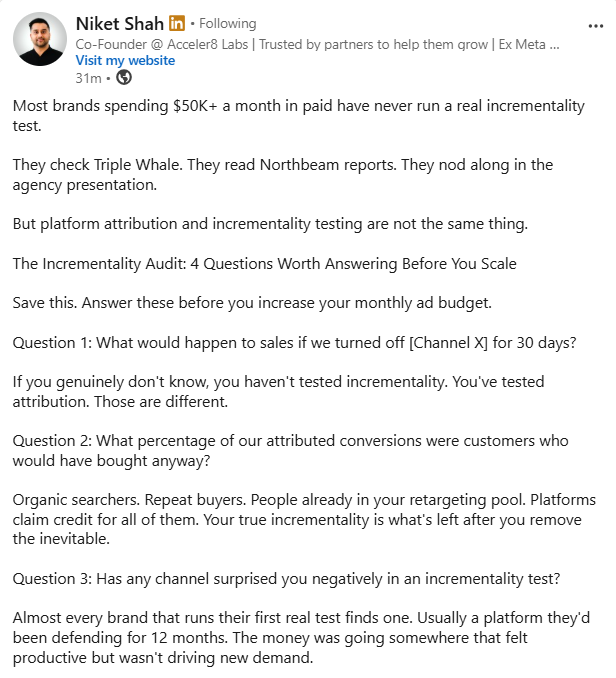
This post distinguishes attribution from incrementality. Attribution shows which platform claimed the conversion, while incrementality measures whether the sale would have happened without that channel. The core argument is that many brands scale spend without knowing which channels are truly creating new demand.
Why it works: Incrementality testing isolates actual business impact instead of relying on platform-reported credit. This reveals which channels generate net-new customers and which mostly capture existing intent or returning buyers.
Where it needs balance: Incrementality tests can be expensive, operationally disruptive, and difficult to run cleanly. Short-term shutdowns may also distort long-term learning effects. Attribution still provides useful directional insights when interpreted carefully.
🎥 Reel of the Day
What Works:
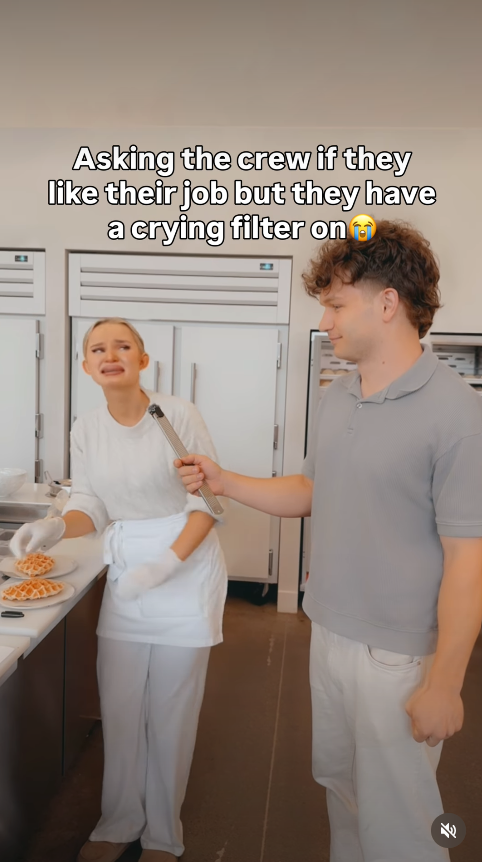
Filter-Led Emotional Hijacking - The crying filter instantly manipulates emotional interpretation before anyone even speaks. Viewers subconsciously process normal workplace answers as emotional breakdowns, creating comedy through artificial emotional misalignment instead of scripted jokes.
The Hook Creates Curiosity Friction - “Asking the crew if they like their job but they have a crying filter on” is incredibly efficient framing. Audiences instantly understand the joke structure while needing to stay for individual reactions and personalities.
Comment Section Extends The Joke - Comments like “you can see the passion and dedication in the tears” continue the comedic universe perfectly. Great reels create participatory humor where audiences naturally start roleplaying within the content concept themselves.
Take an existing viral platform mechanic like a filter, then combine it with emotionally loaded workplace situations. The strongest branded content often comes from remixing familiar internet behaviors into culturally relatable business moments.
Advertise with Us
Wanna put out your message in front of over 40,000 best marketers and decision makers?
Thanks for reading this edition! Keep pushing boundaries, testing ideas, and staying inspired. See you in the next edition with more ways to ignite your marketing success. 🥰