Hub Pages Boost Your AI Citings
💻 The most underbuilt AI visibility asset in your content library, YouTube growth increasingly depends on managing platform risk signals carefully, and more!
Welcome to a space where every edition delivers insights, strategies, and inspiration to fuel your advertising brilliance. 🤯
💻 Hub pages are the most underbuilt AI visibility asset in your content library.
Every content team has them. Pillar pages, topic hubs, resource centers. Built once, linked to occasionally, optimized for PageRank distribution, and left alone.
AI retrieval systems use hub pages differently. They read them as entity boundary declarations, explicit maps of what a brand is authoritative on, which subtopics belong to that authority, and how each relates to the whole.
A hub page that doesn't declare those boundaries clearly isn't a missed SEO opportunity. It's leaving your entire topic cluster invisible to AI retrieval.
Here's how to fix it.
Write the hub introduction as an entity declaration
Open every hub page with three explicit statements: what this topic covers, who it's for, and what the authoritative subtopics are. No warmup. Declaration first.
The operational difference: when AI systems can map a hub to a query in the first paragraph, every subtopic page in that cluster inherits the entity authority signal.
When the hub opens with narrative context instead, AI systems infer the topical boundary from content alone, and often don't, leaving subtopic pages competing as isolated pages rather than as part of a recognized authoritative cluster.
Rebuild anchor text using sub-query mapping
Take your hub's primary topic and run it through ChatGPT with this prompt: "What are the specific questions someone would ask when researching [topic]?" The output is your sub-query map.
Each question corresponds to a subtopic page. That question, compressed into a descriptive phrase, becomes your anchor text.
A hub about email marketing linking to a deliverability page with the anchor "improving inbox placement rates for cold outreach" signals a precise topical relationship.
The same link anchored as "email deliverability" signals a category, not a relationship. AI systems extract the former as a meaningful entity connection. The latter is noise.
Build extractable subtopic descriptions
Above each subtopic link, add a passage using this structure: one sentence naming what the page covers, one sentence connecting it to the hub topic, one sentence stating the specific query it answers. Under 75 words total.
Here's the delta. Without it: "Email Deliverability Guide." With it: "This guide covers the technical and sender reputation factors that determine inbox placement rates.
It connects to this hub's broader email marketing framework by addressing the delivery layer before any engagement optimization makes sense.
Best for teams whose campaigns are sending but not landing." The second version is an extractable passage. The first is a label.
Track whether the restructure is moving citation rates. SEMrush's AI Visibility Toolkit shows your visibility across ChatGPT and Google AI Mode at the topic level. Try it free for 7 days.
Build the entity map. The cluster citations follow.
Together with Insense
You know UGC works for you. Now build the machine.
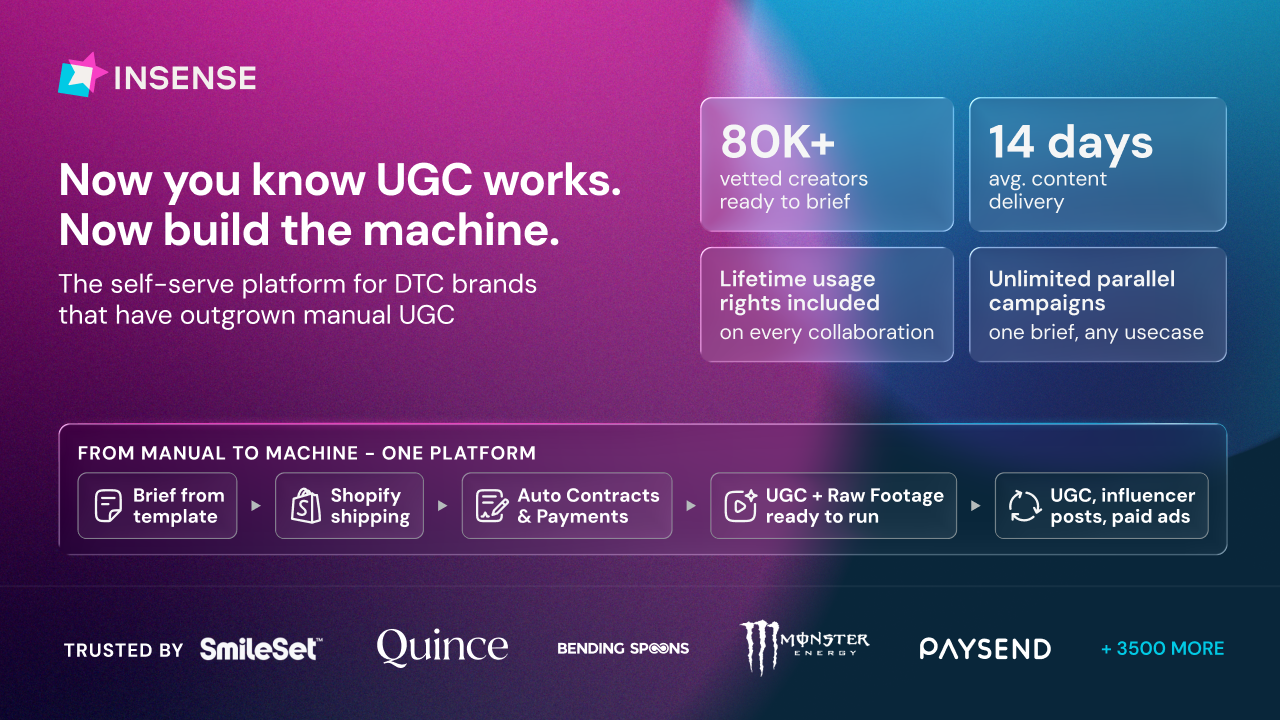
You know creator content works for your brand. The challenge now isn't whether to do it; it's how to do it at volume without the process falling apart.
Insense is the self-serve platform for DTC brands that have outgrown manual UGC.
Source from 80,000+ vetted creators, run multiple campaigns in parallel, automate contracts and payments via Shopify integration, and receive content in 14 days, with full lifetime usage rights included.
Trusted by SmileSet, Paysend, Bending Spoons, Quince, Monster Energy, and 3,500+ brands using Insense to turn what works into a repeatable production system.
Book a free strategy call by May 15 and get a $200 platform credit towards your first campaign.
⚡YouTube Growth in Sensitive Niches Depends on Risk Management
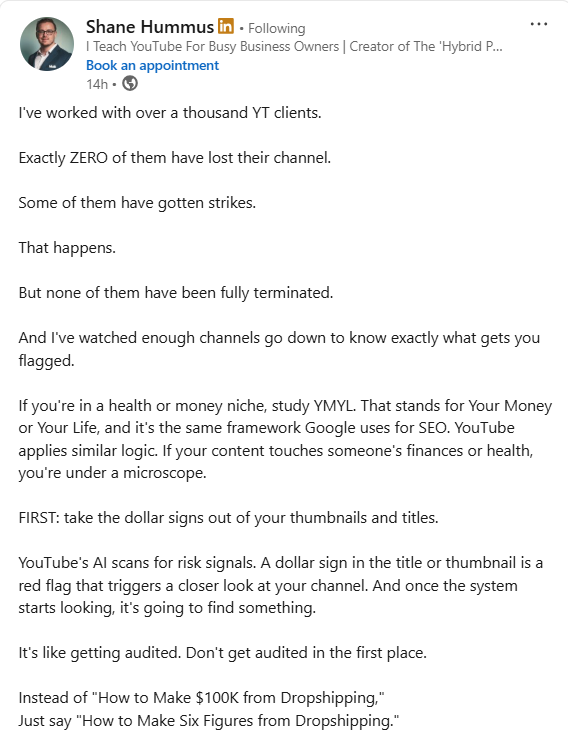
This post frames YouTube growth as partly a compliance strategy, especially in health and finance categories. It argues that channels get flagged less from one mistake and more from accumulating platform risk signals. The focus is on reducing those signals through positioning, disclaimers, niche selection, and avoiding fully automated content.
Why it works: Platforms use automated systems to detect potentially harmful or misleading content. Reducing obvious risk signals lowers the chances of scrutiny. This protects distribution stability and long-term channel survivability.
Where it needs balance: Over-censoring content can weaken hooks and reduce discoverability. Platform policies also evolve unpredictably. Risk reduction helps, but it does not guarantee immunity from strikes or enforcement changes.
🎥 Reel of the Day
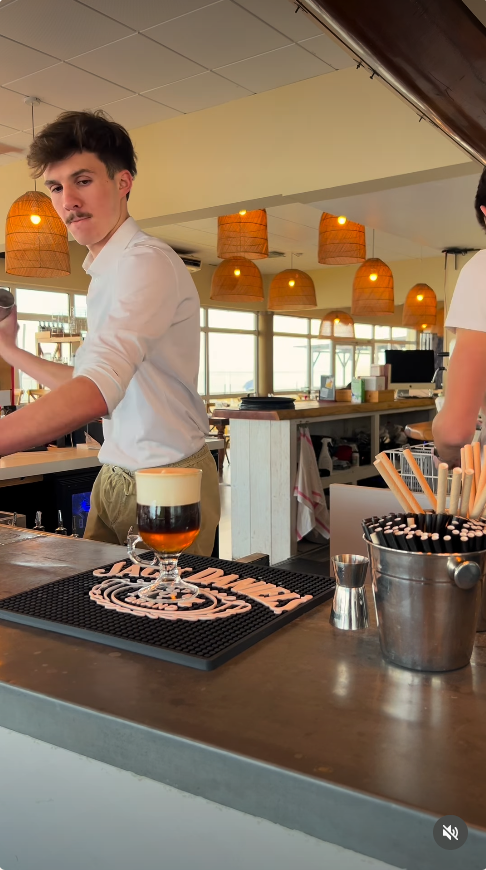
What Works:
Craftsmanship Destruction Tension - The reel works because viewers emotionally watch craftsmanship get destroyed instantly. Humans naturally value visible effort, so ruining the carefully layered drink creates instant emotional frustration mixed with comedy simultaneously.
Tiny Trigger, Massive Reaction - The customer only stirs the drink casually, yet the reaction escalates into chaos immediately. That disproportionate emotional payoff creates humor because audiences recognize the overreaction while secretly understanding the frustration completely.
Visual Simplicity Helps Virality - There are no confusing cuts, heavy editing, or complicated storytelling layers. One simple emotional concept gets exaggerated perfectly, making the reel instantly understandable even without sound or full contextual attention spans.
Take a tiny everyday frustration your staff experiences repeatedly, then exaggerate the emotional reaction cinematically. That formula works because audiences connect harder with emotionally true micro-moments than polished promotional restaurant content.
🥳Events
🔥 Every Week Claude Ships Something New. This Weekend You Finally Catch Up.
This Saturday & Sunday | Virtual Event | Free
The world's first Claude-a-thon is a 2-day live deep dive, 10 AM to 7 PM EST. You will build artifacts and dashboards, automate workflows using Claude Connectors, and run full presentation sessions hands-on.
Advertise with Us
Wanna put out your message in front of over 40,000 best marketers and decision makers?
Thanks for reading this edition! Keep pushing boundaries, testing ideas, and staying inspired. See you in the next edition with more ways to ignite your marketing success. 🥰