Back in stock needs variations
📧The Highest-Intent Email in Most DTC Calendars Gets the Least Attention, and more!
Welcome to a space where every edition delivers insights, strategies, and inspiration to fuel your advertising brilliance. 🤯
📧Back in stock needs variations
A customer signs up for a back-in-stock alert on a specific product. That single action is a clearer purchase signal than almost anything else in the customer journey, more explicit than a cart abandonment, more deliberate than a browse session, and most brands still send the same generic "it's back!" template to everyone on that list regardless of how long they've been waiting or what they actually asked for.
Segment the notification by wait time, not just by product.
A customer who signed up three days ago and a customer who signed up three months ago are not equally likely to still want the product for the same reason.
The long-wait subscriber has had more time to find a substitute elsewhere, and losing that sale a second time often means losing the customer's trust in the waitlist feature entirely.
Send that segment first, with copy acknowledging the wait specifically, before opening the notification to everyone else.
Give repeat customers early access before the general waitlist opens.
A customer with prior purchase history gets notified a few hours ahead of new or one-time signups, turning existing loyalty data into a genuine perk rather than leaving the restock as a first-come free-for-all that treats a five-time buyer identically to someone who signed up once out of curiosity.
Use real historical sell-through data to frame urgency honestly. If a specific SKU sold out within 48 hours the last time it restocked, saying so directly, "this sold out in two days last time," is accurate urgency built from the product's own history, not a manufactured countdown timer. Pull the previous restock's time-to-sellout before writing the send.
Building tiered wait-time segments, a loyalty-based early access window, and copy grounded in actual sell-through history is real production work most teams skip because the standard back-in-stock flow already technically exists and nobody revisits it once it's live.
Connect Omnisend to Claude or ChatGPT and it flags this exact kind of gap, a high-intent automation running on a generic template instead of segmented logic, then creates the tiered segments and drafts each version ready to review. You can get started with ready-made prompts.
The waitlist signup was the customer telling the brand exactly what they wanted and when they wanted to know about it. Most back-in-stock flows still answer that with a form email built once and never touched again.
Together with AirOps
Why are your top pages still missing AI's pipeline

Traffic from AI search is growing, but most teams haven't figured out how to turn it into a pipeline. Comparison pages, pricing pages, and feature pages either aren't getting cited or aren't converting when they are.
On August 5 at 2pm ET, Josh Grant, founder of StackedGTM and former VP of Growth at Webflow, joins AirOps' Josh Spilker for a tactical session on the plays that turn AEO into revenue this quarter.
You'll walk away with:
- Why comparison pages are one of the fastest ways to capture mid-funnel AI search demand
- What makes pricing and feature pages more extractable for models to cite and summarize accurately
- How third-party corroboration from sites like G2, Capterra, and Reddit strengthens on-site messaging
Audit your feature pages against Josh's AEO framework live, and leave with a ranked fix-it list
Can't make it live? Register anyway and get the recording in your inbox within 24 hours.
⚡ Hidden Search Terms Limit Google Ads Optimization
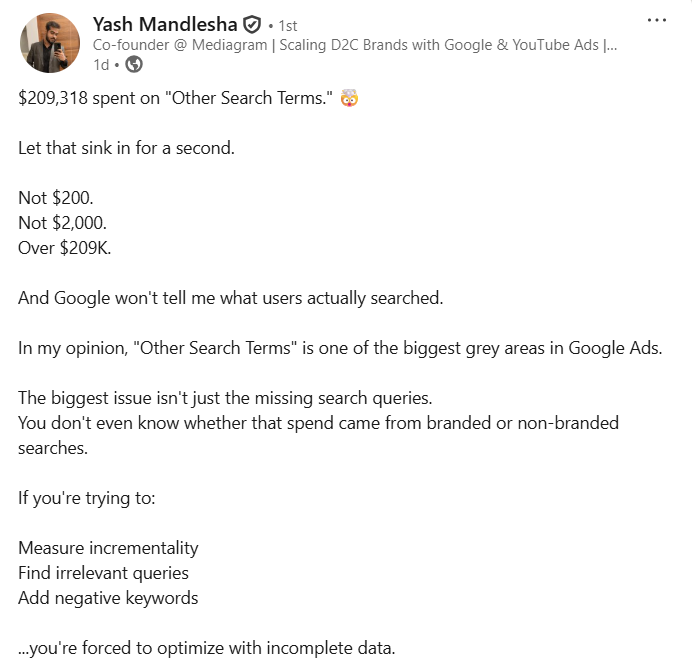
This framework highlights a growing challenge in Google Ads: a significant share of spend can be grouped under "Other Search Terms," leaving advertisers without visibility into the queries driving those clicks. That lack of transparency makes optimization more difficult.
Why it works: Search term reports are essential for identifying irrelevant traffic, adding negative keywords, and understanding whether spend is coming from branded or non-branded searches. Greater visibility enables more informed bidding and budget decisions.
Where it needs balance: Google withholds some search queries to meet privacy thresholds, so complete transparency isn't always possible. While hidden search terms reduce optimization opportunities, advertisers can still improve performance by analyzing broader campaign trends, audience signals, and conversion data alongside the available query reports.
🎥 Reel of the Day

What Works:
Curiosity Through Motion - The dropped lipstick creates an instant curiosity gap, but the unexpected foot movement becomes the real hook. Viewers keep watching to understand why she's stepping toward it instead of picking it up.
Micro Problem Solving - The reel turns a tiny everyday inconvenience into satisfying content. That relatable scenario, combined with a quick visual payoff, creates high completion rates and strong replay value despite its simplicity.
Product First Demonstration - No lengthy explanation is needed. The shoe's hidden functionality becomes obvious through action, making the demonstration feel organic while naturally building product recall and purchase curiosity.
Start with a familiar problem your audience instantly recognizes, then reveal your product's unexpected feature as the solution. The surprise payoff is what drives retention, shares, and comments.
Advertise with Us
Wanna put out your message in front of over 40,000 best marketers and decision makers?
Thanks for reading this edition! Keep pushing boundaries, testing ideas, and staying inspired. See you in the next edition with more ways to ignite your marketing success. 🥰