Creator Programs Are Your Test Engine
🚀 Why creator programs are starting to outperform creative teams, CAC targets often fail when margins and pricing realities stay disconnected, and more!
Welcome to a space where every edition delivers insights, strategies, and inspiration to fuel your advertising brilliance. 🤯
🚀Why Creator Programs Are Starting To Outperform Creative Teams
Brands still think creator marketing is mainly about reach. That is not true. The interesting shift is that creators are slowly becoming the brand’s testing engine itself.
Once a creator gets paid on performance instead of a flat sponsorship fee, their behavior changes completely. They stop thinking like talent and start thinking like distribution.
They test harder. Post more often. Rewrite hooks themselves. Try different angles without being asked.
One good creator with upside attached behaves less like a contractor and more like a mini growth team operating independently.
That changes the economics of content volume fast.
1. Performance incentives create creative iteration without internal overhead
Internal creative teams are expensive to scale because every test requires coordination: briefs, reviews, approvals, editing rounds, feedback loops.
Performance-based creator systems distribute that experimentation outward.
Different creators naturally explore different parts of the market:
- one leans aspirational
- another goes heavy on humor
- someone else accidentally finds a hook that converts moms over 40 at half the CPA
The brand is no longer responsible for generating every idea internally. The market starts surfacing winning angles organically through creator behavior itself.
That is an entirely different operating model from traditional UGC.
2. Organic creator content gives paid teams a huge unfair advantage
This is the part that really matters.
A creator video that already performed organically arrives inside Meta with useful behavioral proof attached to it. You already know:
- people watched it
- people shared it
- people cared enough to comment
- the hook survived cold attention
That removes a massive amount of guesswork from paid creative testing.
Instead of manufacturing ads in a vacuum, the paid team starts scaling ideas that already demonstrated market pull naturally.
Organic becomes creative reconnaissance.
Paid becomes amplification.
3. The real bottleneck becomes operational chaos
The model sounds easy until you try running it at scale.
Suddenly you are managing:
- dozens of creators
- usage rights
- payment tracking
- approvals
- content organization
- affiliate attribution
…across spreadsheets, emails, DMs, and random folders.
That operational mess is usually where momentum dies.
Insense exists because more brands are pulling creator programs in-house but need infrastructure that can actually support the speed modern paid social requires, from creator sourcing and approvals to contracts, payments, and lifetime usage rights. You can book a free strategy call by May 31st and get a $200 platform credit towards your first campaign.
The brands winning right now are not necessarily producing better ads. They are building systems that generate more winning ads naturally over time.
Together with AirOps
Your best content isn't showing up in ChatGPT. Fix it.
You've published the guides, built the backlinks, and kept the editorial calendar moving. But when buyers search on Perplexity or ChatGPT, your competitors get cited. You don't.
AirOps analyzed 15M+ AI queries and built the exact playbook Ramp, Carta, and Webflow are running right now.
- A clear heading structure makes you 2.8x more likely to get cited by AI engines
- 85% of brand mentions come from off-site sources, not your own domain
- Pages not refreshed quarterly lose AI citations 3x faster than updated ones
This playbook breaks down what’s actually working today: structural patterns, refresh cadences, off-site signals, and the operating models driving real AI visibility and pipeline growth.
You’ll also get a practical 90-day action plan your team can execute this quarter.
⚡Some CAC Problems Are Actually Business Model Problems
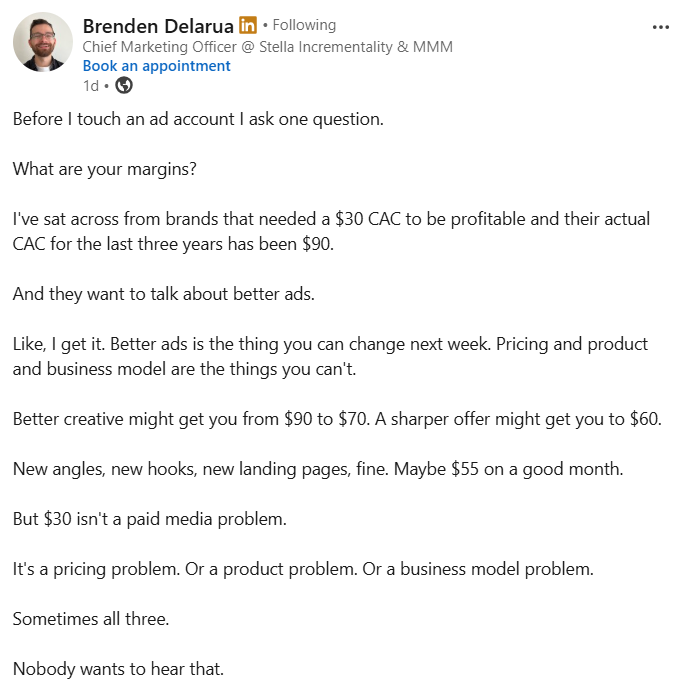
This post argues that many brands misdiagnose profitability issues as ad performance problems. Creative, targeting, and landing pages can improve efficiency, but they cannot fix fundamentally broken unit economics. When required CAC targets are disconnected from reality, no agency or campaign structure can sustainably close the gap.
Why it works: Paid media operates within the constraints of margins, pricing, and product economics. Understanding contribution margins first prevents unrealistic acquisition expectations and helps identify whether growth problems are operational or marketing-driven.
Where it needs balance: Strong creative and positioning can sometimes reshape economics more than expected. Early-stage brands may also tolerate temporarily inefficient CACs while building retention or scale. The key is distinguishing strategic investment from structurally broken math.
🎥 Reel of the Day

What Works:
Creator-Economy Expansion Strategy - The reel transforms one plated dish into multiple content assets, reframing restaurants from food businesses into scalable media production systems strategically online.
Educational Retention Loop Engineering - Creators rewatch tutorials repeatedly to study framing, movement, and pacing, generating unusually high retention through learning-driven replay behavior psychologically online.
Process Transparency As Authority Building - Showing the actual shooting process increases creator trust dramatically because audiences value operational workflows more than polished final outcomes today online.
Turn one product into a “5-shot content system” series. Teach repeatable filming frameworks instead of endlessly posting finished aesthetic food visuals.
Advertise with Us
Wanna put out your message in front of over 40,000 best marketers and decision makers?
Thanks for reading this edition! Keep pushing boundaries, testing ideas, and staying inspired. See you in the next edition with more ways to ignite your marketing success. 🥰