Get more out of every hook
💪The 30-second edit that squeezes more out of a hook you already won with, Different UGC formats solve different jobs, and more!
Welcome to a space where every edition delivers insights, strategies, and inspiration to fuel your advertising brilliance. 🤯
💪The 30-Second Edit That Squeezes More Out of a Hook You Already Won With
A winning hook is usually treated as finished. Trigger words are the fastest way to prove it was not. Add one emotionally charged word or phrase to a hook that already performed and the underlying angle stays intact while the scroll-stopping power increases, often for less effort than any other creative iteration available.
Identify your trigger word inventory before you need it. Trigger words split into two types and both matter.
Unusual words that stop attention purely through unfamiliarity: pussyfoot, bewitched, scuzzy. And ordinary words that carry an emotional charge everyone already feels: lame, icky, feral, unhinged.
Build a running list of 15 to 20 across both types, sourced from your own winning ads, competitor creative, and comment sections where people already use charged language to describe your product category. The list is reusable infrastructure, not a one-time brainstorm.
Apply trigger words to winners, not to new concepts. The technique works because it iterates on proven structure rather than replacing it. Pull your top three performing hooks from the last quarter.
For each one, produce three variants that insert a single trigger word into the existing sentence, changing nothing else about the angle or the claim.
This isolates the trigger word as the only variable, which means a lift or a flop tells you something specific about that word rather than about the whole concept.
Test trigger words against your fatigue data, not your gut. A hook approaching fatigue is the ideal candidate for this edit, since a strong original angle with declining performance often just needs the emotional charge refreshed rather than a full creative rebuild.
Track which trigger words produce lift across multiple hooks over time. Words that repeatedly work across different angles are worth keeping in permanent rotation. Words that spike once and never repeat are novelty, not a real technique, and should be retired from the list.
The value of this edit is the ratio: 30 seconds of work against a measurable lift on creative that already proved itself. Before briefing a new concept next time a hook fatigues, run the trigger word pass first and see if the old winner had one more run left in it.
Together with Omnisend
Your AI Knows What to Send. Omnisend Sends It.
You've got an AI that can talk strategy all day; what it can't do is open your email platform, pull live data, and build the campaign while you watch
Omnisend fixes that. Connect it to Claude or ChatGPT and your AI starts doing the actual work. Real segments, emails drafted and ready to review, zero copy-pasting
- See exactly what's driving revenue in your account by campaign, by segment, by send
- Find the automations and sequences you're missing and what they'd be worth if you turned them on
- Say "build it" and watch your AI create the segment, draft the email, and hand it back ready to send
150,000+ brands are already averaging $79 back for every $1 spent on this platform
Switching used to be the hard part. Omnisend migrates your lists, campaigns, and automations free in 5 days, so the only thing you're really deciding is how long you're okay leaving revenue on the table
Connect Omnisend and let your AI actually do something
⚡ Different UGC Formats Solve Different Jobs
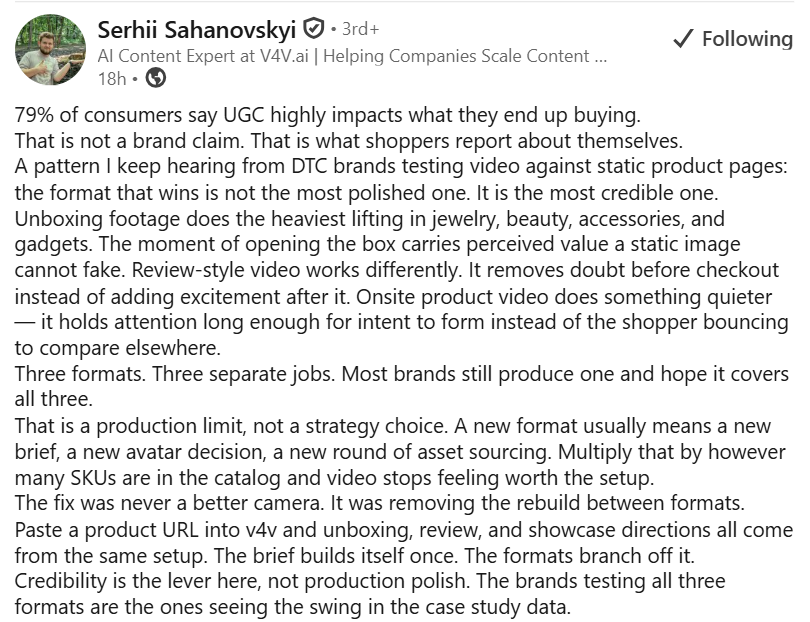
This framework argues that UGC isn't one creative type. Unboxing, reviews, and product showcases each influence different stages of the buying journey. Matching the format to the customer's decision-making process is more effective than relying on one style for every campaign.
Why it works: Unboxings build excitement, review videos reduce uncertainty, and product showcases increase confidence. Together, they create credibility across the buying journey instead of expecting one format to do everything.
Where it needs balance: UGC isn't automatically the best-performing creative. Results depend on the product, audience, and execution. The strongest brands combine authentic customer content with polished brand assets to support different buying moments.
🎥 Reel of the Day
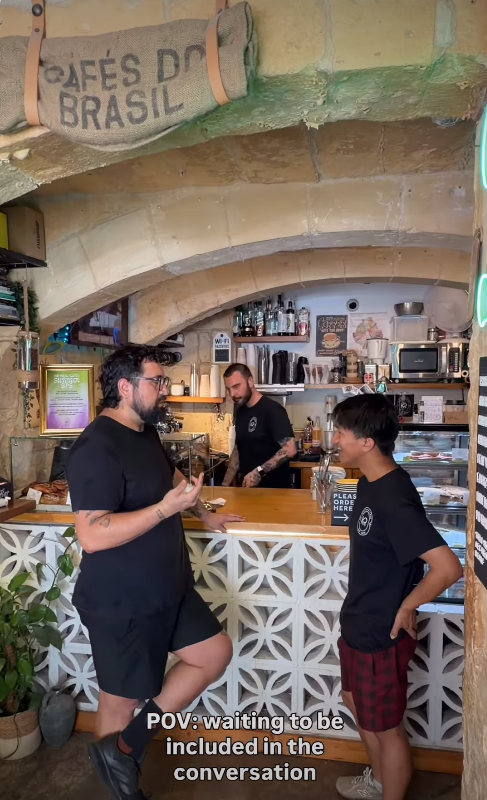
What Works:
Shared Discomfort - Almost everyone has been the awkward third person waiting to join a conversation. The reel turns that universally uncomfortable moment into comedy, making viewers instantly relate before anything else happens.
Background Character - The barista isn't the main subject at first, yet slowly becomes the funniest person in the frame. Rewarding viewers who keep watching creates a stronger completion rate than revealing everything immediately.
Escalating Attention - Each glance toward the conversation becomes slightly more obvious than the last. The progressive escalation keeps anticipation rising until viewers start waiting for the next reaction instead of scrolling away.
Turn employees into recurring background characters instead of product presenters. Let subtle reactions become the entertainment while your store naturally remains the setting, creating highly shareable content without overt promotion.
Advertise with Us
Wanna put out your message in front of over 40,000 best marketers and decision makers?
Thanks for reading this edition! Keep pushing boundaries, testing ideas, and staying inspired. See you in the next edition with more ways to ignite your marketing success. 🥰