Only 28% trust their own CTV spend
🤖 Bot traffic was 65% of all CTV fraud last year. Most buyers genuinely don't know if their placements are clean, Bigger discounts can sometimes protect more margin, and more!
Welcome to a space where every edition delivers insights, strategies, and inspiration to fuel your advertising brilliance. 🤯
🤖 Only 28% of CTV buyers are confident their ads aren't running into bots
Bot traffic accounted for 65% of all CTV ad fraud in the most recent full year of data, and only 28% of advertisers say they're confident their CTV spend is actually landing on fraud-free placements.
That's not a fringe concern about a niche corner of the channel. It means roughly seven in ten CTV buyers either know they're paying for some fraudulent traffic or genuinely don't know either way, a strange place for a channel this expensive to sit without more people treating it as an active line item to manage.
The reason CTV fraud persists at this scale isn't that it's undetectable. It's that verification requires deliberate effort most media plans never allocate, since CTV inventory gets bought through a chain of platforms and exchanges where fraud can be introduced at multiple points, and nobody in that chain has a strong individual incentive to be the one surfacing it.
A buyer who never specifically checks is, by default, part of the 72% without real confidence in their own placements.
Request fraud and verification data as a standard line item on every CTV buy
Most CTV buying conversations focus on reach, targeting, and creative fit, with fraud verification treated as a separate, occasionally-requested audit rather than a default part of the deal.
Make third-party fraud verification data a standard requirement on every CTV insertion order going forward, the same way brand safety reporting became standard rather than optional. A seller unwilling to provide it is telling you something about what that data would show.
Audit your existing CTV spend for the fraud signature, not just your next buy
The 65% bot-fraud figure applies to CTV broadly, which means campaigns running right now are statistically likely to carry some share of fraudulent placements nobody has specifically checked for.
Pull independent viewability and fraud data for your currently running CTV campaigns, not just future buys, and compare it against your platform's own reported delivery numbers.
A meaningful gap between the two is the signature worth investigating before renewing that placement at the same spend level.
Weigh premium, curated inventory against open programmatic specifically on fraud exposure
Open programmatic CTV inventory generally carries more fraud risk than curated, premium marketplace inventory, since the additional layers of open-exchange buying create more points where fraudulent traffic can enter undetected.
Favor sourcing paths with direct publisher relationships and verification built in, rather than buying through the most open, least verified route available. That's a structural fix rather than an after-the-fact audit, and it costs efficiency you have to be willing to give up.
The shortest version of that fix is buying through fewer hands. Tatari plans, buys, and measures streaming, linear, and online video on one platform with direct supply relationships, so delivery gets checked against actual business outcomes rather than taken on faith from a reseller's own report.
A placement that isn't reaching real households shows up as a hole in the conversion data, not just as a line that cleared verification. Vuori, Nutrafol, Calm, Ro, Magic Spoon, and Fiverr all buy their TV this way, self-serve for a first flight or full-service at nine-figure spend.
Fifteen minutes with their team will tell you what your current CTV dollars are actually buying. You can book a free demo here.
Seventy-two percent of buyers can't confidently say their CTV spend is clean. The 28% who can didn't get there by assuming it was.
Together with AirOps
Your Buyers Asked AI. Did Your Brand Appear?

AI is already deciding which B2B tools reach your buyers’ shortlists. If your brand is missing from trusted sources, competitors can win consideration before sales enters the conversation.
On September 29, Foundation CEO Ross Simmonds and AirOps search marketing lead Josh Spilker will unpack research spanning nearly 380,000 AI answers, 3 million citation events, and 81 enterprise software topics.
You’ll walk away knowing how to:
- Build a platform-specific source map across six AI engines, showing where to earn visibility for the buying prompts that matter
- Turn the 84-of-100 dominance of comparison pages and listicles into a clear publishing plan for content AI platforms already cite
- Find and fix unfavorable comparisons before they spread across hundreds of answers and quietly steer buyers toward competitors.
You’ll leave knowing which prompts to track, which sources to prioritize, and where your team should invest first to influence AI-driven buying decisions.
Join live at 1 p.m. ET on September 29.
Can't attend the session live? Register anyway, and you’ll get the recordings in 24 hours.
⚡ Bigger discounts can sometimes protect more margin
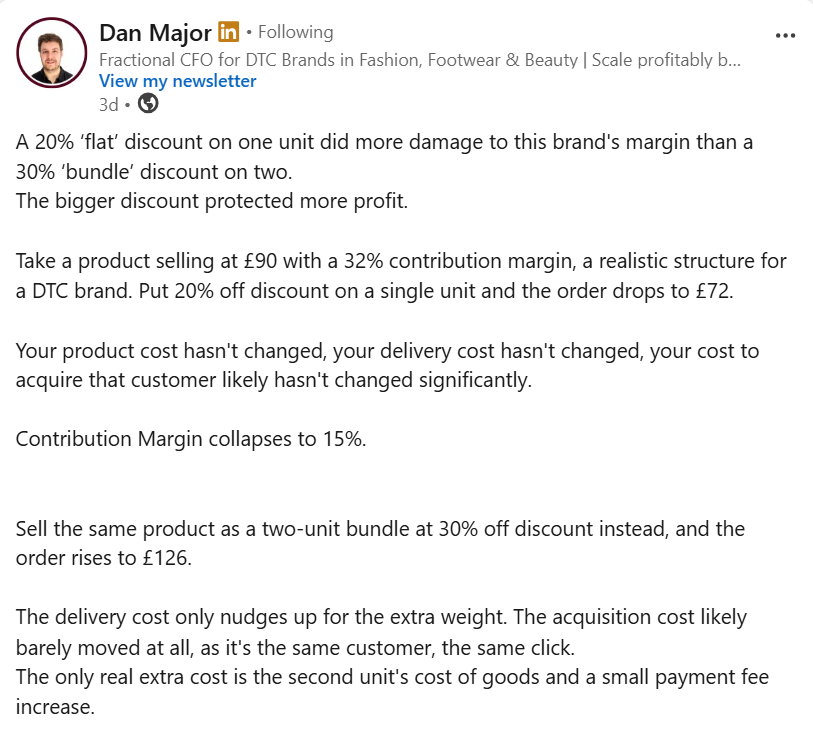
This framework argues that discount depth alone doesn't determine profitability. A deeper bundle discount can preserve more contribution margin when the higher AOV spreads acquisition, delivery, and other fixed order costs across more revenue.
Why it works: Bundles increase units per order without necessarily increasing CAC or fulfillment costs proportionally. That can make a 30% bundle discount economically stronger than taking 20% directly from a single-unit purchase.
Where it needs balance: The outcome depends heavily on COGS, shipping, payment fees, CAC, and whether customers would have bought multiple units anyway. Brands should model contribution margin at each offer level rather than assuming bundles or smaller discounts are automatically more profitable.
🎥 Reel of the Day

What Works:
1. Turn Launches Into Participation - The Opening Weekend Passport turns a store opening into gamified retail, giving visitors missions across the space instead of relying on passive browsing to drive engagement.
2. Design For Exploration - Tasks like finding stickers and identifying products create a store scavenger hunt, deliberately moving shoppers through multiple displays while increasing product discovery and time spent in-store.
3. Reward The Journey - A free gift for completing the passport gives every activity a payoff. This completion incentive encourages shoppers to finish the experience rather than abandoning it halfway through.
For retail launches, build a simple challenge → exploration → reward loop. Give shoppers reasons to visit different store areas, create shareable moments, and visually document turnout for post-event content.
Advertise with Us
Wanna put out your message in front of over 40,000 best marketers and decision makers?
Thanks for reading this edition! Keep pushing boundaries, testing ideas, and staying inspired. See you in the next edition with more ways to ignite your marketing success. 🥰