Search is more than just answers
💪It has started to complete actions, and that is what you need to capture, Amazon optimizes for conversion, not discovery, and more!
Welcome to a space where every edition delivers insights, strategies, and inspiration to fuel your advertising brilliance. 🤯
💪Search Just Started Completing Actions Instead of Just Answering Questions
Google's AI Mode now connects directly to third-party apps inside Search itself: Instacart, Canva, YouTube Music, among the first. A query doesn't have to stop at a written answer anymore. It can resolve into an actual action inside a connected app, executed on the user's behalf, without a website ever entering the picture.
This is a genuinely different moment from the citation and extraction problems most AEO advice still focuses on. Getting mentioned by a model, and getting mentioned accurately, both assumed the buyer would eventually land on a page and take it from there themselves. Action-capable search removes that assumption entirely.
The model can now execute the outcome directly, inside another app, which means a brand's actual website may never be the place the transaction happens at all, no matter how well that website was built or optimized.
What changes first: structured data stops being a nice-to-have for search visibility and starts being the literal interface an AI agent interacts with to complete an action. A feature or pricing page with clean, structured, machine-readable data isn't just easier to cite anymore; it's a candidate for direct execution.
A page without it may simply be unreachable by an agent trying to act, regardless of how well-written the content is for a human reader.
What changes second: the businesses positioned to benefit are the ones with API-level or structured-data-level integration ready before their competitors even notice this shift happened.
Waiting for action-capable search to become mainstream before preparing for it means starting the integration work at the exact moment demand for it spikes and building capacity gets expensive and slow.
What changes third: measurement breaks in a new way. A transaction completed entirely inside a connected app, without a site visit, won't show up in the analytics stack most teams still rely on, which means the businesses winning this channel first may not even know it's happening until competitors visibly pull ahead.
On August 5 at 2pm ET, Josh Grant, founder of StackedGTM and former VP of Growth at Webflow, joins AirOps' Josh Spilker to work through what actually needs to be true structurally for a page to be ready for this shift, not just cited, not just extractable, not just well-written for a human, but genuinely action-ready for a system operating on a buyer's behalf.
You can secure your free spot here. Can't make it live? Register anyway and the recording lands in your inbox within 24 hours.
Together with Billo
Half of the top UGC ads share 3 hook types. Most marketers skip all of them.
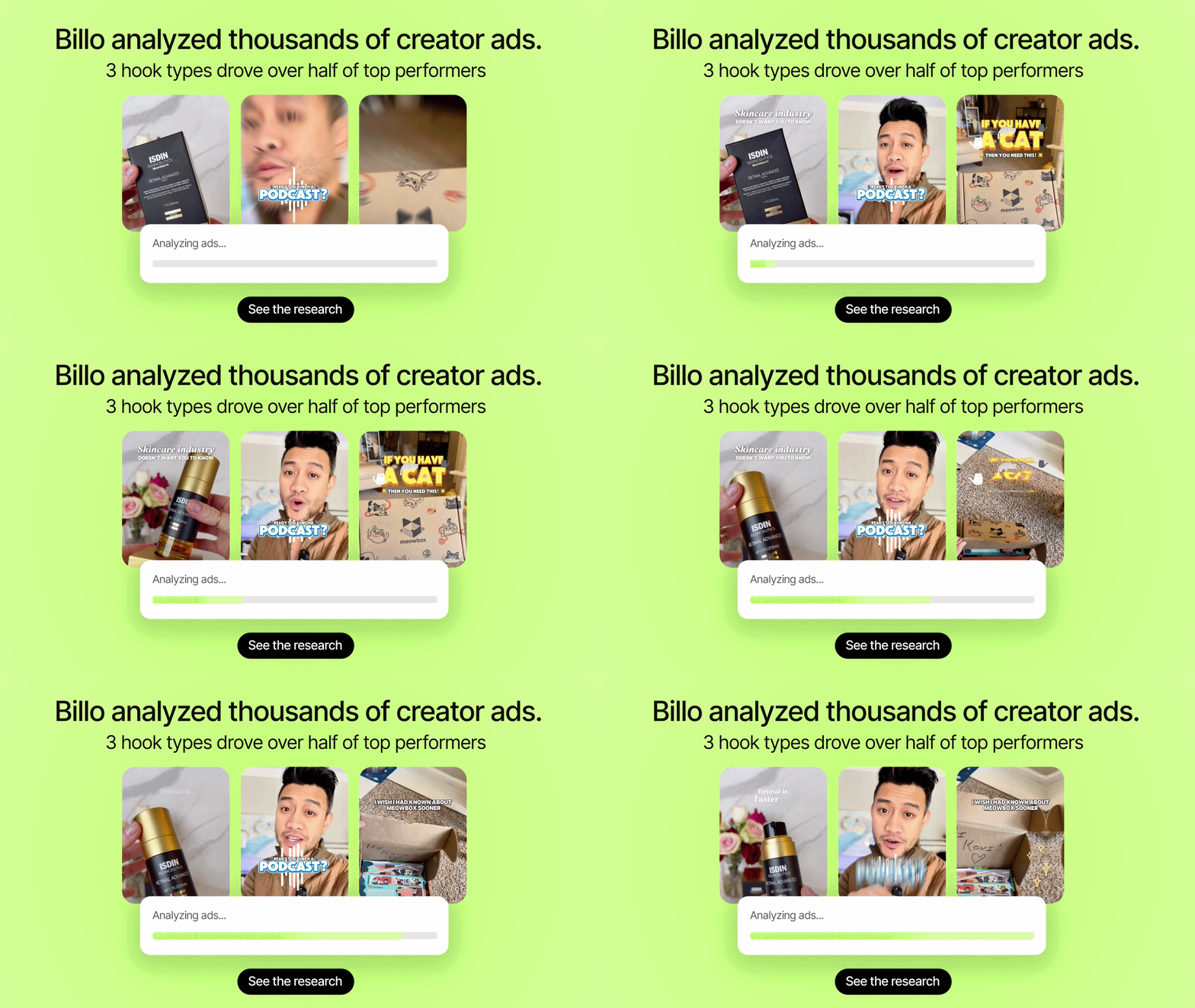
Billo analyzed every top-performing creator ad on the platform and tagged each one by hook type. The hooks most marketers default to - list formats, FOMO framing, comparison setups, and insider angles barely showed up at the top.
The three that won are in the full breakdown, with the exact lines those ads opened with.
Read it before your next round of creator ads.
⚡ Amazon Optimizes for Conversion, Not Discovery
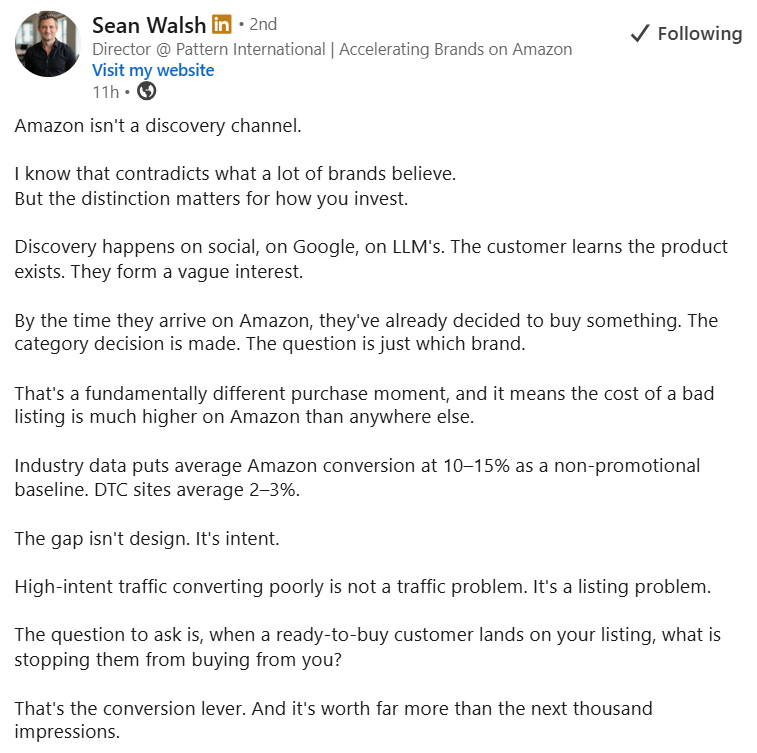
This framework argues that Amazon is primarily a high-intent shopping platform rather than a product discovery channel. By the time shoppers reach a listing, they're usually evaluating brands within a category, not deciding whether they need the product at all.
Why it works: Because purchase intent is already high, improving product listings can have a larger impact than acquiring more traffic. Strong images, persuasive copy, reviews, pricing, and clear value propositions help convert shoppers who are already close to buying.
Where it needs balance: Amazon is increasingly becoming a discovery platform through sponsored ads, recommendations, and search browsing. While conversion optimization is critical, brands still benefit from investing in visibility and awareness both on and off Amazon to drive long-term growth.
🎥 Reel of the Day

What Works:
Irresistible Hook Setup - The opening frames create instant curiosity by implying kids are impossible to shop for. The adorable dinosaur reveal lands within seconds, delivering a payoff that spikes replay value and hook efficiency.
Emotion Sells Product - The product is never overexplained. Instead, viewers watch a genuinely joyful reaction, letting emotional storytelling communicate value far better than listing features ever could.
Share-Driven Positioning - The reel taps directly into parent identity. The caption encourages tagging other parents, while the relatable humor and cuteness naturally fuel shares, comments, and save-worthy gifting inspiration.
For products bought as gifts, prioritize the recipient's authentic reaction over product specs. Emotional payoffs consistently outperform feature demos because viewers imagine creating that same moment themselves.
💃Events
🔥 Why Some Pages Get Cited In AI Search While Higher Rankings Get Ignored
June 17 | 60 Minutes | Virtual Event
Google's AI Mode is changing how buyers discover brands, and rankings alone no longer guarantee visibility. Learn the content signals AI uses to choose citations, how to identify visibility gaps before they cost pipeline, and the workflows top B2B teams are using to earn references in AI answers, with insights from Chris Long, co-founder of Nectiv.
Can't make it live? Register anyway, you'll get the recordings within 24hours.
Advertise with Us
Wanna put out your message in front of over 40,000 best marketers and decision makers?
Thanks for reading this edition! Keep pushing boundaries, testing ideas, and staying inspired. See you in the next edition with more ways to ignite your marketing success. 🥰