Stop chasing the wrong problem
🫠 The retention fire drill that wasn't about retention, Stronger offers often beat better ads, and more!
Welcome to a space where every edition delivers insights, strategies, and inspiration to fuel your advertising brilliance. 🤯
🫠 The Retention Fire Drill That Wasn't About Retention
Two subscription brands, same month, same opening line on the call: something's breaking, come look at our retention.
Neither had a retention problem. Both had an offer that was never going to work at the volume they were pushing it.
Here's the math nobody ran before scaling spend:
- Acquisition cost per customer
- Gross margin per order
- Actual reorder frequency, not the number in the deck
One of these brands came out at a six-month payback. Strip out the subscription framing, and the product itself paid back in under two months on its own. Call it 1.6. The gap between those two numbers is the whole story, and no amount of tweaking reminder emails or portal UX closes it.
They didn't want to hear it. Growth had been good enough that questioning the offer felt like sabotage. So it was said plainly: right now, it works.
The day churn outpaces subscriber growth, the business is underwater, and there's no retention flow that reverses that, because the flow was never the thing holding it up.
"Our LTV is broken" is a symptom sentence. It describes the pain without naming the source. The LTV is broken because the offer that built it was never going to produce a real LTV play at this margin, this AOV, this reorder rate.
You don't fix that with a better win-back sequence. You fix it by changing what's being sold, how it's priced, or what commitment the subscriber is actually making.
Before touching any retention flow this quarter, run the same calculation on your own numbers. If payback lands after the point where most subscribers are already gone, the flow work is expensive maintenance on a problem retention was never going to fix.
Together with Stack Influence
The ad channel where the creative buys your product first
Most UGC is actors holding products they were shipped for free. The audience can tell.
Stack Influence runs it differently: vetted micro-influencers purchase your product on Amazon, use it, then create the content.
The result is creative with receipts - and a side effect most channels cannot offer: those real purchases drive sales velocity that lifts your organic Amazon rank while the content earns external traffic.
You get full-rights image and video UGC to repurpose across paid social, paying per creator instead of per impression.
One brand activated 187 creators: BSR up 11X, recurring sales up 8X, $342K YoY. Another went from zero to $150K a year plus an Amazon's Choice badge on 291 collaborations. Magic Spoon, Unilever, and Thrasio all run this engine.
Sign up in the next two weeks and take 10% off your first campaign.
⚡ Stronger Offers Often Beat Better Ads
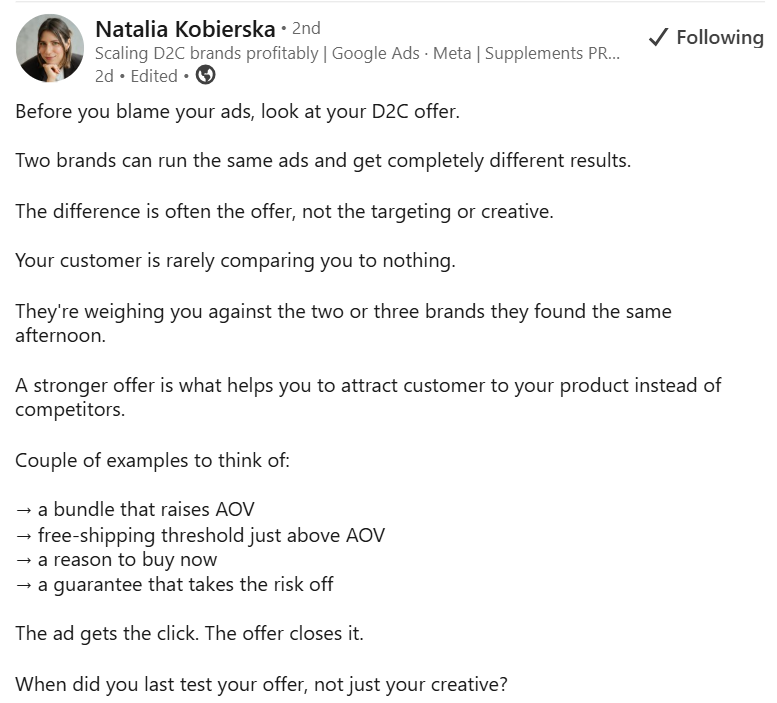
This framework argues that many performance issues blamed on creative or targeting are actually offer problems. Customers rarely compare your product in isolation—they compare it against competing options. A compelling offer often becomes the deciding factor after the click.
Why it works: Bundles, guarantees, urgency, and smart shipping thresholds increase perceived value and reduce purchase friction. When the offer is stronger, the same ad spend can generate better conversion rates and higher revenue.
Where it needs balance: A better offer cannot compensate for poor traffic or weak positioning forever. Deep discounts and constant promotions can also erode margins and train customers to wait. The strongest offers create additional value, not just lower prices.
🎥 Reel of the Day
What Works:
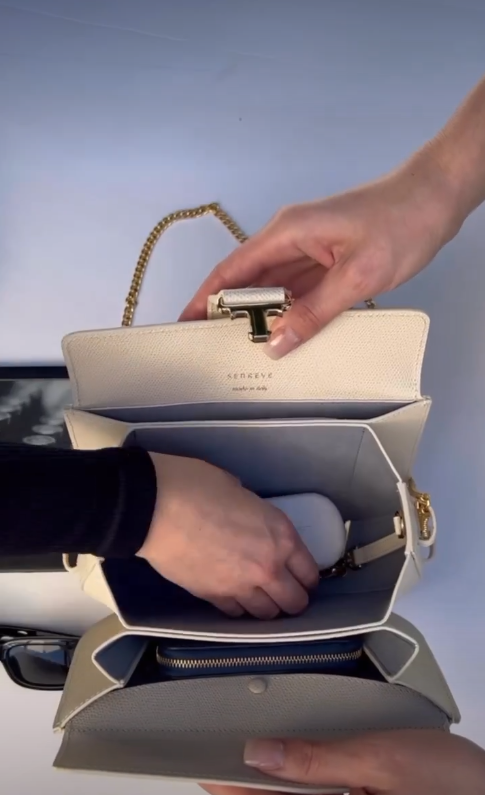
Capacity Reveal - The hook immediately challenges a common luxury-bag objection: "Will everything fit?" Watching each everyday item disappear inside creates a satisfying retention loop that naturally lifts watch-through and replay value.
Visual Progression - Every placement acts as a micro pattern interrupt. Instead of explaining features, the reel visually proves capacity one object at a time, making the product demonstration feel oddly satisfying rather than promotional.
Quiet Luxury - Branding stays subtle while the product remains the hero. Minimal styling, premium lighting, and creator-native overhead framing make the reel feel organic, reinforcing quality without sacrificing retention or recall.
Don't list product benefits. Turn every feature into a visual challenge viewers want answered, then reveal the solution step by step to increase completion rate while naturally positioning the product as the answer.
Advertise with Us
Wanna put out your message in front of over 40,000 best marketers and decision makers?
Thanks for reading this edition! Keep pushing boundaries, testing ideas, and staying inspired. See you in the next edition with more ways to ignite your marketing success. 🥰