Stop starving your creatives
🫠Your best creative is getting starved before it's ever tested, Add-to-cart activity often reveals purchase intent before conversions happen, and more!
Welcome to a space where every edition delivers insights, strategies, and inspiration to fuel your advertising brilliance. 🤯
🫠 Your Best Creative Is Getting Starved Before It's Ever Tested
Meta's optimization engine has one job: minimize cost-per-result. When a $5,000 commissioned video and a $50 internal cutdown sit in the same campaign, the engine does not see a production cost difference. It sees early output cost. The cheap creative reads better on day one because it has lower CPA before the data exists to evaluate either properly.
So the algorithm feeds the cheap creative. The expensive one starves. It never reaches the impression threshold required to know whether it works. It was not tested. It was queued behind creative that cost less to prove wrong.
The Two Cost Layers Your Account Is Conflating
Every account runs two cost layers simultaneously. Almost no account manages them separately.
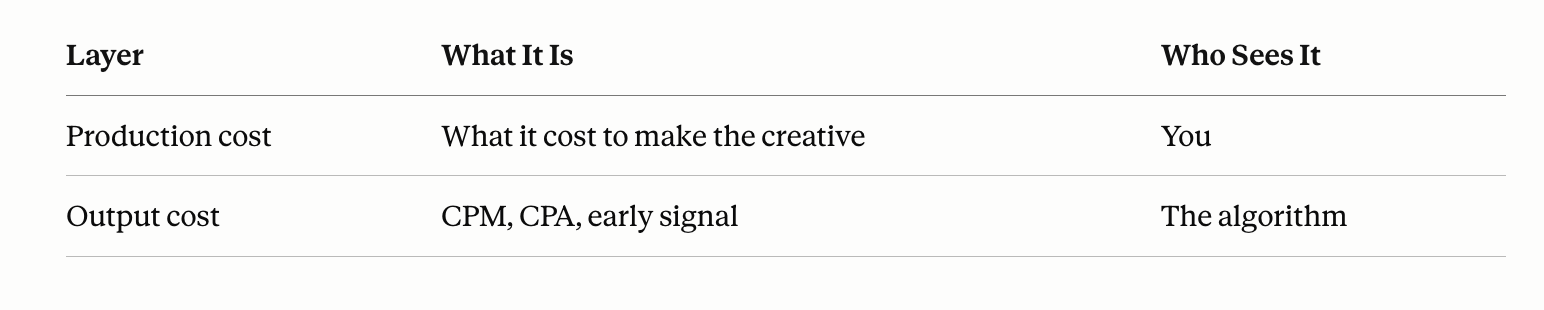
The algorithm only optimizes against output cost. It has no visibility into production cost and no reason to care. A $5,000 video and a $50 cutdown are identical inputs until one of them proves itself. The cheaper one proves itself faster by default because its early CPA looks cleaner against a cold audience.
The result: the most expensive creative in your account consistently gets the least learning budget.
Set A Spend Floor And Isolate Expensive Creative In ABO
The fix has two parts and takes fifteen minutes to implement.
First, move expensive creative into its own ABO campaign rather than leaving it to compete under CBO. Under CBO, the algorithm automatically deprioritizes anything with weaker early signal, which is every expensive creative before it has data. ABO gives each creative a fixed budget regardless of how it reads on day one, removing the competition dynamic entirely.
Second, set a minimum daily spend floor based on account CPA: 3x account CPA spread across a 7-day window. A $20 CPA account means $60 over seven days, roughly $8.50 per day per creative. That guarantees sampling across different days, different audience states, and different platform behavior patterns before any judgment gets made.
The same budget logic applies beyond the ad account. BreakingSilos 2026 is free, online, June 9th, with 30+ sessions on cross-channel signal strategy, where attribution bleeds BOFU performance, and what AI is already saying about your brand using signals you never controlled. You can reserve your free spot here.
Judge It On Different Numbers
Expensive creative does different work and needs a different metric set to reveal it.
Stop comparing a $5,000 commissioned video against a $50 cutdown CPA. That is the wrong math, and it will always produce the wrong conclusion.
The metrics that reveal what expensive creative is actually doing: add-to-cart rate, net new customer percentage, and blended account impact in the 30 days following the creative going live. These surface the work the CPA column hides.
The algorithm cannot see production cost. Your judgment has to compensate for that blind spot, because nothing else in the account will.
Together with Modash
Your influencer picks are costing you launches.
Not the content. Not the brief. The roster.
You can nail the strategy, brief the creators perfectly, and still watch a launch flatline. Because the problem isn't execution. It's that the wrong people are on your roster, and you won't know it until the numbers come back empty.
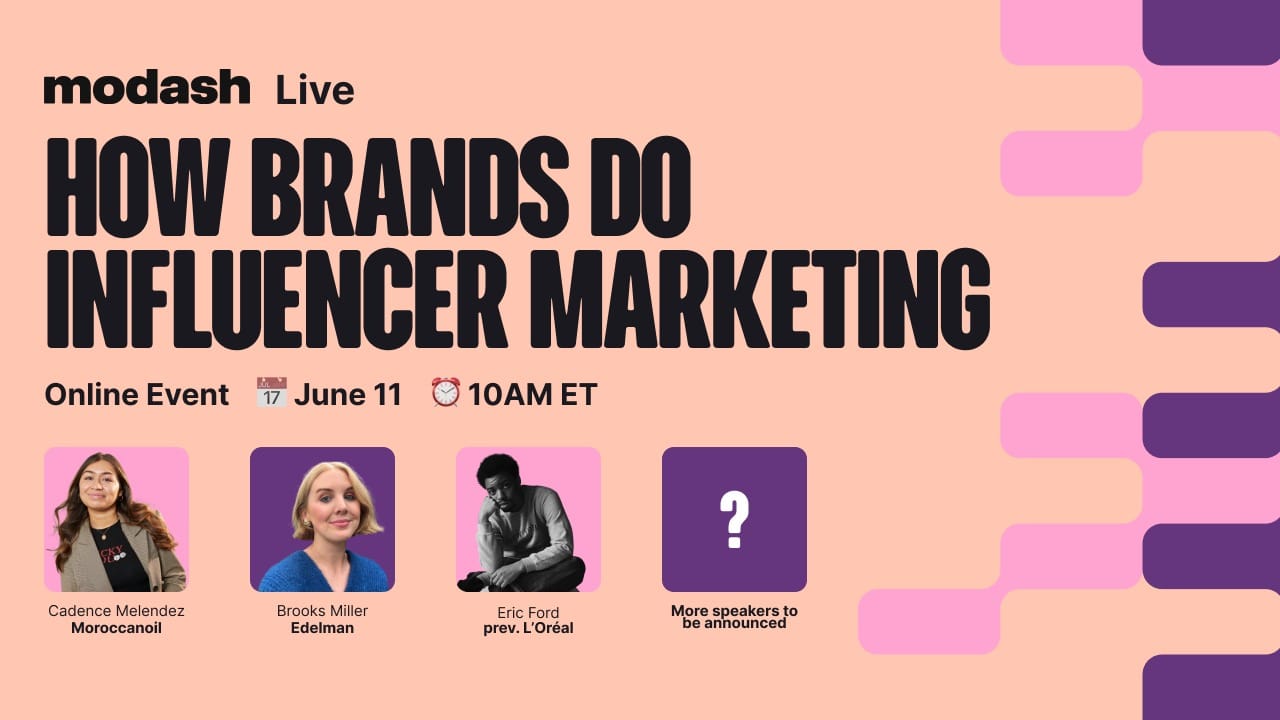
On June 11th, Modash is running a free 3-hour session with the brand-side teams who've cracked this.
Cadence Melendez, Influencer Marketing at Moroccanoil, Brooks Miller, EVP of Creator Marketing at Edelman, and Eric Ford, formerly Global Communications at L'Oréal, are sharing exactly how they build rosters that move product, not just impressions.
→ The selection signals Edelman uses to separate creators who shift perception from those who just rack up views
→ Why your highest-reach creators are often your lowest-trust ones, and how L'Oréal's team handles that tradeoff
→ How Moroccanoil evaluates creator-brand fit beyond niche and audience size, and why most teams skip it
You'll leave knowing exactly which creators don't belong on your list, and what to do about it before it costs you.
Can't make it live? Register anyway, and they'll send you the replay.
⚡ Add-to-Cart Rate Is an Early Indicator of Sales Effectiveness
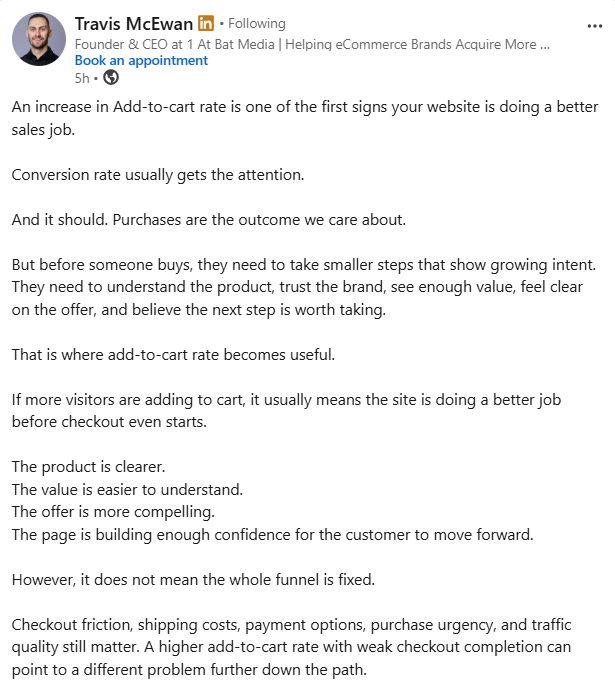
This post positions the add-to-cart rate as a leading indicator of conversion health rather than a vanity metric. Before a purchase happens, customers must first understand, trust, and value the offer enough to move forward. A rising add-to-cart rate often signals that the product page is doing a better job of creating buying intent.
Why it works: Add-to-cart actions reflect growing purchase intent before checkout begins. Improvements here often indicate stronger messaging, clearer value propositions, better product presentation, or increased customer confidence in the offer.
Where it needs balance: A higher add-to-cart rate does not guarantee more sales. Checkout friction, shipping costs, payment options, traffic quality, and pricing can still prevent conversions. It should be analyzed alongside downstream funnel metrics, not in isolation.
🎥 Reel of the Day
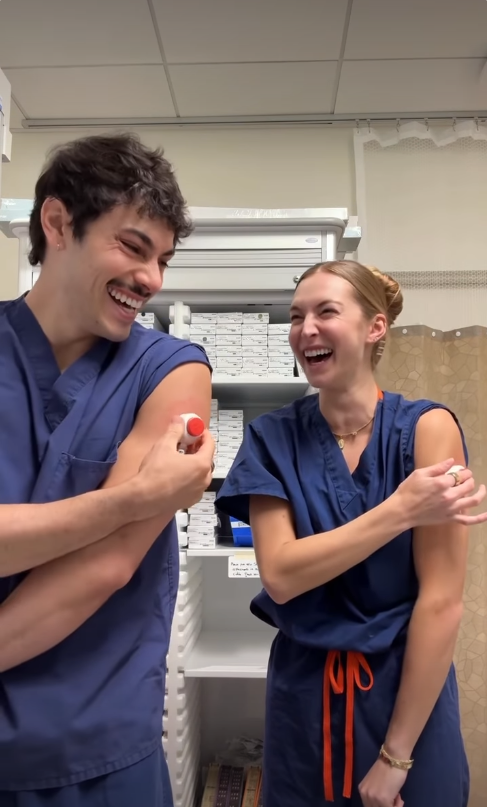
What Works:
Live Objection Resolution - The reel turns the biggest purchase barrier into the storyline itself, eliminating skepticism through real-time emotional proof rather than explanations.
Experience-First Product Demonstration - The reel sells the feeling of using the product before explaining the product, making emotional certainty precede rational evaluation.
Social Risk Reversal Framing - Watching professionals willingly test it publicly reduces perceived personal risk, creating permission for viewers to imagine trying it themselves.
Turn your strongest customer objection into a live experiment where real people discover the solution themselves, allowing proof to emerge naturally instead of being claimed.
💃Events
🔥 Rand Fishkin, Co-Founder of SparkToro, Is Revealing How AI Forms Brand Opinions From Signals Most Marketers Never Controlled
June 9 | Virtual Event | Free
AI already has an opinion about your brand, and you didn't write it. Rand Fishkin, Co-Founder of SparkToro, and Crystal Carter, Head of AI Search at Wix, show you exactly which signals shape it and how to own them across 30 sessions zero vendor pitches.
✅ Reserve Your Free Spot
Can't make it live? Register anyway, you'll get the recordings within 24hours.
🔥 The AI System Chime Built That Runs Their Entire Search Workflow Without a Single Daily Prompt
June 11 | Virtual Event | Free
Most marketing teams are still manually running every AI task they have. Bridget Nelson built something different at Chime, and it runs without daily input. June 11, she's on stage with Tyler Roehmholdt from Bitly, showing exactly what that system looks like inside a real org.
✅ Reserve Your Free Spot
Can't make it live? Register anyway, you'll get the recordings within 24hours.
Advertise with Us
Wanna put out your message in front of over 40,000 best marketers and decision makers?
Thanks for reading this edition! Keep pushing boundaries, testing ideas, and staying inspired. See you in the next edition with more ways to ignite your marketing success. 🥰