That shortcut is gonna cost you
🚨Platforms are starting to police the shortcut everyone’s been taking, CRO can make existing traffic more valuable, and more!
Welcome to a space where every edition delivers insights, strategies, and inspiration to fuel your advertising brilliance. 🤯
🚨Platforms are starting to police the shortcut everyone’s been taking
For the past few years, AI-generated content has largely been treated as a creative shortcut. Faster production, lower costs, and higher output made it an easy decision for many brands, especially in commerce content where demand for fresh assets never stops.
The platforms are starting to signal that not every shortcut will be treated the same way.
This year, TikTok updated its Live Shopping rules to prohibit non-real-time verbal content during shopping livestreams, including AI-generated voices, pre-recorded narration and radio-style scripts. Around the same time, Meta expanded its AI content labeling efforts with Content Seal, designed to identify content created using Meta’s AI tools.
Different platforms. The same direction.
The closer content gets to a purchase, the higher the standard becomes
These updates aren’t broad statements against AI.
They’re focused on situations where viewers are deciding whether to trust what they’re seeing and hearing before making a purchase.
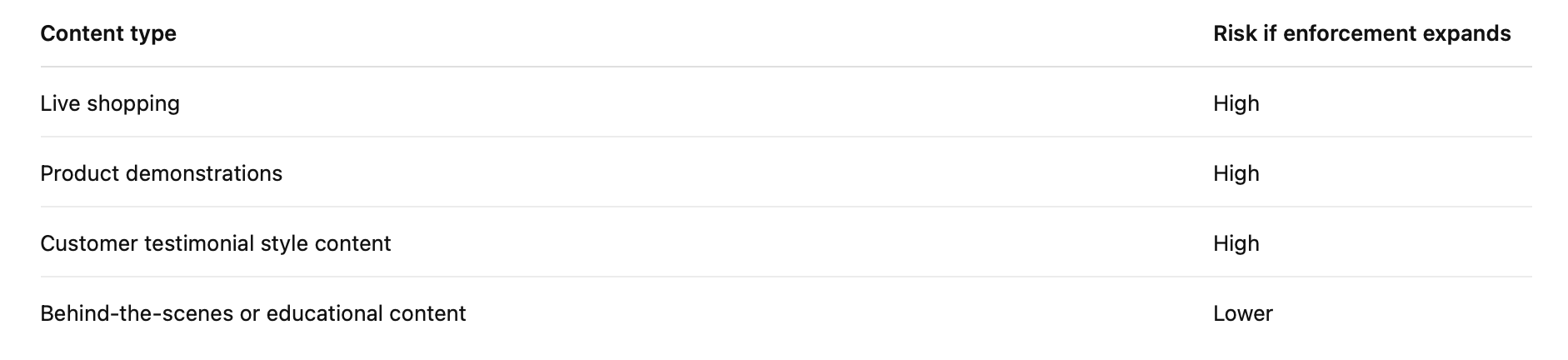
The pattern is becoming clear.
The more a format depends on authenticity, the more likely platforms are to expect authentic human participation.
Audit your commerce content before the platforms do
Rather than reviewing your entire content library, start with assets closest to a buying decision.
Ask one question:
Would this content still satisfy a genuine real-time, human-present standard if platform rules became stricter next quarter?
That simple exercise usually separates low-risk content from assets that rely heavily on synthetic voices, scripted simulations or AI-generated presenters.
Content built around real people using real products doesn’t face the same uncertainty because there’s no authenticity claim for a platform to question.
Build the kind of content platforms are moving toward
The long-term trend isn’t difficult to see.
Platforms are investing in better detection while simultaneously placing more importance on trustworthy commerce experiences. That makes genuine creator content a more durable asset than synthetic alternatives designed primarily for speed.
That’s exactly the model Insense supports through its network of 100,000+ vetted creators across 57 countries, helping brands produce authentic UGC with real people instead of relying on the types of synthetic content platforms are increasingly scrutinizing. You can book a free strategy call by August 28 and receive $200 in platform credit toward your first campaign.
The biggest risk isn’t using AI.
It’s building a commerce strategy around a shortcut that platforms are steadily making harder to rely on.
Together with Omnisend
Everyone’s talking about AI. Here’s how three email marketing experts are actually using it.
What do experienced email marketers actually ask AI when real campaign decisions are on the line?
In this free 56-minute session, Jimmy Kim, founder of eCom Email Marketer, and Chase Dimond, co-founder of eCom Email Marketer, open up their workflows and show the prompts they use to review performance, pull useful reports, and decide what to do next.
You’ll learn:
- How to spot missed opportunities hiding in your campaign data
- The exact prompts Jimmy and Chase use to pull reports, analyze campaigns, and take action
- Where AI genuinely improves email marketing and where human judgment still needs to lead
The session was recorded in ChatGPT, but Omnisend works with Claude too, so the same workflows carry over.
New to Omnisend? It’s an email and SMS marketing platform used by more than 150,000 ecommerce brands, generating an average of $79 for every $1 spent.
Migration is free, takes up to five business days, and plans cost up to 35% less than Klaviyo’s.
Watch the full 56-minute session, no signup required.
⚡ CRO can make existing traffic more valuable
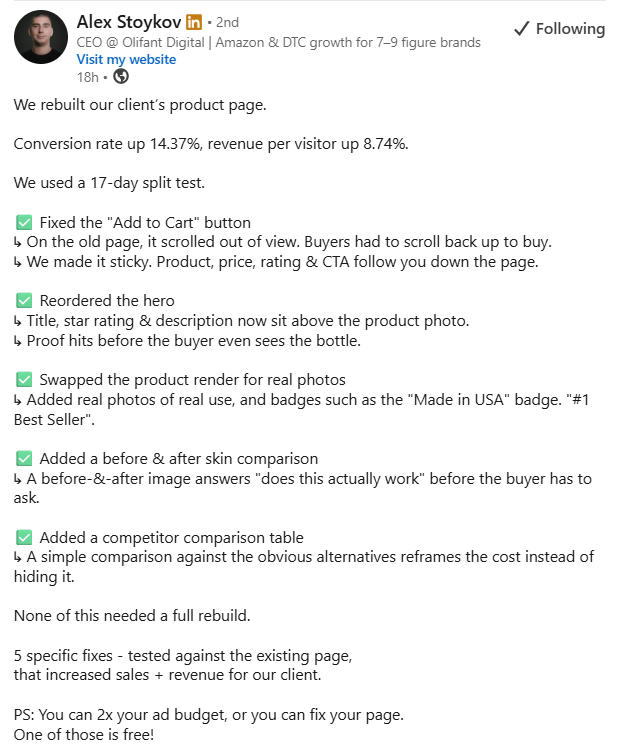
This framework shows how targeted product-page changes can improve performance without a full redesign. Sticky CTAs, earlier social proof, authentic imagery, before-and-afters, and comparison tables each remove a specific source of purchase friction.
Why it works: Each change answers a buying question faster: Does it work? Can I trust it? Is it better than alternatives? How do I buy? Reducing those gaps can increase conversion from traffic the brand already paid to acquire.
Where it needs balance: The 14.37% lift came from one specific test, not a universal CRO formula. Sticky CTAs or comparison tables won't improve every PDP. The principle worth copying is diagnosing friction, testing focused changes, and letting customer behavior determine what stays.
🎥 Reel of the Day

What Works:
The joke exploits friendship economics - Everyone knows the awkward expectation that knowing the owner means getting special treatment, making the premise instantly relatable without explanation.
The payment becomes the punchline trigger. He conveniently appears only after she pays, turning his friendly greeting into proof that he was protecting the transaction first.
The café becomes the comedy set. Products, counter and staff remain naturally visible while the story unfolds, giving the business constant exposure without interrupting viewers with promotion.
Build comedy around the unwritten rules of your business. Friends expecting discounts, customers arriving at closing, regulars ordering “the usual.” Familiar tensions give brands endless jokes audiences understand instantly.
Advertise with Us
Wanna put out your message in front of over 40,000 best marketers and decision makers?
Thanks for reading this edition! Keep pushing boundaries, testing ideas, and staying inspired. See you in the next edition with more ways to ignite your marketing success. 🥰