That weak ad may be the anchor
🥲Your TikTok program is four disconnected channels pretending to be a system, Attribution and incrementality answer two completely different marketing questions, and more!
Welcome to a space where every edition delivers insights, strategies, and inspiration to fuel your advertising brilliance. 🤯
🧐 The Meta Ads With the Worst ROAS Are Sometimes Holding the Entire Account Together
One of the most expensive mistakes in Meta buying is killing “inefficient” ads that are quietly stabilizing the account underneath the surface. Because not all creatives exist to do the same job.
Some ads extract demand. They convert people who are already close to making a purchase.
Others perform a much more important function:They expand the account’s future buying pool, stabilize CPMs, reduce audience saturation, and continuously feed Meta fresh behavioral data.
Most teams optimize only for extraction. That works for a while. Then the scale suddenly becomes fragile.
1. Separate “Structural Creatives” from “Extraction Creatives”. This distinction changes how you evaluate every ad account.
Extraction creatives:
- retarget efficiently
- convert warm demand
- produce strong immediate ROAS
- usually absorb spend aggressively
Structural creatives:
- reach colder audiences
- lower account-wide frequency pressure
- expand discovery pools
- create future converters, not immediate ones
Structural creatives often look worse inside Ads Manager because Meta attributes value poorly across time and exposure depth.
The dangerous part: when teams kill these ads too aggressively, Meta reallocates spend toward narrower high-intent pockets.
Initially, performance improves. Then the account starts showing faster fatigue cycles, rising CPM volatility, shrinking audience penetration, unstable scaling performance
That is not creative burnout. That is audience compression caused by over-optimization.
2. Watch the spend concentration before you watch ROAS deterioration
Most accounts do not collapse suddenly. They over-concentrate slowly. A common pattern inside unstable scaling accounts:
- Top creatives absorb disproportionate spend
- Exploration traffic declines
- Meta repeatedly targets overlapping behavioral clusters
- acquisition efficiency becomes dependent on fewer audience pockets
You can often spot this before blended performance weakens.
Look for:
- frequency rising faster than spend
- declining first-impression ratios
- stable CTR paired with weaker new-customer efficiency
- returning-session growth is slowing despite stable purchase volume
Many teams actively prevent this.
Some maintain creative-spend caps so Meta cannot force excessive delivery concentration into a tiny group of winning ads. Others intentionally preserve budget allocation toward broader structural creatives even when direct ROAS underperforms.
The goal is not maximizing short-term efficiency. The goal is to preserve discovery capacity inside the account.
3. Slow creative systems quietly train Meta into narrower behavior
This is where many brands accidentally create optimization fragility. When creative production slows down:
- Weaker exploratory ads get cut faster
- Teams become dependent on existing winners
- Meta repeatedly relearns the same engagement patterns
- Audience diversity inside delivery narrows
Eventually, the account becomes highly efficient at finding the same type of buyer repeatedly. That is usually where scaling stalls.
Insense helps brands maintain enough creator testing velocity to continuously feed Meta new hooks, angles, creators, and audience entry points without operational bottlenecks slowing exploration. You can book a free strategy call by May 22 and get a $200 platform credit towards your first campaign.
The hidden advantage is not just more UGC volume.
It is preventing the account from collapsing into repetitive optimization behavior that slowly destroys scalable acquisition.
Together with T-Mobile
Get 10 Voice Lines for $200 & $150 credit per new voice line*

Right now, pay just $20 line when you switch 10 or more lines on T-Mobile for Business CoreMobile plan.
Bring your device and keep your current numbers. Plus, get an additional $150/line back when you switch. No limit. Learn more now.
*10 lines for $200/mo; each additional line $20/mo./line with Autopay; plus taxes & $35 device connection charge. $150/line credit via one-time bill credit.
⚡Retention Fails More From Indifference Than Dissatisfaction
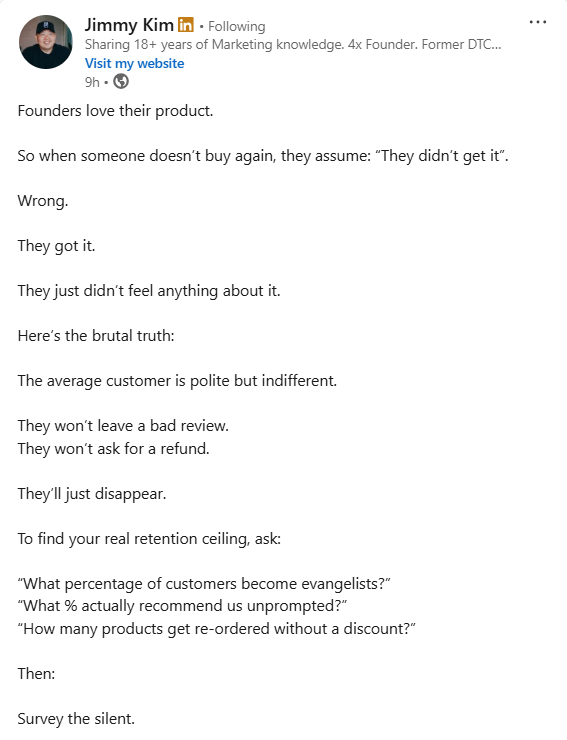
This post argues that many customers do not churn because they hated the product, but because they felt no emotional connection to it. Silent churn often hides behind neutral experiences. Measuring repeat behavior, referrals, and emotional attachment reveals retention strength more accurately than satisfaction alone.
Why it works: Emotional resonance drives advocacy and repeat purchasing. Neutral customers rarely complain, but they also rarely return. Surveying passive customers uncovers hidden friction and reveals what prevents stronger brand attachment.
Where it needs balance: Not every category naturally creates emotional attachment or evangelism. Functional products may rely more on convenience or utility. Retention should be evaluated alongside category expectations and purchase behavior patterns.
🎥 Reel of the Day

What Works:
Literal Joke Engine - The reel turns a customer service phrase into a physical gag. “Speak to a manager” becomes two employees literally playing to decide who becomes the manager.
Humanized Brand Positioning - Instead of selling washes directly, the brand sells personality and workplace culture subconsciously. Modern audiences emotionally remember businesses that feel socially entertaining rather than corporately polished online.
Native Platform Humor - The joke feels built specifically for short-form internet culture instead of traditional advertising. That platform-native energy helps audiences perceive the reel as content first and marketing second.
The most viral service-business reels often come from reframing repetitive workplace moments using comedic inversion. Instead of inventing concepts artificially, they dramatize emotionally familiar situations audiences already recognize deeply.
Advertise with Us
Wanna put out your message in front of over 40,000 best marketers and decision makers?
Thanks for reading this edition! Keep pushing boundaries, testing ideas, and staying inspired. See you in the next edition with more ways to ignite your marketing success. 🥰