The Deliverability Problem You Can't See
💬 Marketing Messages isn't a real answer anymore, and carriers are enforcing that, More email addresses can mean more brand touchpoints, and more!
Welcome to a space where every edition delivers insights, strategies, and inspiration to fuel your advertising brilliance. 🤯
💬Stop blasting outdated lists
10DLC campaign registration used to accept a vague description of what a business sends over SMS. Carriers now require specific, detailed use-case documentation, exactly what messages get sent, to whom, and how consent was captured, before a number gets approved to send at any real scale.
Generic language that used to clear registration without a second look is getting flagged now, and businesses still running on outdated registrations are seeing messages throttled or blocked without warning as enforcement keeps tightening through the rest of 2026.
Check the current registration first. Pull whatever use-case description is on file with the campaign registry. If it reads like a single vague sentence, "promotional and transactional messages," that's the exact language now failing stricter review.
It needs to name the specific message types running through the number: cart abandonment, shipping updates, win-back offers, each documented separately rather than bundled into one generic label.
Match consent language to each specific message type. A customer who opted in for shipping updates alone doesn't have documented consent for promotional blasts, even if both run through the same registered number.
Carrier filtering increasingly checks for this mismatch, and a mismatch between what was consented to and what's actually being sent is exactly the pattern that gets a number throttled.
Audit send patterns against the documented use case before volume increases. A registration built around occasional transactional alerts that's now running weekly promotional campaigns has drifted from what carriers approved, and that drift is invisible until deliverability quietly starts declining for reasons that look unrelated at first.
Running this audit manually means reviewing the registered use case, the actual message types currently in flight, and consent records for each, cross-referencing all three by hand across every active number.
An AI connected to a live Omnisend account can pull the current send patterns directly and compare them against the documented use case, flagging any drift before it costs deliverability. Omnisend already serves 150,000+ brands, averaging $79 back for every $1 spent, migrating a full setup free within five days, with pricing up to 35% lower than Klaviyo's.
You can get started with the ready-made prompt and run the comparison before the next campaign scales in volume. Check whether the registration on file still describes what's actually being sent. If it doesn't, that gap is exactly what carriers are now built to catch, and the throttling that follows rarely comes with a warning first.
Together with Omnisend
150,000 brands run on Omnisend. Now their AI does too.
You're still exporting CSVs, switching tabs, and copy-pasting numbers just to answer "what worked this week?" That's not a workflow.
Omnisend MCP connects your ChatGPT or Claude directly to your live Omnisend account. Ask it real questions, get real answers, and act without ever leaving the conversation.
- Connect the Omnisend MCP server to ChatGPT or Claude
- Paste any prompt into your conversation and watch it pull from live account data
- Say "now do it," and your AI adjusts segments, builds campaigns, fixes what's broken
Omnisend gives you a ready-made prompt library to hit the ground running. From a quick store snapshot to a full monthly executive summary, the prompts are already written for you.
150,000+ brands run on Omnisend, and they're averaging $79 back for every $1 spent.
Switching takes zero effort since Omnisend migrates you for free within 5 days, and your bill drops up to 35%.
Connect your AI and run your first prompt today!
⚡ More Email Addresses Can Mean More Brand Touchpoints
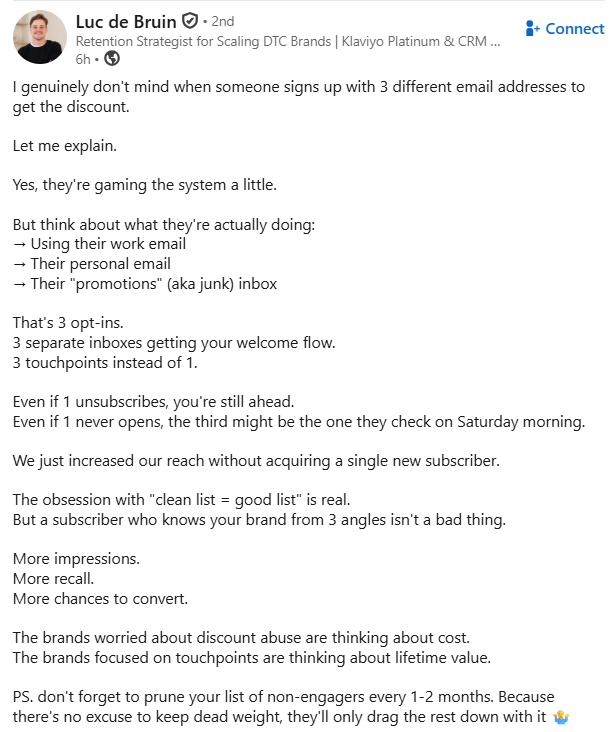
This framework challenges the assumption that multiple sign-ups from the same customer are always a loss. While they may redeem an extra discount, they're also creating additional opportunities for your brand to appear across different inboxes and contexts.
Why it works: Repeated exposure can strengthen brand recall. Reaching customers through multiple inboxes increases the likelihood that at least one welcome flow or campaign gets seen, keeping the brand top of mind throughout the buying journey.
Where it needs balance: This strategy isn't universally beneficial. Multiple sign-ups can inflate list size, distort engagement metrics, and increase promotional costs. The best approach is to balance customer reach with thoughtful discount policies, list hygiene, and accurate subscriber tracking.
🎥 Reel of the Day

What Works:
Problem Before Proof - The hook starts with the biggest objection buyers have about white couches. That immediately aligns with audience intent, and viewers stay for the stain test instead of scrolling away.
Visual Proof Wins - The entire reel revolves around one satisfying transformation: spill, wipe, clean. No explanation is needed because the product benefit is demonstrated in seconds, driving strong completion and replay value.
Minimalism Builds Trust - The clean overhead shots, neutral background, and zero distractions keep all attention on the stain. That simplicity makes the demonstration feel authentic rather than like an overproduced advertisement.
List the top buying objection, then recreate it on camera and resolve it in real time. Showing the proof beats explaining the feature, making the content both highly shareable and conversion-focused.
Advertise with Us
Wanna put out your message in front of over 40,000 best marketers and decision makers?
Thanks for reading this edition! Keep pushing boundaries, testing ideas, and staying inspired. See you in the next edition with more ways to ignite your marketing success. 🥰