Two platforms Two rulebooks
⚖️ Your Amazon listing needs a disclosure tag your website doesn't, and it's the same image on both, Creative strategy doesn't always need reinvention, and more!
Welcome to a space where every edition delivers insights, strategies, and inspiration to fuel your advertising brilliance. 🤯
⚖️ Your marketplace listing and your website are now legally different documents
Amazon told sellers on July 22 to tag any listing image containing a photorealistic AI-generated person with specific metadata, following New York's synthetic performer disclosure law, effective June 9, with penalties up to $5,000 per violation.
That rule applies to Amazon listings specifically. Your own website, running the same product imagery, sits under obligations nobody has necessarily reconciled against what Amazon now requires.
Ecommerce sellers tend to treat marketplace and owned-site content as the same asset published in two places. Regulation is starting to treat them as two separate compliance surfaces that happen to share source files, and the gap is where a brand ends up compliant on one and exposed on the other without noticing.
Audit provenance, not just presence
Start by identifying which product images contain AI-generated people, not which platform they're published on, since seeing the full picture across every platform at once, rather than exporting each one separately, is exactly the cross-platform visibility Semrush One is built to give you. You can try free for 7 days here. It's a media-level audit before it's a channel-level one.
For every image containing a synthetic person, record how it was produced, real and enhanced or fully generated, and which platforms currently display it. That record is what New York's law and Amazon's tagging requirement both turn on, and almost nobody currently keeps it.
Track where consistency breaks between marketplace and owned channels
A tagged, disclosed image on Amazon and an untagged, undisclosed version of the same image on your own site is not a strange inconsistency. It's the default state for a seller who updates one platform first and assumes the other inherited the change.
Build a simple cross-reference: for every image requiring disclosure on one platform, confirm the equivalent asset elsewhere carries the same treatment. Where it doesn't, that's not a marketing gap. It's the exact scenario the statute's advertiser-liability language was written to catch.
Treat this as the first of many, not a one-off fix
New York's law is the first state statute of its kind, not the last. Tracking which content requires which disclosure across which platform, as more states adopt their own versions, does not stay manageable as a spreadsheet past a handful of jurisdictions.
Maintaining a single source of truth for content provenance and disclosure status across every channel a brand publishes to isn't optional past a handful of jurisdictions.
The product is the same. The publishing surface used to be the only thing that mattered. Increasingly, the platform is part of the compliance question too.
Together with Levanta
The biggest holiday mistake brands make? Trying to build a creator program in November.
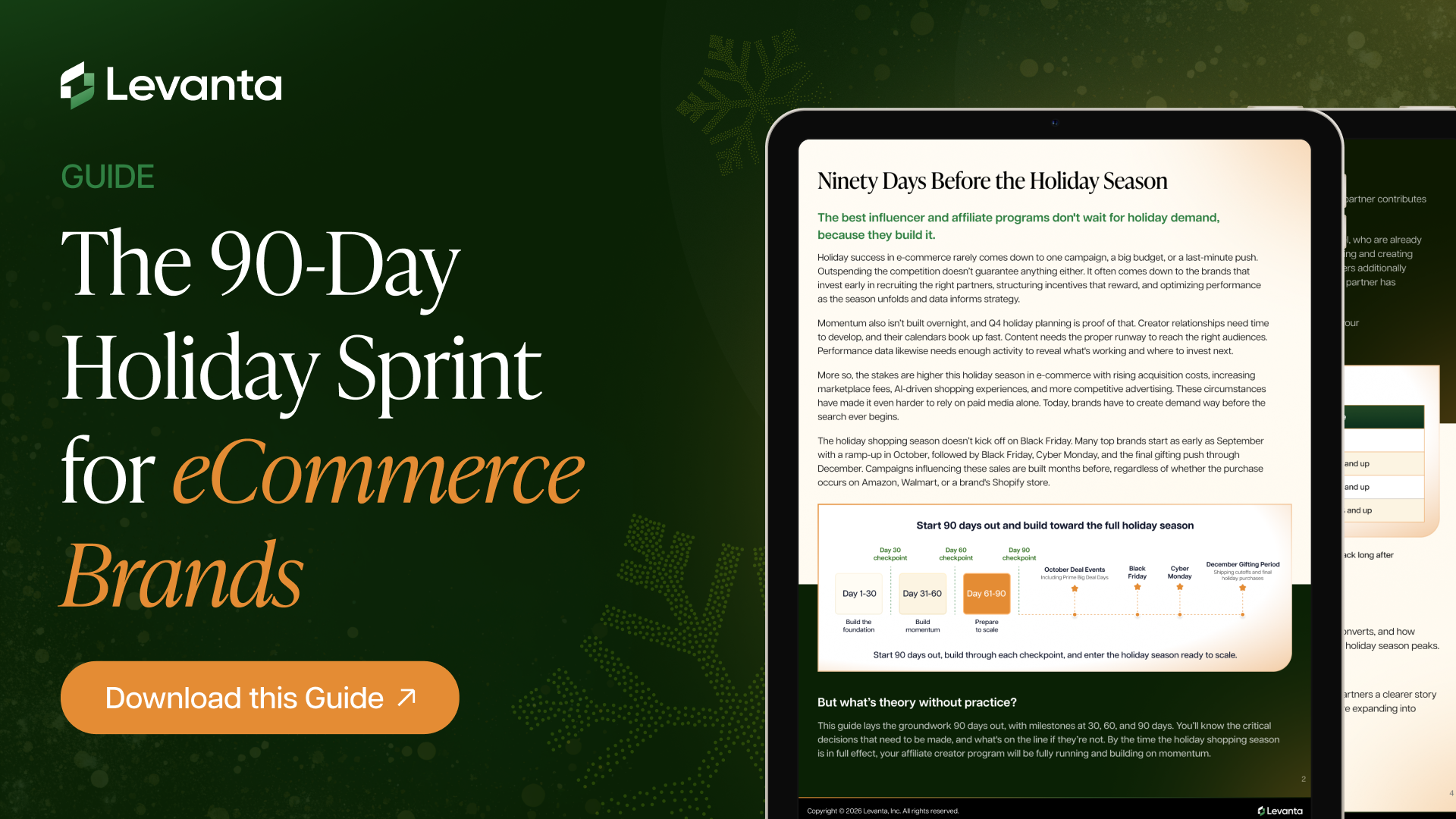
The strongest holiday programs are built over the 90 days leading up to peak shopping season. That is when brands recruit the right partners, test incentives, and build enough momentum to scale when demand arrives.
Trusted by 3,000+ eCommerce brands, Levanta created The 90-Day Holiday Sprint, a free step-by-step playbook to:
- Recruit and activate creators before their holiday calendars fill
- Build competitive commission structures without sacrificing margin
- Use Day 30, 60, and 90 checkpoints to create a program ready to scale for BFCM
Don’t wait until November to build the creator program you will wish you already had. Your 90-day countdown starts now.
⚡Creative strategy doesn't always need reinvention
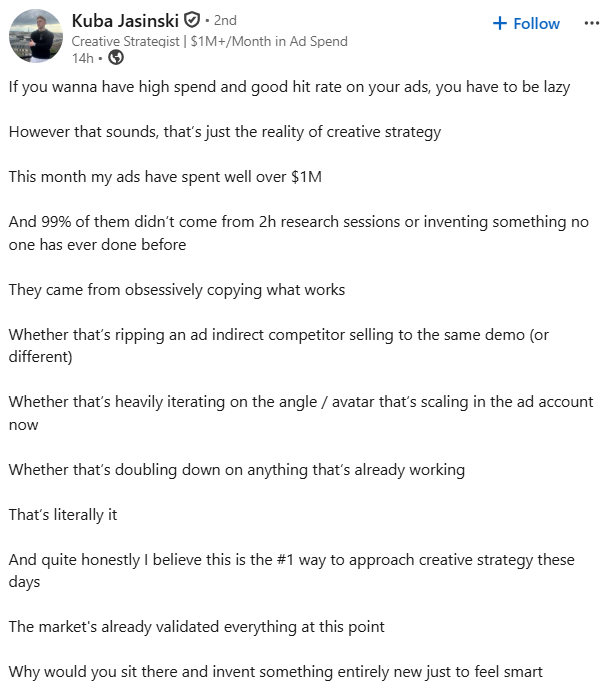
This framework argues that higher ad hit rates often come from building on proven ideas rather than constantly inventing new concepts. Competitor patterns, winning angles, and existing account data can reveal what the market already responds to.
Why it works: Starting with validated concepts reduces guesswork. Teams can spend more effort improving proven angles, avatars, hooks, and formats instead of repeatedly betting budget on completely untested ideas.
Where it needs balance: Copying patterns too aggressively can make every brand look identical and eventually create creative fatigue. The strongest approach borrows proven principles while adding enough original positioning, execution, and customer insight to remain distinctive.
🎥 Reel of the Day

What Works:
Celebrity Curiosity Hook - Johnny Depp smelling raw fragrance materials creates immediate curiosity because viewers are watching a genuine reaction, not a scripted product demo. His recognition moments naturally drive completion.
Luxury Feels Human - Dior strips away the usual polished fragrance advertising and lets viewers watch the messy creative process. That makes Sauvage feel handcrafted, artistic and more credible without losing premium positioning.
Product Becomes Story - The fragrance itself barely needs hard selling. Dior makes the formulation process the narrative, so viewers understand Sauvage Extrait through ingredients, reactions and craftsmanship before receiving the brand reveal.
Instead of asking a celebrity to praise the product, put them inside the creation process and capture unscripted reactions. Education becomes entertainment while the product earns credibility naturally.
Advertise with Us
Wanna put out your message in front of over 40,000 best marketers and decision makers?
Thanks for reading this edition! Keep pushing boundaries, testing ideas, and staying inspired. See you in the next edition with more ways to ignite your marketing success. 🥰