You got personalization wrong
😁Here’s how you can actually do it in a way that moves the needle, Popup timing doesn’t drive performance, offer quality does, and more!
Welcome to a space where every edition delivers insights, strategies, and inspiration to fuel your advertising brilliance. 🤯
Together with AirOps
ChatGPT doesn't cite simple content. It never did.
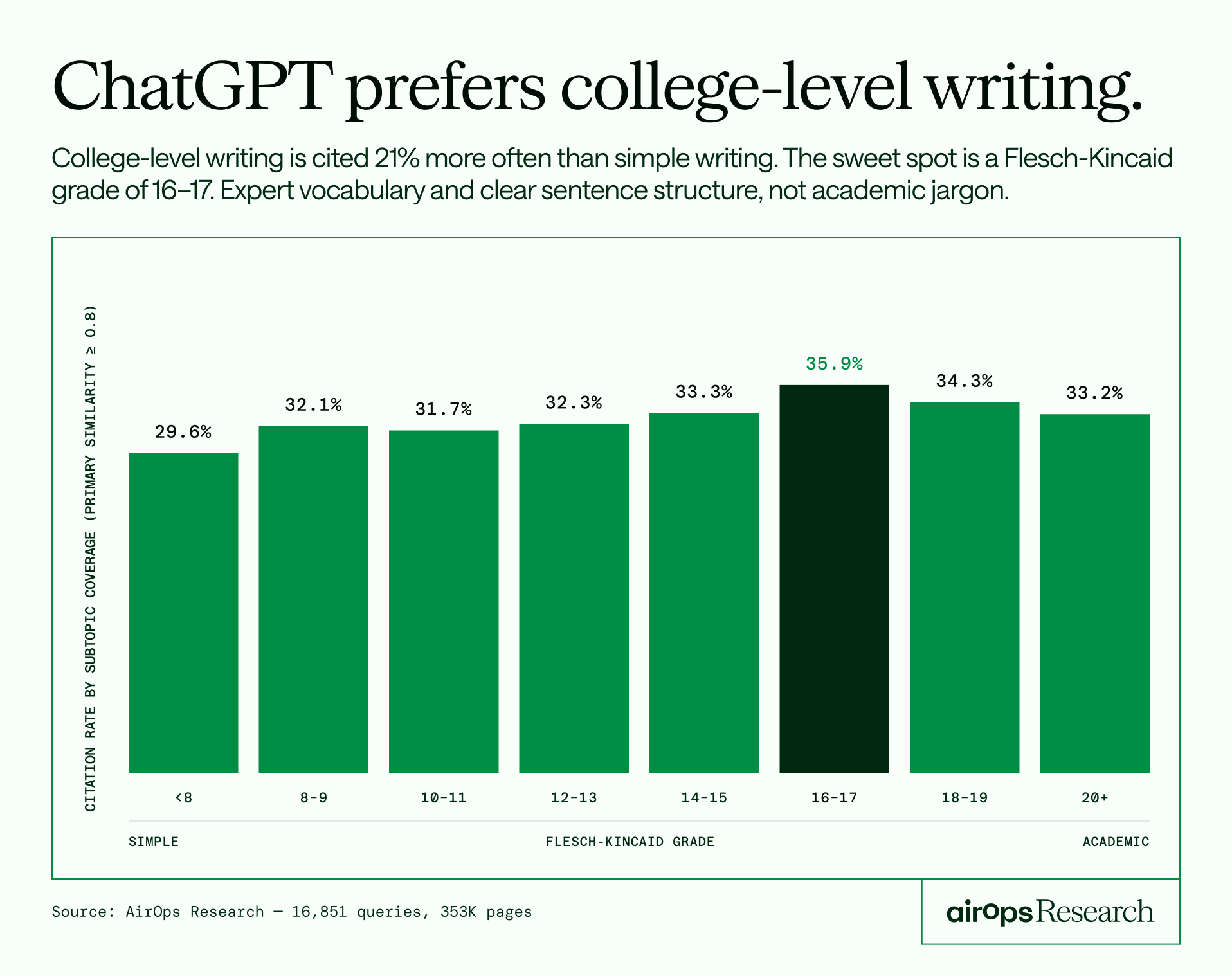
Most marketers are writing for readability. Shorter sentences, simpler words, easier skimming. ChatGPT is penalizing them for it.
AirOps studied 16,851 queries and 353,799 pages across 10 industries and tracked 20 signals to find out exactly what gets a page cited versus ignored.
Here's what the data found:
- Pages ranked in position 1 get cited 4x more than position 10. If you're not on page one, you're essentially invisible to AI.
- Comprehensive guides are getting outperformed by focused 800-word pages. Everything you built for SEO may be working against you.
- Pages aged 30-90 days hit the highest citation rate. Your older content is bleeding visibility silently.
The report breaks down all 20 signals with controlled comparisons across each. No theory. Just data on what ChatGPT actually responds to.
😁You’re Not Bad at Personalization. You’re Just Doing the Wrong Kind.
Everyone’s obsessing over “personalization” right now. First name in emails. Dynamic product feeds.
AI segments that feel impressive in dashboards… and invisible in reality.
And still, most copy feels flat. Because here’s the uncomfortable part, no one says out loud.
People don’t convert because you know them. They convert when they feel like you’ve caught them in the act.
That moment where they pause and think, “Wait… this is literally me.” That’s the game.
1. Call out behavior, not identity
Most brands say: “Founders struggle with scaling.”
Weak.
Say: “You’ve been ‘about to fix this’ for 2 weeks, but keep pushing it to tomorrow.”
That’s not a persona. That’s a moment. Moments convert. Labels don’t.
2. Use the “almost embarrassing truth”
The highest-converting lines are slightly uncomfortable.
Like: “You know exactly what to do… You just haven’t done it yet.”
No one says that publicly. Everyone feels it privately. That gap is where attention spikes.
3. Write what they’d never admit in a survey
Surveys get clean answers. Conversion comes from the messy truth.
Nobody writes:
“I don’t trust myself to follow through.”
But they feel it. If your copy only reflects what users say, you’ll always sound like everyone else.
4. Anchor to real-life loops
Not demographics. Not interests. Loops.
“You open this tab, skim, close it, and tell yourself you’ll come back later.”
That loop exists across thousands of people. Feels hyper personal. Scales infinitely.
5. Turn attention into commitment instantly
Most people treat reading as passive. Flip it.
“If you’re still reading this, you already know this is a problem.”
Now they’re not browsing. They’re involved. That tiny shift changes conversion more than any personalization token ever will.
What actually changes
Once you see this, you can’t unsee it.
The best landing pages, ads, even onboarding flows… They don’t “personalize.”
They recognize patterns of behavior so precisely that it feels like personalization. No data needed. No fancy stack.
Just brutally accurate observation. And honestly… that’s harder to fake than any AI-driven personalization system but when you get it right, it hits way deeper than “Hi {FirstName}” ever will.
⚡ Popup Timing Doesn’t Drive Performance, Offer Quality Does
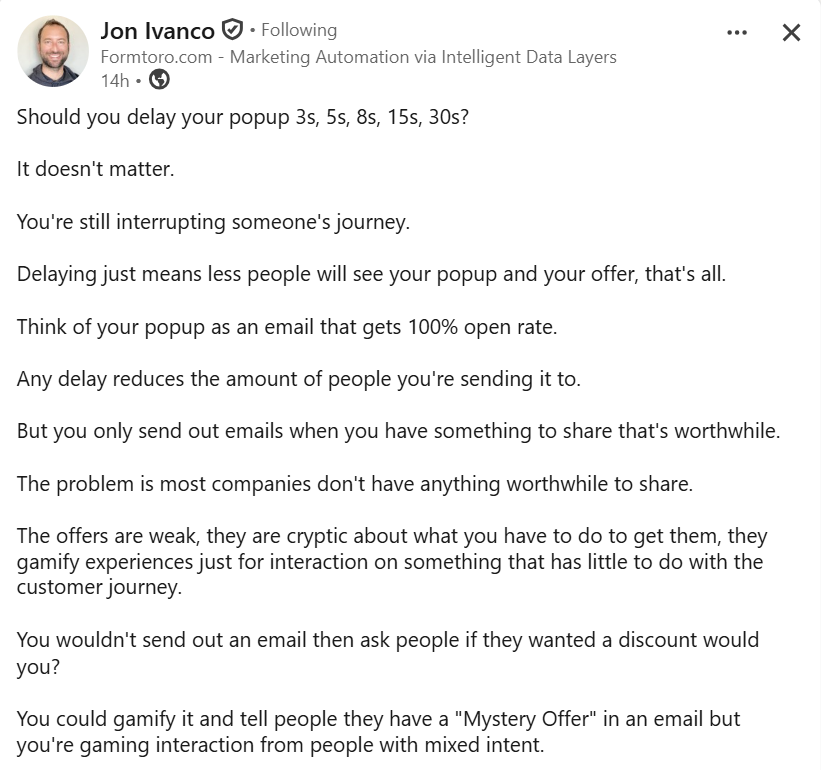
This argument challenges the obsession with delay timing for popups. Instead, it reframes performance around offer strength and user experience. Whether shown instantly or delayed, the real driver is whether the offer is compelling and aligned with the visitor’s intent, not the timing itself.
Why it works: Users respond to value, not timing mechanics. A strong offer captures attention regardless of when it appears. Focusing on intent and clarity improves both opt-in quality and downstream conversion rates.
Where it needs balance: Timing still impacts user experience and visibility. Immediate popups may annoy some users, while delays reduce reach. The optimal approach depends on traffic source, intent level, and overall site experience design.
Together with The Operator's Stack
The Decision That Pays for Itself in Days
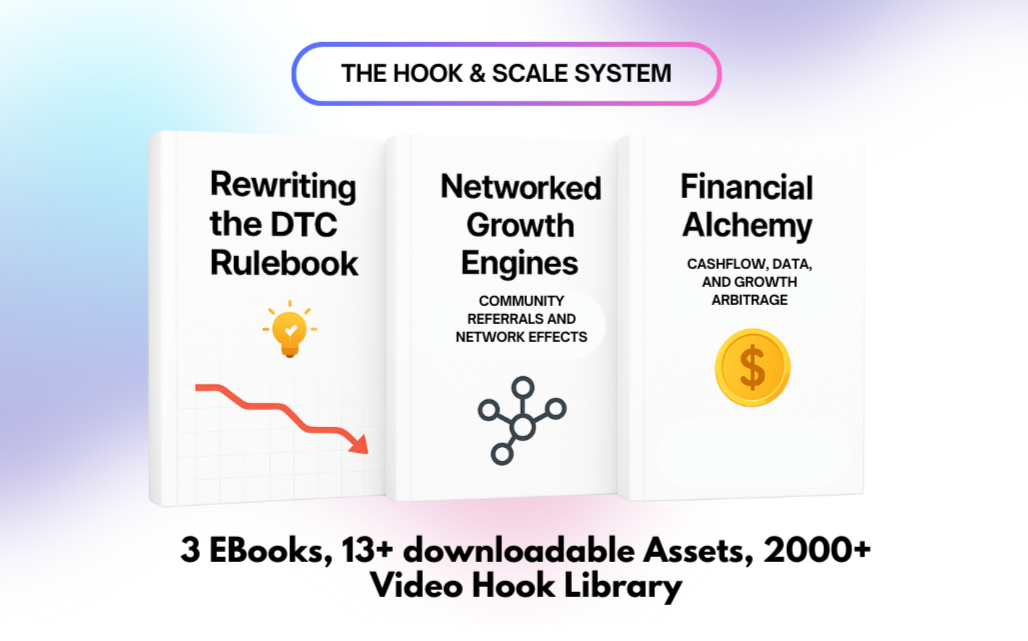
Every quarter, another channel flatlines. CAC climbs, conversions drop, and the pressure for answers intensifies. The truth? Funnels aren’t broken; the buyer’s journey has shifted under your feet.
Rewriting the DTC Rulebook is built from campaigns that sold to the most skeptical buyers.
Inside, you’ll see the exact behavioral shifts dismantling funnels and get plug-and-play systems like the Community Cultivation Canvas, Emotional Storytelling Framework, and Owned Media Checklist ready to launch the same day.
Buy now and you’ll also unlock two bonus playbooks plus 2,000+ Viral Video Hooks (updated monthly):
- Networked Growth Engines – Build acquisition loops powered by community, referrals, and partnerships.
- Financial Alchemy – Advanced cashflow and timing strategies to protect margins and scale faster.
These tools were curated after 100+ days of research and are valued at over $900. Today, you can own the complete 3-in-1 bundle.
Get your copy now and fix the leak before next quarter’s numbers land!
🚀 Reel of the Day

What Works:
Primal Origin Story - The product isn’t introduced; it’s born. This reframes it from a manufactured object to a natural entity, triggering deeper psychological associations with evolution, rarity, and something that exists beyond human creation systems.
Delayed Reveal Tension - The slow cracking builds anticipation before showing the product. This stretched moment increases dopamine response, making the reveal feel earned, memorable, and far more satisfying than instant exposure.
Micro Cinematic Arc - The reel compresses birth, tension, reveal, and aftermath into seconds. This complete narrative structure creates emotional engagement, making the content feel like a story instead of a simple product showcase.
Stop “showing” your product.
Make it feel like it emerged from something bigger, whether that’s nature, culture, or conflict, because emergence always feels more powerful than creation.
Thanks for reading this edition! Keep pushing boundaries, testing ideas, and staying inspired. See you in the next edition with more ways to ignite your marketing success. 🥰