Your competitor audit is broken
They're winning in ChatGPT while you watch Google, Bing succeeds when enterprise workflows shape how buyers search and purchase, and more!
Welcome to a space where every edition delivers insights, strategies, and inspiration to fuel your advertising brilliance. 🤯
🥖 Your competitor audit is broken
The standard competitor gap analysis pulls competitor sitemaps and identifies topic coverage gaps in Google.
The higher-leverage analysis is looking at competitor citation share in AI engines, because that's where the consideration set is increasingly being formed. Your competitor can be invisible in Google and dominant in ChatGPT, and the standard competitor audit will miss it entirely.
Audit Competitor Citation Share Across ChatGPT, Perplexity, And Claude
Run 20-30 buyer queries that should naturally surface your category through all three AI engines. Track which competitors get cited, which queries cite multiple competitors, and which queries cite nobody from your category.
For most categories, the audit produces an uncomfortable result: 2-3 competitors are getting cited disproportionately, while the rest of the category (often including your brand) is invisible. The pattern reveals which competitors have built the off-site signal density and content structure that AI engines reward.
AirOps analyzed 15M+ AI queries and built the exact playbook Ramp, Carta, and Webflow are running right now, including structural patterns, refresh cadences, off-site signals, and a 90-day action plan. You can get the playbook.
Identify The Queries Where Competitors Are Getting Cited And You're Not
The citation gap is the diagnostic. For each query where a competitor gets cited and your brand doesn't, document what content the AI engine pulled from and what structural patterns the cited content shares.
Common patterns: comparative content ("X vs Y"), use-case content ("best X for Y scenario"), and definitional content ("what is X"). If competitors have these formats and you don't, the citation gap explains itself.
Build The Content That Closes The Gap, Prioritized By Buyer Intent
Not every citation gap is worth closing. Citations on top-of-funnel definitional queries are lower priority than citations on bottom-of-funnel comparison queries.
Prioritize by buyer intent. Comparison queries get built first, because the buyer asking "X vs Y" is closer to purchase than the buyer asking "what is X."
Use-case content second. Definitional content third. Most teams reverse this order because definitional content is easier to write, which is exactly why it produces the lowest citation lift on revenue.
The competitor gap exists. Most teams are auditing the wrong surface to see it.
Together with HubSpot
Quick gut check: how many of your marketing tools actually talk to each other?
If the answer is "not enough," you're losing context every time a signal moves between platforms.
HubSpot's updated Essential Apps for Marketers collection pulls together key apps from TikTok Lead Syncing to Canva to Amplitude that connect directly to your CRM, so insights, leads, and creative all live in one place.
Less tab-switching, more context, and AI that actually knows your business.
⚡Bing Works in B2B When Buying Is Process-Driven, Not Preference-Driven
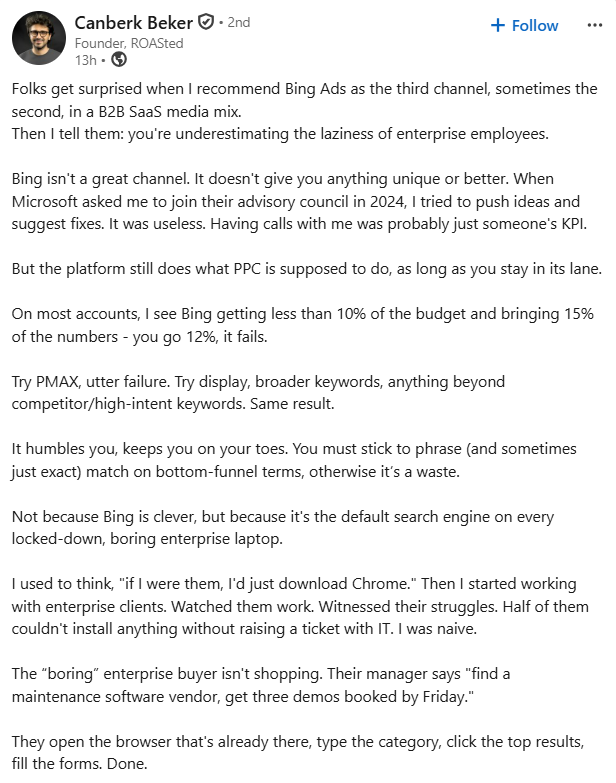
This post argues that Bing succeeds in specific enterprise environments because many corporate buyers use default systems and mandated workflows. The value is not superior platform performance, but access to high-intent users completing operational tasks on locked-down enterprise devices.
Why it works: Procurement-led buyers prioritize speed, compliance, and process completion over exploration. Bing captures these users at high intent because it sits inside default enterprise workflows, where search behavior is more functional than preference-driven.
Where it needs balance: Bing’s effectiveness is highly category dependent. Scaling beyond bottom-funnel intent often reduces efficiency quickly. It works best in operational B2B niches, not creator-led, developer-led, or product-led adoption environments.
🎥 Reel of the Day

What Works:
Competence Shock - Owners usually project perfection, so intentionally acting inexperienced creates absurd tension that feels instantly funny, memorable, and replayable socially.
Shared Service Anxiety - “Sorry, it’s my first day” triggers universal hospitality trauma memories, turning familiar workplace stress into emotionally recognizable comedy audiences instantly connect with.
Reverse Prestige Branding - Instead of flexing perfection or luxury, the owner deliberately lowers status, making the brand feel warmer, more authentic, and culturally likable online.
Place high-status figures inside relatable low-status situations because vulnerability consistently outperforms polished perfection in shareable branded entertainment content online.
Advertise with Us
Wanna put out your message in front of over 40,000 best marketers and decision makers?
Thanks for reading this edition! Keep pushing boundaries, testing ideas, and staying inspired. See you in the next edition with more ways to ignite your marketing success. 🥰