Your CRM Knows Who Buys
🚀 Your creative pretends they are all the same person, Removing poor-quality conversions can improve future lead quality, and more!
Welcome to a space where every edition delivers insights, strategies, and inspiration to fuel your advertising brilliance. 🤯
🚀 Your CRM Knows Who Buys
Most brands have done the segmentation work. They know they have a 28-year-old buyer in one cohort, a 44-year-old in another, a buyer concentrated in warmer climates, and a buyer with a completely different size range and styling preference.
That data informs email flows, product development, and pricing strategy. It almost never reaches the creative brief. The person in the ad is selected by aesthetic preference, not by segment data.
1. Pull the Segment Map and Count the Creative Gap
Take your current buyer segmentation: however many distinct profiles exist in your CRM or analytics stack. Then audit your active creative library and count how many of those profiles have a corresponding visual representation.
The number is almost always one, occasionally two. Every segment without a visual match is one where the identification mechanism never fires, hesitation stays higher than it should, and conversion reflects that gap.
2. Write the Segment Brief Before the Production Brief
The production brief specifies what to shoot. The segment brief specifies who each shot is for and what that person needs to see before they will purchase.
A segment brief for a 50-plus buyer looks different from one for a 25-year-old even on an identical product, because the hesitation pattern differs, the aspiration context differs, and the social proof signals they respond to differ. Write the segment brief first.
Dreem closes the gap between what the segment brief calls for and what a single shoot can deliver: one product image generates model shots across 400+ virtual talents covering every body type, age, ethnicity, and size, with video output for PDP, paid, and organic. Each segment gets a corresponding visual context without requiring a separate shoot for each.
3. Track Segment Creative Performance in Its Own Reporting Lane
Aggregate ROAS across all creative masks which segments are actually converting. Once segment-specific creative exists, track performance by the segment each asset was built for rather than by campaign. That reporting loop tells you which visual contexts are working, which are underperforming, and where to expand the creative investment next.
Together with AirOps
There's a new ranking system running right now, and your pages aren't even on it.

Your best page just lost a buyer to ChatGPT, and you'll never know it happened. Ranking on Google means nothing to AI search, which runs on its own rules for what gets cited.
On July 9 at 11am ET, Jairo Guerrero, Founder of Organic Hackers, shows you how to find out where you actually stand. He's spent years pulling raw server logs to see exactly how AI crawlers treat real pages, not theory, actual behavior.
You'll walk away knowing:
- How to check if AI crawlers are even reaching your pages right now
- The render and retrieval gaps that quietly disqualify strong content
- Which structured data signals actually influence what gets cited
- How to read your own server logs for crawler activity you're currently missing
This is the session that turns "why aren't we showing up" into a checklist you run the same week.
Can't make it live? Register anyway and get the recording in your inbox within 24 hours.
⚡Most Advertisers Tell Google What a Good Lead Looks Like, But Never What a Bad Lead Looks Like
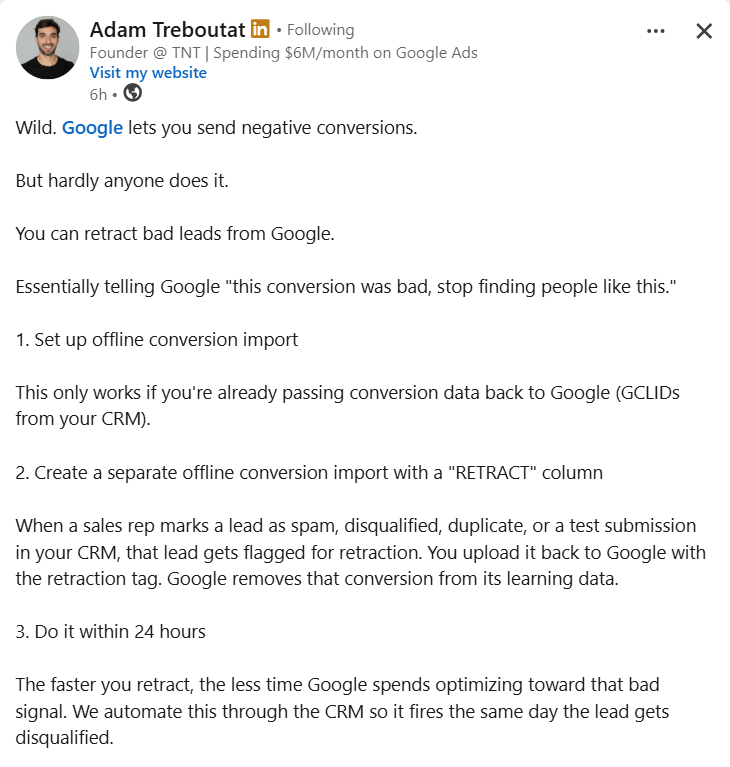
This framework focuses on improving algorithmic learning by removing poor-quality conversion signals. Instead of only feeding Google successful conversions, brands can also retract spam, duplicate, test, or disqualified leads. The goal is to improve optimization quality by cleaning the training data itself.
Why it works: Machine learning systems optimize around the signals they receive. If low-quality leads remain classified as conversions, Google will continue searching for similar users. Removing bad conversion data helps the algorithm prioritize audiences that are more likely to become qualified opportunities and customers.
Where it needs balance: Lead qualification is not always black and white. Over-aggressive retractions can reduce volume and potentially remove leads that may have converted later. The strongest systems use consistent sales qualification criteria and reliable CRM processes before feeding negative signals back into advertising platforms.
🎥 Reel of the Day

What Works:
The reel weaponizes false panic. Viewers genuinely think something went horribly wrong before realizing they're watching nail art transformation.
Emergency-room storytelling elevates a boring process. Nail prep becomes a dramatic rescue mission instead of another routine beauty tutorial.
The nail polish bottles become defibrillators. Familiar salon products suddenly gain a completely different narrative role and meaning.
Borrow storytelling from completely unrelated worlds. Turn ordinary transformations into rescues, mysteries, competitions, or investigations for attention.
Advertise with Us
Wanna put out your message in front of over 40,000 best marketers and decision makers?
Thanks for reading this edition! Keep pushing boundaries, testing ideas, and staying inspired. See you in the next edition with more ways to ignite your marketing success. 🥰