Your seeding deadline is earlier
"Seed in September" assumes the product's already in the creator's hands. For most brands, it isn't yet, More test variants don't always mean faster learning, and more!
Welcome to a space where every edition delivers insights, strategies, and inspiration to fuel your advertising brilliance. 🤯
📦 Your seeding deadline is earlier than the calendar says
Seed creators in August and September so they know the product before November, the standard BFCM playbook says, and the logic holds: CPMs run 20 to 60% higher by October, and building the roster while costs are low buys time to find proven winners before the auction gets expensive. What that timeline skips is that seeding isn't a calendar event. It's a shipping problem wearing a marketing deadline.
A creator can't post about a product they don't have, and "seed in September" assumes the product arrives in September too. For any brand with a production run, a fulfillment queue, or standard shipping transit between an order and a doorstep, the real deadline for starting that process sits weeks before the date most teams circled.
Work backward from your first paid flight, not forward from today
Start with the date you need proven content ready to put behind paid spend, then subtract backward: time for the creator to receive the product, time to create and post, time for organic performance to signal which pieces are worth scaling, and only then the shipping and production time to get the product into their hands.
Most teams build this calendar forward from today, which is why seeding always ends up compressed. Building it backward from the flight date it's meant to feed shows the real start date, and for a lot of brands that date has already passed once shipping is accounted for.
Audit your actual fulfillment timeline before committing to a creator count
Production lead time and shipping transit vary enormously by category, and most teams work from an assumption about their own timeline rather than a checked number.
Pull your actual average order-to-delivery time for last quarter, not the number on your shipping page, then multiply that against the creator count you're planning to seed, since a roster large enough to find winners takes real fulfillment capacity, not just budget.
Treat repeat creators as the shortcut the shipping math actually rewards
Since 81% of BFCM collaborations involve repeat creators, a roster already shipped to once skips the fulfillment lag entirely for anyone still active and worth rehiring.
Building that kind of repeat roster past $2M in scale, and connecting Ads Manager to a performance dashboard showing which past creators are worth rehiring before availability tightens, is what Insense works with brands like Il Makiage, Quince, Huda Beauty, and Monster Energy to do. You can book a free strategy call to map creator availability in your niche and get $200 toward your first campaign.
September 11 isn't a marketing deadline. Once shipping is factored in honestly, it might already be a tight one.
Together with AirOps
What 300+ Marketing Leaders Are Changing Now
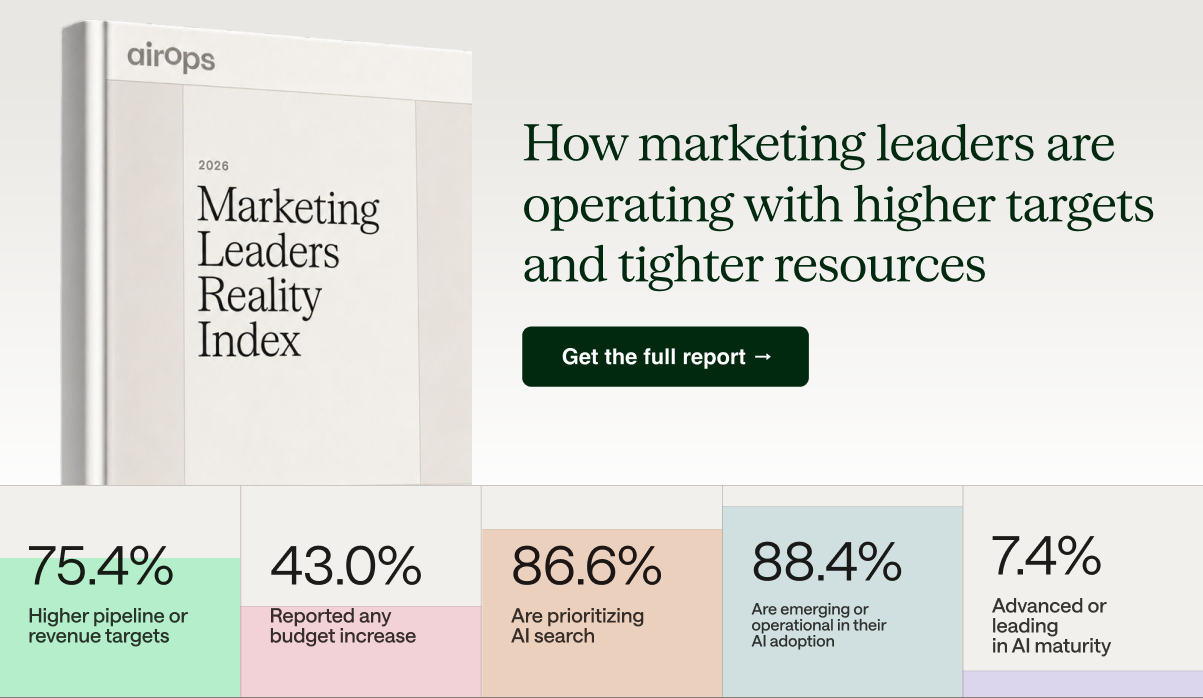
Marketing teams are increasingly inheriting revenue goals their budgets were never designed to support. When the plan breaks, marketing still carries the full commercial cost of the shortfall.
AirOps surveyed 300+ CMOs and VPs to measure exactly how widespread that pressure has become and reveal where leaders are reallocating resources as AI search rapidly changes the channel mix.
- Pressure-test your targets against the 75.4% of leaders carrying higher pipeline or revenue expectations.
- Strengthen funding conversations with proof that only 43.0% received additional budget.
- Identify your AI-search exposure, as 86.6% prioritize it while measurement confidence remains at 23%.
The Marketing Leaders Reality Index gives you a practical reference point for evaluating whether your operating model can support the results leadership expects.
See which moves other marketing leaders are making before they become standard practice.
Get the Marketing Leaders Reality Index.
⚡ More test variants don't always mean faster learning
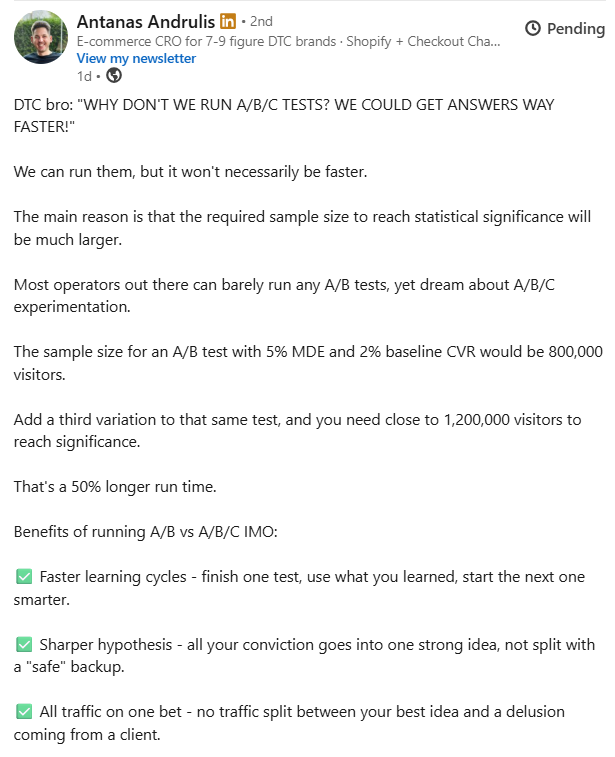
This framework argues that adding more variants to an experiment can slow down decision-making. Every additional variation divides traffic further and increases the amount of data required to confidently identify a winner.
Why it works: Focused A/B tests concentrate traffic around one clear hypothesis. This can produce cleaner learnings that inform the next experiment instead of testing several weaker ideas simultaneously.
Where it needs balance: The sample-size math depends on the statistical method, power, significance level, and how comparisons are handled. High-traffic brands can also benefit from multivariate testing when several strong hypotheses need to be evaluated quickly.
🎥 Reel of the Day

What Works:
Tension Before Product - Miu Miu withholds the bag and opens on a stubbornly serious portrait instead. The repeated request for a smile creates curiosity, giving viewers a reason to wait for the payoff.
Product Creates Emotion - The bag isn't simply introduced into frame. It becomes the thing that finally makes her smile, connecting Miu Miu with an immediate emotional transformation rather than relying on product features.
Delayed Brand Reveal - Miu Miu waits until the narrative has built anticipation before placing the orange bag prominently in frame. That delayed reveal makes the product arrival feel like the reel's payoff rather than advertising interruption.
Instead of opening with the product, build a tiny problem first. Introduce the product as the solution, then let the character's reaction communicate its desirability before landing the brand message.
Advertise with Us
Wanna put out your message in front of over 40,000 best marketers and decision makers?
Thanks for reading this edition! Keep pushing boundaries, testing ideas, and staying inspired. See you in the next edition with more ways to ignite your marketing success. 🥰