Your website is a claim
📋AI systems trust what independent sources say about you over what your own site says about itself, Creative strategy can be treated like an experiment, and more!
Welcome to a space where every edition delivers insights, strategies, and inspiration to fuel your advertising brilliance. 🤯
📋 Your website is making a claim. The rest of the internet decides if it's a fact
Ask an AI system what a brand does or how it compares to a competitor, and the answer rarely comes primarily from that brand's own website.
Schema markup, an About page, a well-optimized product description read to a model as a business's own assertion about itself. What shapes the answer is whether independent sources elsewhere say the same thing.
That's a real shift in what "optimization" means, and it explains a pattern more ecommerce brands are running into: ranking well on Google while being thin or wrong in ChatGPT, Gemini, or Perplexity's description of the same brand, because the two systems aren't scoring the same inputs.
Audit what the internet says about you, not what your site says
Pull ten prompts a customer would actually ask about your category and look for how your brand gets described, not just whether it gets named.
Check for three failure modes: omitted entirely despite strong organic rankings, named but described in outdated terms, or described in a way that contradicts what your own site says.
Each has a different root cause: the first usually means your brand lacks independent corroboration, the other two usually mean existing sources are stale or conflicting. Running that check across ChatGPT, Perplexity, Gemini, and Google AI Mode in one pass rather than prompting each separately is what Semrush's AI Visibility Toolkit is built for. You can try it free for 7 days.
Map where your entity actually gets corroborated
That corroboration lives in a specific, findable set of places: review platforms, marketplace listings, press coverage, retailer product pages carrying your copy, and any independent site writing about your category that mentions you.
Pull a list of every third-party source describing your brand and check two things: is it current, and does it match your positioning today? A brand that repositioned in the last year almost always has outdated third-party descriptions still feeding AI answers, because nobody updated anywhere but its own site.
Prioritize genuine independence over volume
Fifty mentions from the same affiliate network read to an AI system as one source repeating itself, not fifty confirmations. A handful of genuinely independent mentions, a real review site, a category publication, an unaffiliated retailer, carries more weight than far more coordinated placements.
The web has always shaped how people understand a brand secondhand. AI systems just made that secondhand version the primary one a customer sees first.
Together with Tatari
The brands winning BFCM start optimizing early.
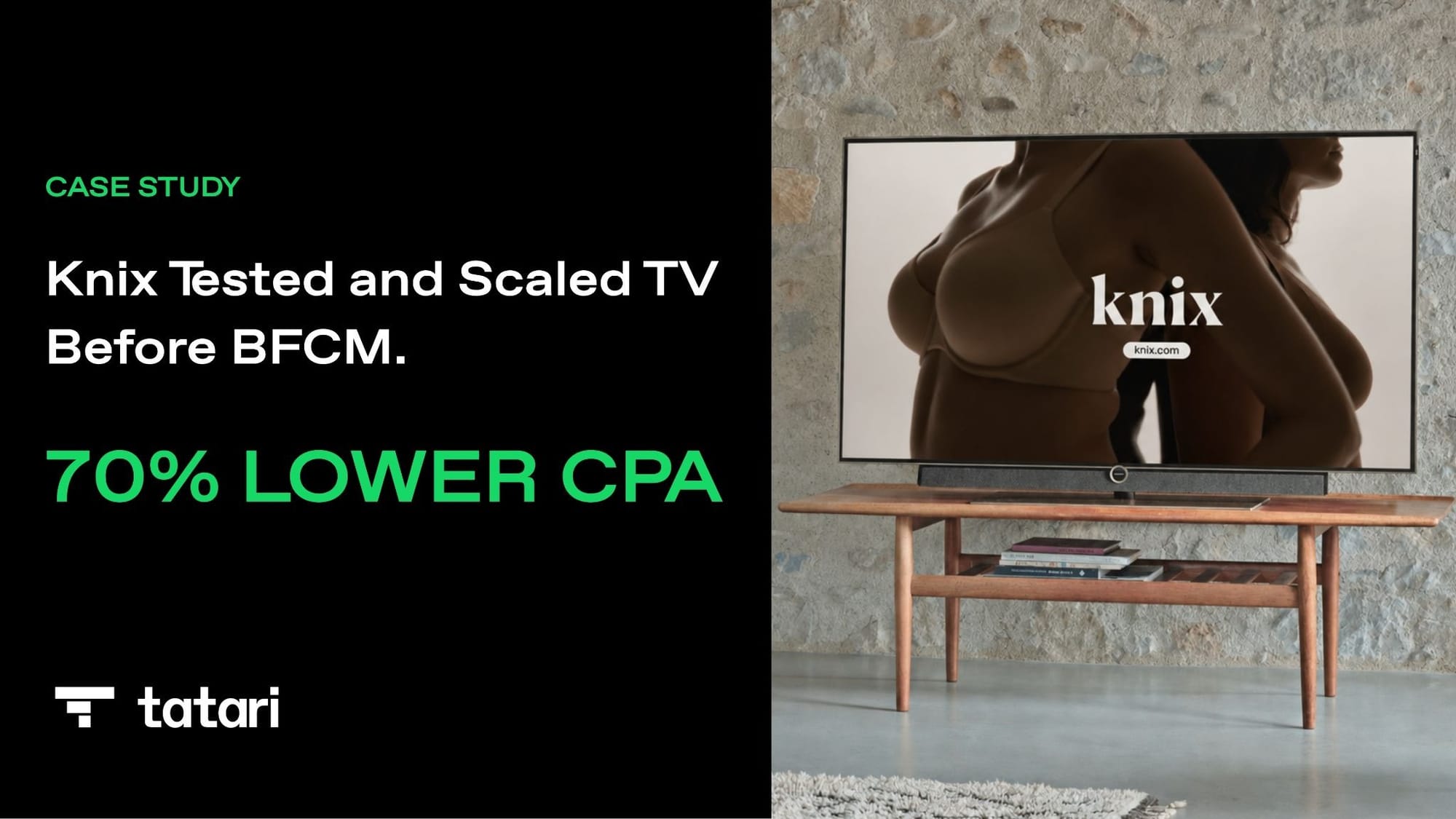
Tatari surveyed TV advertisers about their 2026 holiday plans, and brands are moving early.
Nearly 6 in 10 are increasing their BFCM TV budgets, and 54% plan to launch holiday messaging before mid-November
Launching earlier gives brands time to find what converts before TV inventory gets more competitive and expensive.
That’s how Knix approached TV. After testing ahead of peak season, one spot drove 9,000 site visits within five minutes at a 70% lower CPA. Creative testing also doubled response rates and cut CPV by 45%.
The extra runway helped Knix identify what deserved more budget before purchase intent peaked.
By Black Friday, you don’t want to be still testing. You want to be scaling.
See how Tatari can help you scale TV for BFCM.
P.S. In NYC Oct. 29? Join Tatari at Forward for an afternoon on what’s next in advertising with Reddit CEO Steve Huffman, and marketers from Liquid IV, MANSCAPED, and more.
⚡ Creative strategy can be treated like an experiment
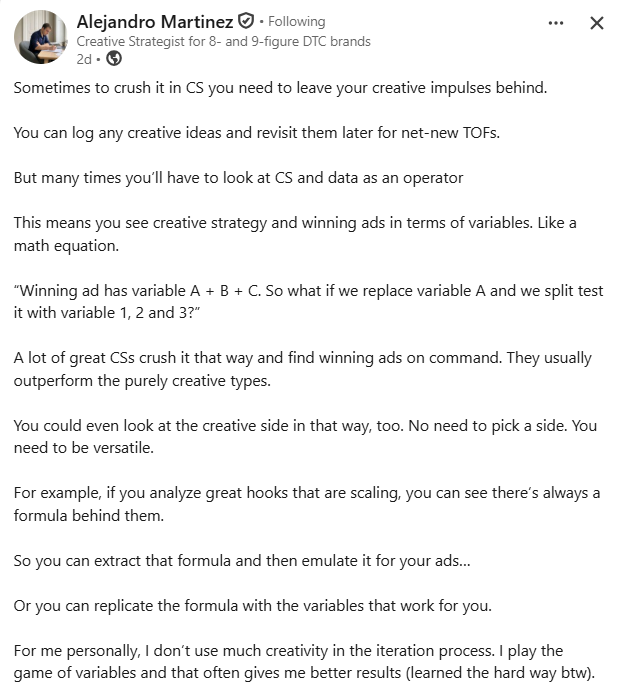
This framework argues that creative strategists can improve iteration by breaking winning ads into variables rather than constantly relying on new ideas. Keep the proven elements fixed, change one component, and measure what actually improves performance.
Why it works: Controlled iterations make it easier to understand why an ad wins. Testing hooks, angles, visuals, or offers individually creates reusable learnings that can make future creative decisions more intentional.
Where it needs balance: Too much structure can limit genuine creative breakthroughs. Variable testing is powerful for iterating proven concepts, while more exploratory creative is still valuable for discovering entirely new angles and formats.
🎥 Reel of the Day

What Works:
Product Reveal Hook - “Your rainjacket has a special feature” creates an immediate open loop. You know something is about to happen, but not what, which gives the first seconds strong hook efficiency.
Demo Beats Claims - Instead of saying “water reactive,” they physically soak the jacket and let the cheetah print appear. That transformation is the proof, making the product benefit instantly understandable and memorable.
Transformation Drives Retention - The print gradually becoming visible gives the reel a built-in retention curve. Viewers keep watching because the payoff develops frame by frame rather than arriving immediately.
Don’t explain an unusual product feature upfront. Create a visual trigger that activates it on-camera, then delay the full reveal slightly so the demonstration itself becomes the retention mechanic.
Advertise with Us
Wanna put out your message in front of over 40,000 best marketers and decision makers?
Thanks for reading this edition! Keep pushing boundaries, testing ideas, and staying inspired. See you in the next edition with more ways to ignite your marketing success. 🥰