You’re discounting the wrong objection
🧐The win-back email that offers a discount without ever naming why someone left, Ecommerce scale comes from expanding the economics of acquisition, and more!
Welcome to a space where every edition delivers insights, strategies, and inspiration to fuel your advertising brilliance. 🤯
🧐The win-back email that offers a discount without ever naming why someone left
Standard win-back sequences follow a familiar shape: acknowledge the absence, offer a discount, hope the incentive closes the gap. The problem is that this treats every lapsed customer as though the same thing happened to them.
Someone who stopped buying because the product no longer fit their routine and someone who left because the price gradually became uncomfortable don’t need different coupon codes. They need different reasons to reconsider.
Find the reason before writing the email
Start outside the email platform. Pull cancellation surveys, support tickets, exit feedback, and any other place customers explain why they stopped buying, then look for reasons that repeat often enough to deserve their own treatment.
A subscription skincare brand doing this found two dominant explanations:
“It stopped fitting my routine.”
“The price crept up over time.”
Neither was the generic forgetting problem its existing win-back sequence assumed. More importantly, those two objections require almost opposite responses. Routine fatigue calls for making the product easier to fit back into someone’s life. Price resistance requires addressing value and cost directly.
One win-back flow becomes three different conversations
Instead of sending every lapsed customer through the same sequence, use the information already sitting in their history to estimate why they left.
Purchase pattern → likely routine fatigue → acknowledge that routines change and introduce a smaller or more flexible product option.
Tenure plus price changes → likely price resistance → address the cost directly, explain what changed where relevant, then make the return economics easier.
No obvious churn signal → unknown reason → keep the broader win-back treatment rather than pretending to know something the data doesn’t support.
The skincare brand above used two reason-specific versions around routine fatigue and price, and saw win-back conversion improve meaningfully over the generic sequence they replaced.
The important part isn’t pretending segmentation can perfectly read someone’s mind. It’s using available evidence to make a better first hypothesis than “everyone forgot.”
Make the discount earn its place
There’s a useful experiment hiding inside the new flows.
Keep the incentive comparable, but change what comes before it. Run the reason-led versions for a full quarter and measure conversion separately.
If the price-led segment consistently wins, you’ve learned something larger than which email works. Price may be a retention problem worth addressing earlier in the lifecycle. If routine-fatigue customers respond strongly to flexibility, that insight belongs in product and subscription design too.
The win-back flow becomes a churn research system, not merely a recovery campaign.
That first segmentation step is exactly where AI can remove some of the manual work.
Omnisend connects directly with ChatGPT and Claude, so teams can ask questions about campaigns, automations, and subscribers inside the AI tools they already use, including pulling a lapsed-buyer segment and drafting the email to send it.
Its new guide covers 10 practical workflows like this, from finding the highest-earning welcome email to catching rising bounce rates early. You can read the guide.
A discount can change the economics of returning. It can’t answer the reason someone decided to leave in the first place.
Together with AirOps
Why your AI visibility keeps disappearing overnight
Only 30% of brands stay visible in an AI answer from one run to the next. Run the same prompt 5 times, and only 20% show up in all 5. That's not a ranking problem.
Rankings barely move day to day. AI visibility does, and most teams are still measuring it with a dashboard built for the old game.
AirOps broke down what's actually driving citations in 2026:
- Freshness compounds. Pages updated in the last 3 months are 3x more likely to get cited.
- Structure matters more than design. Clean heading hierarchy alone lifts citation odds 2.8x.
- Most of it happens off your site. 85% of brand mentions in AI search come from third-party sources, not your domain.
Five metrics replace the old scorecard: citation rate, mention rate, share of voice, sentiment, and source attribution. They need a weekly review, not a quarterly one.
If your GEO (Generative Engine Optimization) strategy still lives inside your SEO report, you're measuring last quarter's game.
Want the full breakdown on where citations come from and how to track them weekly?
⚡ Ecommerce scale comes from expanding the economics of acquisition
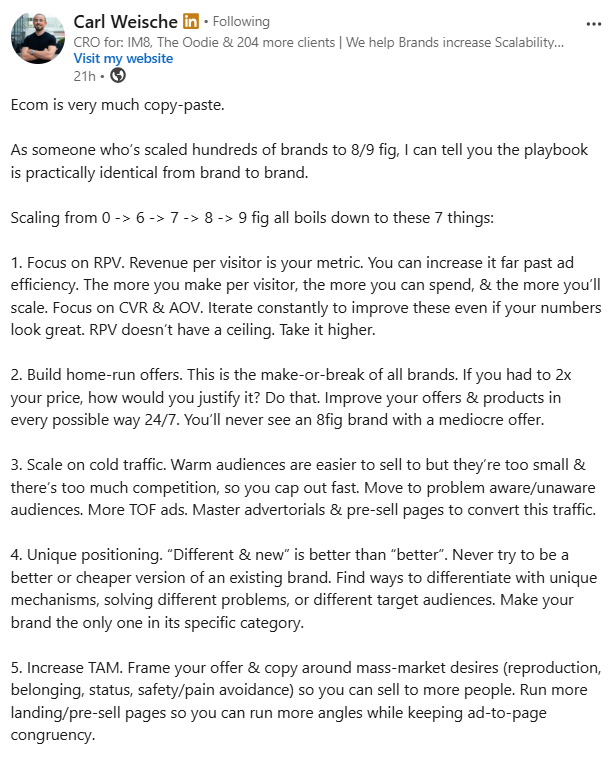
This framework argues that scaling isn't just about making ads cheaper. Increasing revenue per visitor, strengthening offers, improving positioning, and eventually increasing LTV gives a brand more room to acquire customers and reach larger markets.
Why it works: Better CVR and AOV make every visitor more valuable, while stronger positioning and cold-traffic funnels expand the available audience. As brands mature, the constraint naturally shifts from acquisition toward CRO, retention, and brand.
Where it needs balance: There is no universal scaling sequence, and ecommerce is far from completely copy-paste. Category economics, margins, repeat behavior, competition, and distribution can radically change the playbook. Claims that these principles make eight-figure growth inevitable should be treated as experience-based opinion, not a guarantee.
🎥 Reel of the Day
What Works:
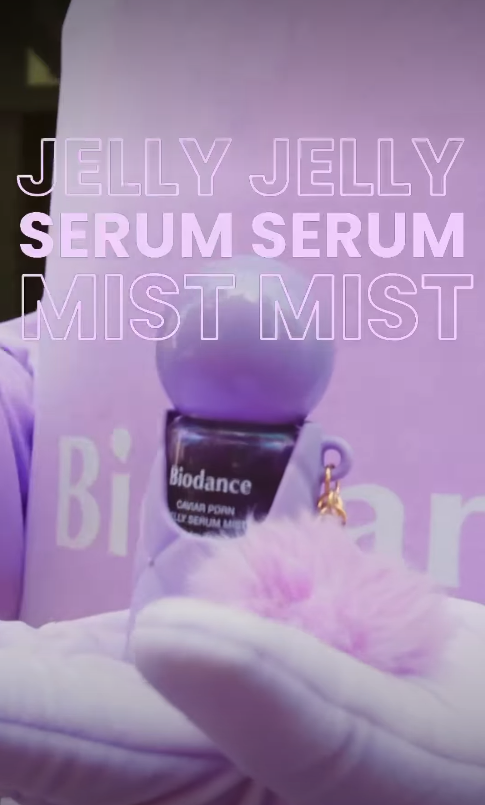
1. Turn the product into a character - Making the serum bottle a giant “Pibi” mascot gives Biodance a recognizable personality, transforming ordinary Sephora availability news into something playful, memorable, and inherently social.
2. Make retail availability the storyline- Instead of saying “Now at Sephora,” Pibi physically travels through New York to Sephora. The distribution announcement becomes an adventure audiences can follow rather than an advertisement.
3. Physical spectacle creates stopping power - An oversized purple serum walking through real Manhattan streets creates immediate visual incongruity. People naturally notice something that clearly does not belong at that scale.
Turn distribution news into a destination story. Instead of posting “We’re now at Retailer X,” create a character, object, or product journey that physically leads audiences to the retailer.
Advertise with Us
Wanna put out your message in front of over 40,000 best marketers and decision makers?
Thanks for reading this edition! Keep pushing boundaries, testing ideas, and staying inspired. See you in the next edition with more ways to ignite your marketing success. 🥰