You’re Optimizing The Wrong Metrics
📊The three metrics that tell you what's actually broken in your Google Ads account, tROAS scaling depends more on signal quality than aggressive target efficiency, and more!
Welcome to a space where every edition delivers insights, strategies, and inspiration to fuel your advertising brilliance. 🤯
📊 The Three Metrics That Tell You What's Actually Broken In Your Google Ads Account, And Most Teams Are Looking At The Wrong Ones
Conversion rate and ROAS are downstream symptoms, not diagnostics. The five upstream metrics that actually tell you what's broken (Impression Share, IS Lost to Budget, IS Lost to Rank, CTR, Conversion Rate) sit in a different report.
The framework underneath: three problem types (visibility, engagement, conversion) by three solution levers (budget/bid, quality, targeting). Nine boxes. Every broken campaign lives in one.
Strategy 1: Pull The Five Diagnostic Metrics Before Touching Any Setting
For each campaign you want to fix, pull Impression Share, IS Lost to Budget, IS Lost to Rank, CTR, and Conversion Rate. Five numbers, every time, before any decision.
Most teams skip this because they have a hypothesis already (CTR is low, so rewrite the ad). The hypothesis is sometimes right. The structured pull is always more reliable, because the diagnostic prevents you from fixing what isn't broken.
Strategy 2: Map The Current State Onto The 3x3 Matrix
The five metrics tell you which problem row you're in. Low IS or high IS Lost to Budget points to visibility. Healthy IS with low CTR points to engagement. Healthy IS and CTR with low conversion rate points to conversion.
The solution column is the second decision.
Visibility fixes: budget (raise spend), quality (raise ad relevance to win the auction cheaper), or targeting (broaden keywords).
Engagement fixes: bid (higher positions), quality (rewrite ad copy), or targeting (refine match types, add negatives). Conversion fixes: budget (eliminate caps that distort bidding), quality (rebuild the landing page), or targeting (reset the conversion action).
Naming both axes turns a vague hunch into a specific intersection.
Strategy 3: Run The Diagnostic Weekly, Not When Something Breaks
The five-metric pull is most valuable as a routine, not a fire drill. Weekly cadence catches the bucket shift two to three weeks earlier than reactive optimization.
The problem is volume. Running this every week with the discipline to act on it takes more time than most teams have.
Pounce runs creative analysis, brief generation, competitor intel, and performance optimization through AI agents that work the way a strong performance team works, not the way a dashboard works. The cadence the discipline requires is the cadence the agent layer makes possible. You can get started for free with Pounce today!
The five metrics are the diagnostic. The nine boxes are the fixed vocabulary.
Together with Insense
You don't need another agency. You need a better system.
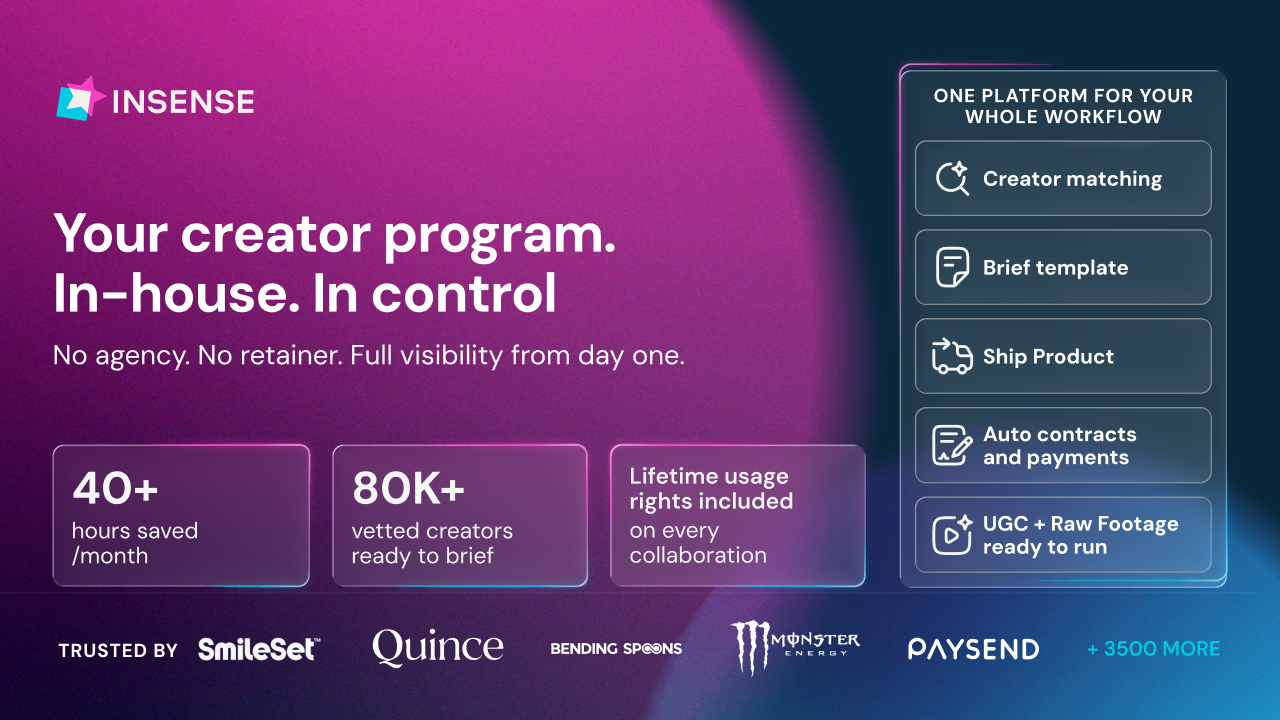
More DTC brands are pulling creator marketing in-house because agency models are too slow, too rigid, and too expensive to test at the speed that paid social demands.
Insense is the self-serve platform built for that transition.
Source from 80,000+ vetted creators, interactive brief templates and approvals in one place, automated contracts and payments, and lifetime usage rights included on every piece of content.
Over 3500 brands like Quince, Paysend, SmileSet, and Monster Energy use Insense. No retainer. No middleman. Full visibility and control from day one.
Brands save 40+ hours a month and get first creator applications within 48 hours.
P.S. If you need occasional assistance with influencer scouting, post-production, or platform management, they offer customizable and hybrid managed services.
Book a free strategy call by May 31st and get a $200 platform credit towards your first campaign.
⚡tROAS Works Best When Fed Stable Volume and Real Value Signals
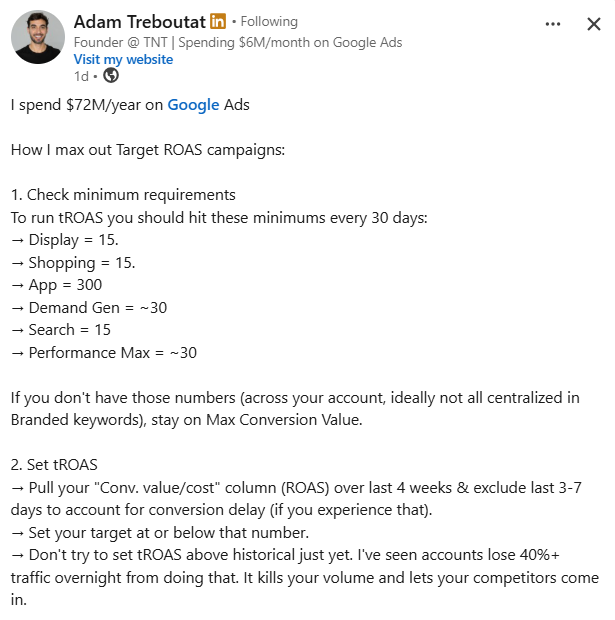
This framework explains how to scale Google Ads using Target ROAS without choking volume. The core idea is that tROAS only performs well when campaigns have enough conversion data, realistic targets, and accurate value signals guiding optimization. Most failures come from pushing efficiency targets too aggressively, too early.
Why it works: Google optimizes toward the value signals it receives. Stable conversion volume and realistic ROAS targets allow the algorithm to scale efficiently while prioritizing higher-value customers and conversions.
Where it needs balance: tROAS can reduce reach quickly if targets are too restrictive or conversion volume is weak. Heavy reliance on automation also requires strong tracking accuracy and patience before making optimization decisions.
🎥 Reel of the Day
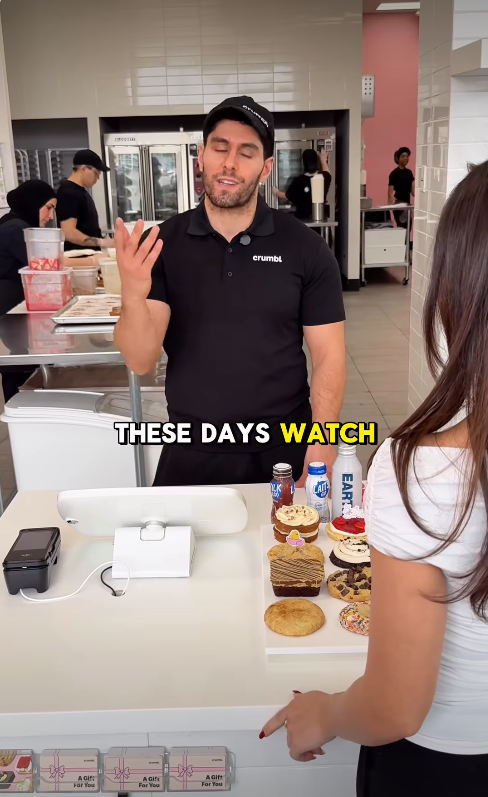
What Works:
Expectation Reversal Funnel Design - The reel weaponizes a universal retail fear: customers pretending they forgot wallets. Audiences instantly recognize the behavioral pattern emotionally and socially.
Social Proof Through Shared Frustration - The employee rant feels authentic because retail workers constantly experience abandonment friction, fake intentions, and incomplete checkout behavior from uncertain customers daily.
Brand Integration Without Forced Selling - Cookies remain visually present throughout every emotional beat, embedding product awareness subconsciously while entertainment carries the actual attention burden naturally for viewers.
Stop filming products passively. Engineer short-form scenarios exposing recognizable customer-worker tensions because shared social truths outperform aesthetic food shots consistently online.
Advertise with Us
Wanna put out your message in front of over 40,000 best marketers and decision makers?
Thanks for reading this edition! Keep pushing boundaries, testing ideas, and staying inspired. See you in the next edition with more ways to ignite your marketing success. 🥰