Google now matches by IP
🛰️ Customer Match takes IP addresses and timestamps now, and one missing column can match the wrong person, Amazon PPC can be used to support organic rank, and more!
Welcome to a space where every edition delivers insights, strategies, and inspiration to fuel your advertising brilliance. 🤯
🛰️ Your customer match list just got two new columns
Google's Customer Match upload page quietly grew from six column headers to eight. The new pair is "User IP address" and "User Interaction timestamp", first reported in late September.
The rule worth memorizing sits in one line of the help page. If you upload an IP without a timestamp, Google defaults to the "latest known" user of that IP.
Think about a shared home router or a coworking space. That fallback can tie your customer's row to someone else entirely, so the timestamp column is what makes this signal work.
Build a clean IP export
- Pull IPs from server-side sources, such as order events, checkout logs and form submissions, where each IP has a real event time attached.
- Pair every IP with the timestamp of that event. Google accepts formats like 2026-09-14T17:01:54Z.
- Strip office IPs, VPN ranges and known bot traffic.
- Remove anyone located in the EEA, UK or Switzerland, where Google doesn't support IP matching.
- Keep hashing emails, phones and names with SHA-256 as usual, but send IPs and timestamps unhashed.
Analytics exports usually lack event-level timestamps, which pushes every row into the "latest known" fallback. Skip them.
Attach IPs by freshness
An IP from last week says a lot more than one from 2024. Tier your rows:
- Recent buyers (last 90 days): email, phone, IP and timestamp
- Lapsed buyers: email and phone only
- Old IP with no fresh event: leave the IP out
The 90-day cutoff is my judgment for consumer IPs, which tend to rotate. Tighten it if your customers buy mostly on mobile networks.
Spend the gain on exclusions
Better matching pays off fastest on lists you exclude from prospecting.
If you run Performance Max with the new customer acquisition goal, your Customer Match list defines who counts as existing. A higher match rate means fewer past buyers get bid on at new-customer value.
If you run prospecting Search or YouTube, exclude the refreshed recent-buyer list there too.
To measure the lift, upload your recent buyers twice. One list carries email and phone only, and the other adds IP and timestamp. Compare the sizes Google reports, then keep whichever wins.
Before you upload
Check that your privacy notice covers sharing IP data with advertising platforms, and confirm consent with whoever owns compliance.
Then build the two test lists this week, ahead of holiday traffic.
Together with Billo
The Growth Targets Changed. What About Your Budget?
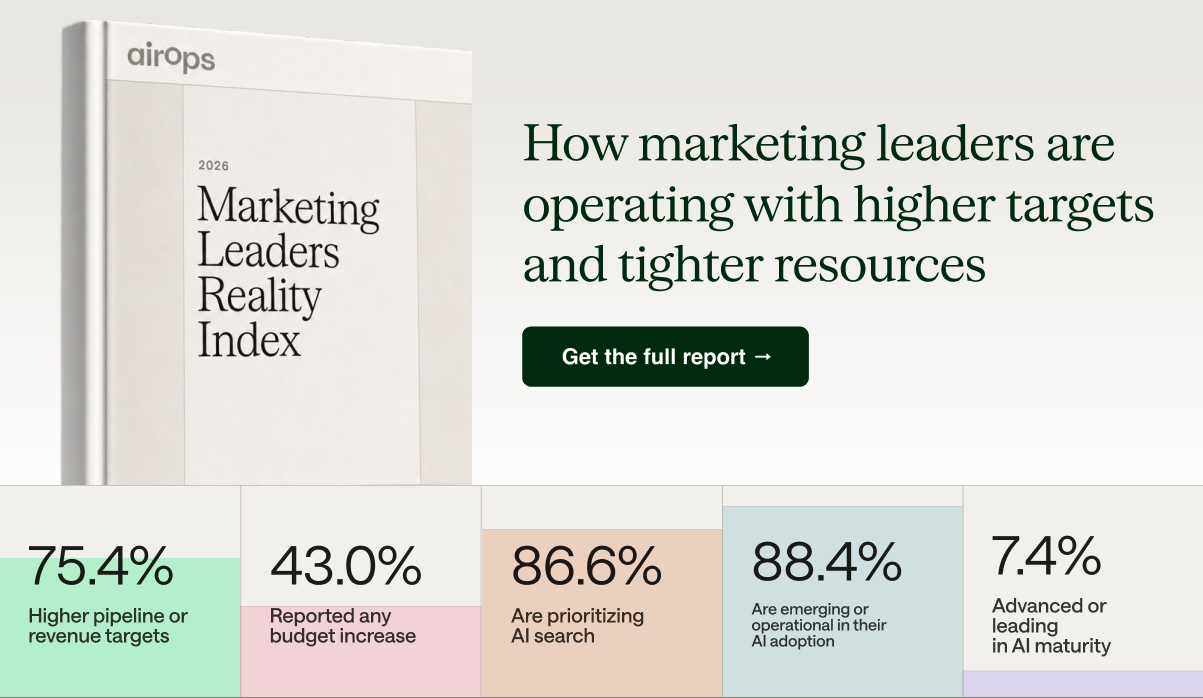
Targets are climbing faster than budgets can keep up, and you’re expected to make the numbers work. Before you commit to more pipeline, see how other marketing leaders are handling the same pressure.
AirOps surveyed 300+ CMOs and VPs to uncover how leaders are reallocating budget and closing capability gaps while being asked to deliver more pipeline with less support.
Here’s what’s inside:
- 75.4% of leaders face higher targets this year. Discover how they’re responding and where your plan stands against theirs.
- Only 43.0% received more budget to match. If you’re asking for more resources, use these benchmarks to strengthen your case.
- 86.6% are betting on AI search, but only 23% trust their measurement. Use that gap to question what you can actually measure before spending more.
Pull the benchmark most relevant to your team into your next budget request, alongside the target you’re expected to hit.
⚡ Amazon PPC can be used to support organic rank
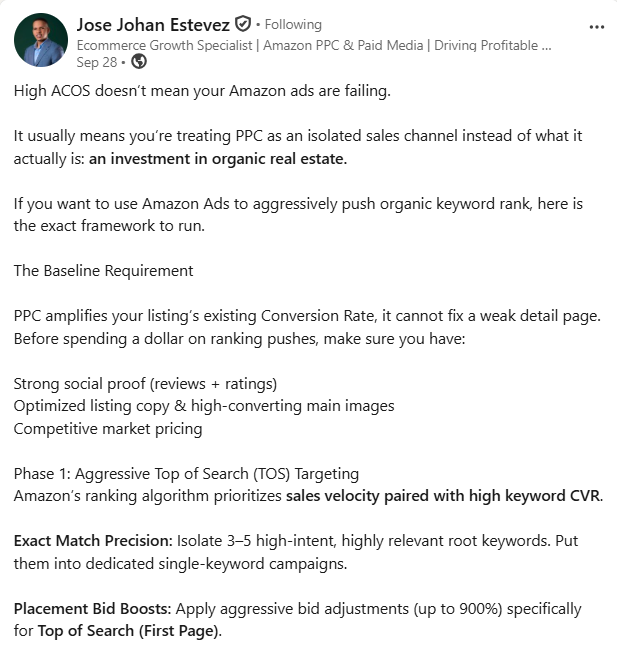
This framework treats advertising as more than a direct sales channel. Aggressive spend on strategically important keywords can generate sales velocity while stronger organic placement potentially improves the economics beyond the individual campaign.
Why it works: Focusing spend on relevant, high-converting searches connects advertising with organic visibility. Looking at TACoS alongside ACOS can then show whether expensive paid sales are contributing to healthier overall account economics.
Where it needs balance: High ACOS isn't automatically justified by a ranking goal, and aggressive Top of Search bidding doesn't guarantee organic lift. Brands need to track keyword-level organic rank, total sales, contribution margin, and TACoS to confirm the additional spend is actually creating incremental value.
🎥 Reel of the Day

What Works:
1. Turn The Recipe Into Entertainment - Instead of jumping straight to the finished drink, the reel shows the full coffee recipe process, making preparation itself the content and giving viewers a reason to stay.
2. Make Every Step Visually Satisfying - Blending, straining, simmering, freezing and filtering create constant process-driven visual changes. Each action gives the edit a fresh beat, which keeps a long tutorial from feeling repetitive.
3. Create Curiosity Through An Unexpected Combination - Watermelon coffee sounds unusual enough to earn the click. The reel then rewards that curiosity by showing how the ingredients are transformed rather than relying only on novelty.
For detailed how-to content, keep the information dense but visually simple: one action per shot, clear ingredient labels, satisfying transformations and a strong series format viewers can recognize instantly.
🥳 Events
🔥 What Meta’s Own Data Says About Creator Ads Right Now
October 7 | 11 AM ET | 60-Minute Virtual Event
Hear Reyna Baker from Meta break down Partnership Ads performance, then see how Curtis Howland applies those signals after managing $100M+ in Meta spend. You’ll leave knowing which creator-ad setups deserve testing and what to change before your next campaign.
Can't attend the session live? Register anyway, and you’ll get the recordings in 24 hours.
🔥 How Top Brands Measure, Fund, and Scale Creator Marketing
October 21 | Online | Free Festival
Return on Influence Festival ’26 brings together teams from Adobe, Edelman, ŌURA, Ogilvy, and more to unpack how creator programs actually run. Learn how they measure ROI, justify budget, structure partnerships, and scale from 5 to 5,000 creators without adding chaos.
Can't attend every session live? Register anyway, and you’ll get the recordings in 24 hours.
Advertise with Us
Wanna put out your message in front of over 40,000 best marketers and decision makers?
Thanks for reading this edition! Keep pushing boundaries, testing ideas, and staying inspired. See you in the next edition with more ways to ignite your marketing success. 🥰