Meta just reshuffled your winners
📉 Since March saves and shares stopped counting as clicks, and your best ads may be sitting on the pause list, Platform ROAS doesn’t tell the whole growth story, and more!
Welcome to a space where every edition delivers insights, strategies, and inspiration to fuel your advertising brilliance. 🤯
🔍 The Ad you paused last week might have been your best one
Picture two ads in the same campaign. Ad A shows 31 purchases on 7-day click. Ad B shows 22, so B gets paused on Monday.
What the default view hid: B also drove 19 purchases through saves, shares and video views. Since March 18, Meta files those under a separate 1-day engage-through window instead of counting them as clicks.
Common Thread's review of 50 accounts found 7-day click ROAS fell 13% on average after the switch. The damage is uneven, and it falls hardest on your most watchable creative. Here's how to stop cutting it.
The 20-minute re-rank
- Pull ad-level results from March 18 onward only, since older rows mix two definitions of a click.
- Add 7-day click, 1-day engage-through and 1-day view as separate columns.
- Divide each ad's engage-through purchases by its total.
- Sort every ad into a bucket. Closers sit under 15% engage-through, assisters above 35%, hybrids in between.
Those cutoffs are my working judgment, so tune them to your account. Then check the pause history. Any assister switched off since March deserves a relaunch.
Splice assisters into closers
Assisters stop the scroll, and closers convert the click. Combine them:
- Lift the first three seconds of your top assister.
- Attach the offer, proof and end card of your top closer.
- Launch the hybrid as a new concept and judge it on click plus engage-through.
A skincare account might pair a viral texture close-up with the closer's "30-day refill" offer frame.
Curtis Howland has managed $100M+ in Meta spend and joins Billo CEO Donatas Smailys and Meta Partner Manager Reyna Baker to break down creative testing under these platform changes. It's a free 60-minute session on October 7 at 11 AM ET, with recordings within 24 hours. You can secure your free spot here.
New kill and scale rules
Your old thresholds were tuned to inflated click counts, so rewrite them.
If an ad misses target CPA on clicks alone but clears it with engage-through added, keep it running for another week.
If it misses on both after spending 2x target CPA, cut it.
If click CPA looks great, but engage-through is near zero, check its new-customer share before scaling, because it may be harvesting existing buyers.
Before moving real budget onto assisters, use Meta's incremental attribution view or a conversion lift test as the tiebreaker. Run the re-rank before Friday. Every wrong pause costs more once Q4 CPMs climb.
Together with Insense
Your BFCM Creator Calendar is Already Mapped
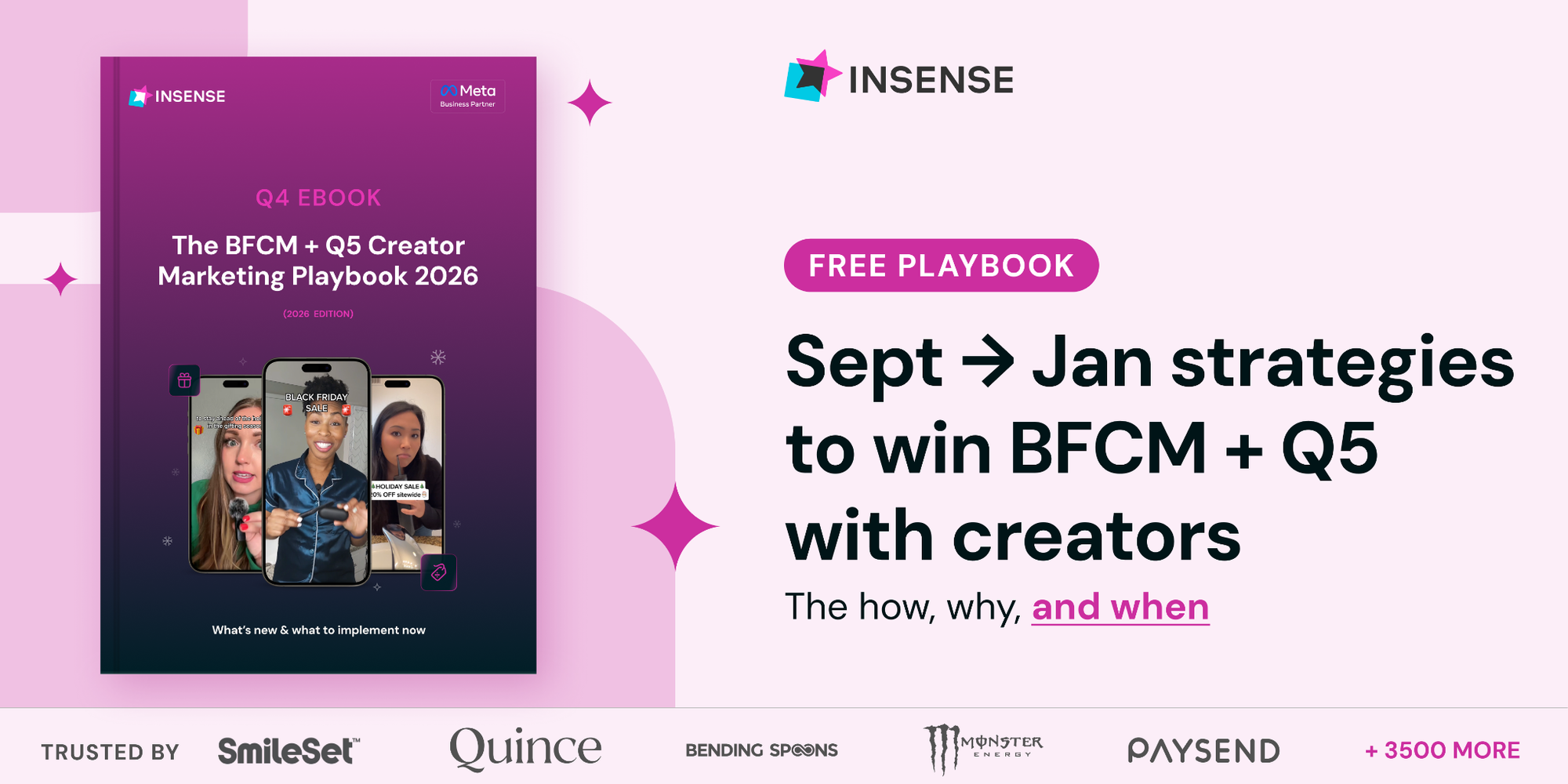
Still sourcing creators when your Black Friday ads should be running? Every delay leaves less time to test what actually sells before your biggest spending weeks.
Insense’s free BFCM + Q5 Creator Marketing Playbook gives marketers a week-by-week plan from September through January, so every creator campaign starts with a clear deadline and purpose.
Inside, you’ll find:
- A week-by-week August-to-January calendar showing when to secure permissions, test content, scale winning creators, and move into Q5.
- A practical creator scorecard using conversions, engagement quality, and reliability, so November budgets back proven performers over follower counts.
- Q5 action plan covering licence extensions, January creative, and the recommended 10–15% budget reserve for the lower-cost post-holiday window.
You’ll also get benchmarks for creator-handle ads, modular UGC testing, live shopping, hook rates, and creative volume, helping your team set measurable targets before spending rises.
⚡Platform ROAS doesn’t tell the whole growth story
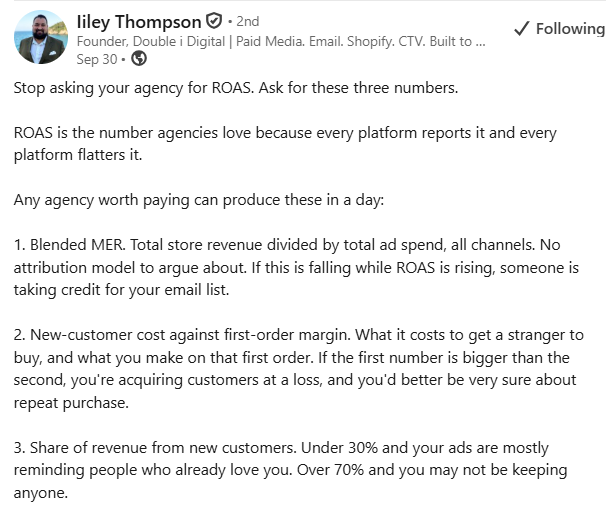
This framework shifts reporting from platform-attributed performance toward business-level economics. Blended MER, new-customer acquisition cost against first-order margin, and new-customer revenue share reveal whether advertising is actually contributing to sustainable growth.
Why it works: These metrics reduce dependence on each platform’s attribution model. They connect media spend with total revenue, acquisition profitability, and the balance between acquiring new customers and monetizing existing ones.
Where it needs balance: The suggested thresholds aren't universal. A low first-order margin can work with strong repeat economics, while new-customer revenue mix varies by category and growth stage. These metrics are most useful alongside contribution margin, retention, and incrementality data.
🎥 Reel of the Day

What Works:
1. Problem First Hook - Opening with the messy old nail routine instantly establishes a relatable problem. Spilled polish and uneven application exaggerate the frustration while making the transformation more satisfying.
2. Before vs. After - The “used to vs. now” comparison gives the product an obvious job. Viewers understand the improvement immediately without needing a lengthy explanation of what the gel pen does
3. Finish With Proof - Ending on the polished finished nails completes the transformation. The clean result becomes visual proof of the product while giving viewers the satisfying payoff promised by the opening.
For a problem-solving product, dramatize the old method, reveal the easier alternative, demonstrate it in close-up, quantify the convenience, then finish with a clear before-and-after payoff.
Advertise with Us
Wanna put out your message in front of over 40,000 best marketers and decision makers?
Thanks for reading this edition! Keep pushing boundaries, testing ideas, and staying inspired. See you in the next edition with more ways to ignite your marketing success. 🥰