Industry average is not your threshold
🧮 The industry average tells you nothing about your program. Here's the math that actually does, Email can improve the economics behind paid acquisition, and more!
Welcome to a space where every edition delivers insights, strategies, and inspiration to fuel your advertising brilliance. 🤯
🧮 Stop quoting the industry average. calculate your own.
Email and SMS marketing averaging $79 for every $1 spent is a real, widely cited industry figure, and it's also almost useless as a planning number for any individual brand, because an average across thousands of businesses at wildly different list sizes, send frequencies, and product margins tells you almost nothing about what your specific program actually returns.
Most teams never calculate their own version of that number. They either quote the industry average as if it applies to them or, more commonly, never calculate a return-per-dollar figure at all, running email and SMS as a channel that "obviously works" without ever pricing exactly how well.
Calculate your platform cost per revenue dollar, not per send
Take your total monthly email and SMS platform cost, subscription fees, SMS message costs, any add-ons, and divide it by the revenue your platform's own attribution credits to email and SMS for that month.
This is a different number than cost-per-send, which most platforms show by default and which tells you almost nothing about whether the spend is working. Cost-per-revenue-dollar is the number that actually answers whether the channel is earning its budget.
Segment the calculation by list health, not just total revenue
A blended average across your entire list hides a program that might be performing very differently across its healthiest and weakest segments.
Running that comparison honestly, rather than assuming the current platform's number is close to whatever the industry average claims, is the same math one agency ran before deciding a pre-BFCM switch to Omnisend was worth the calculated risk.
Calculate the same cost-per-revenue-dollar figure separately for your most-engaged segment and your least-engaged one.
A wide gap between the two usually means the aggregate number is being propped up by a small, highly engaged group while a large, disengaged portion of the list is quietly dragging down what looks like a healthy blended average.
Recalculate the number before assuming your current platform is your cheapest option
A platform that looks efficient on a blended average can look different once the calculation accounts for list health and true platform cost, especially when SMS pricing has been rising across the category and platform costs vary by up to 35% for functionally similar service. That's the math that landed $113K in holiday revenue on a new platform, matching the year before. You can read the full story.
$79 per $1 is a real number. It's just not your number until you've actually run it.
Together with Levanta
How Much Revenue Is Your Roster Leaving Behind?
Open your dashboard and ask two questions: which creators brought in new customers last month, and which commissions kept them posting?
If the answers are not obvious, your team is guessing where to invest while stronger revenue opportunities go unfunded.
Levanta’s self-diagnostic checks your program against seven warning signs, then pinpoints the roster gap costing you sales before you spend another dollar recruiting creators.
- Hyperice generated $500K+ in one quarter and crossed $100K per month within 30 days, with commissions below 1%.
- JLab tripled affiliate sales as Levanta creators drove 364K+ clicks and contributed 48% of total conversions.
- MISSION generated 3,600 orders in 60 days at a 9% conversion rate and 25:1 ROAS after Amazon’s Brand Referral Bonus.
You leave knowing which relationships deserve another campaign and where your next dollar can return more revenue.
Run it before another month passes with high-potential creators sitting inactive.
Download Levanta’s 7-step checklist to find the roster gaps costing you sales.
⚡ Email can improve the economics behind paid acquisition
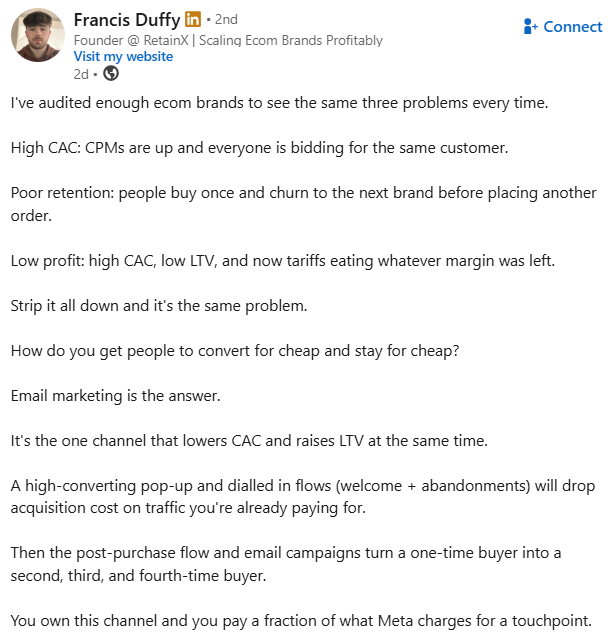
This framework argues that email connects acquisition and retention. Capturing more paid traffic through pop-ups and abandonment flows can improve first-purchase efficiency, while post-purchase campaigns create additional revenue from customers already acquired.
Why it works: Email creates relatively low-cost repeat touchpoints without paying for every impression. Strong lifecycle flows can recover abandoned shoppers, encourage repeat purchases, and increase LTV, giving brands more room to afford rising acquisition costs.
Where it needs balance: Email doesn't directly solve every CAC or retention problem. Product quality, pricing, acquisition efficiency, and repeat-purchase potential still determine the economics. Email works best as a multiplier of strong fundamentals, not a replacement for them.
🎥 Reel of the Day

What Works:
1. Lens-Led Transition - The subject physically reaches toward the lens, turning a simple hand movement into the transition itself. The interaction feels unexpected, tactile, and instantly more engaging than a conventional cut.
2. Curiosity Before Promotion - The reel opens with a confused expression and unusual camera interaction before mentioning the menu. That brief “what’s happening?” moment earns attention before viewers realize they’re watching restaurant content.
3. Editing Becomes Hook - There’s no need for a heavy written hook because the visual trick performs that job. Simple footage becomes scroll-stopping when viewers want to understand how the transition was executed.
Build the edit into the action: have the subject cover, grab, push, swipe, or rotate the lens, then use that movement to reveal the product, location, or offer.
Advertise with Us
Wanna put out your message in front of over 40,000 best marketers and decision makers?
Thanks for reading this edition! Keep pushing boundaries, testing ideas, and staying inspired. See you in the next edition with more ways to ignite your marketing success. 🥰