Meta finally splits creative results
🔬 Ads Manager now reports performance for each image, video, and text in an ad, so you can see which piece is working. Relevant Amazon traffic doesn't guarantee conversions, and more!
Welcome to a space where every edition delivers insights, strategies, and inspiration to fuel your advertising brilliance. 🤯
🔬 One $5,000 ad, broken into pieces: what Meta's new asset reports reveal
Here's an ad spending $5,000 across three videos and four headlines. Until now, you'd judge it as one unit with one cost per purchase. Now you can see inside it.
Video A took $2,400 at a $38 cost per purchase. Video C took $1,100 at $71. Headline 2 converted at nearly double the rate of Headline 4. Those figures are illustrative, but the view is real. On October 27, Social Media Today reported that Meta Ads Manager now breaks down performance for individual assets inside an ad: each image, video and piece of text. Carousel and collection ads are excluded.
For that ad, the next move is obvious: replace Video C and Headline 4, then compare blended cost per purchase over the following seven days.
A strong video can carry a weak headline for weeks, and a great headline can sit beside images nobody stops for. With peak season close and new creative slow to make, swapping pieces beats rebuilding ads.
The rule I use
An asset taking at least a fifth of the ad's spend while converting at half the rate of its best sibling gets replaced. That's my judgment, and it keeps decisions consistent across a busy account.
Run it on your top ten ads
- Sort each ad's assets by spend.
- Compare cost per purchase or click-through rate within the ad.
- Flag the passengers: assets taking spend and trailing clearly.
Swap one piece at a time
Replace the weakest asset and leave the rest untouched. Change several at once and you won't know what helped.
Look across ads, too
If the same headline wins in several ads, that's a message insight. Build your next creative brief around it.
Don't over-prune
Cutting every asset except the winner backfires. Meta needs options to match different people, and a lone asset fatigues faster. Keep a few strong performers in each ad.
Watch the sample size
In small ads, asset numbers swing on a handful of conversions. Judge only assets with enough spend to read, and treat small gaps as noise.
Track each week
- Spend share and cost per purchase by asset
- Assets per ad after cleanup
- Ad performance after each one-piece swap
Monday morning
Break down your highest-spend ad by asset. Note the weakest headline and the weakest visual. Those are your first two swaps.
Together with Omnisend
Get their email while you have their attention

You spend hours creating content that gets people interested. Then ask them to find your bio, open a link, and fill out a form.
Every extra step gives a potential subscriber another reason to drop off.
Omnisend’s Social Capture lets you collect their email right inside Instagram, while they’re already engaging with your brand.
Here’s how it works:
- Connect Instagram and choose a keyword, with an optional discount for subscribing.
- Omnisend automatically DMs anyone who comments or messages that keyword, asking for their email.
- Those who subscribe go straight into your Omnisend list, ready for your welcome series.
You’ll have a way to follow up with interested shoppers when your next offer goes live, without hoping they see another post.
New to Omnisend? Its ecommerce email and SMS platform is trusted by 150,000+ brands. Migration is free and takes up to five business days.
Start collecting subscribers before your next launch needs them.
⚡Relevant Amazon traffic doesn't guarantee conversions
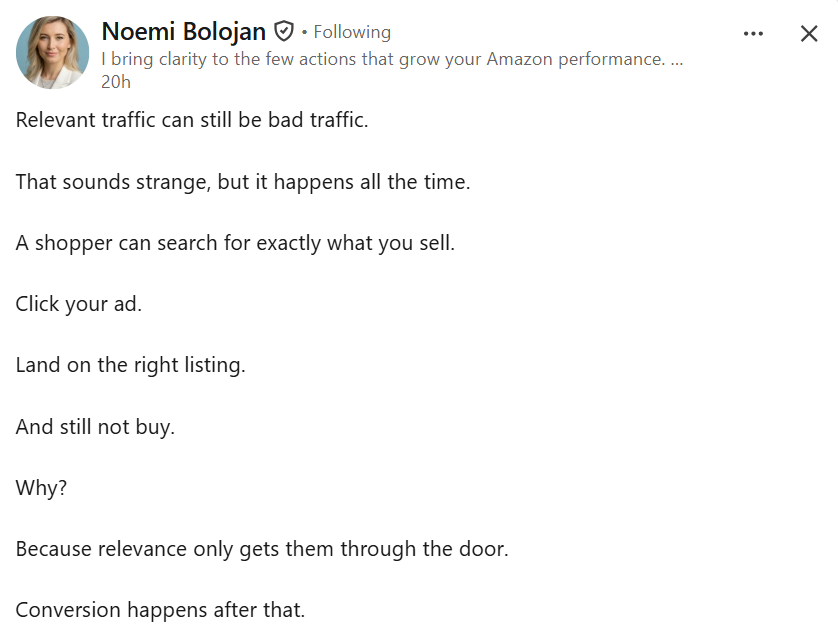
This framework argues that keyword relevance is only the first step in Amazon advertising. Even highly relevant traffic can fail to convert when pricing, reviews, listing quality, or competing offers make another product more attractive.
Why it works: Evaluating the full journey from search term to purchase helps separate targeting problems from listing and offer weaknesses. This allows brands to improve conversion fundamentals instead of repeatedly adjusting bids or excluding relevant keywords.
Where it needs balance: Low conversion rates don't always indicate a listing problem. Traffic volume, placement, shopper intent, and competitive conditions also influence performance. Brands should gather sufficient data and compare performance against relevant benchmarks before making major changes.
🎥 Reel of the Day

What Works:
1. Relatable Problem, Instant Hook - “How to sleep 8 hours in economy” targets a universal travel struggle. The promise of comfortable sleep in cramped airplane seats immediately captures attention.
2. Visual Demonstration Sells the Solution - Instead of explaining product features, the reel shows the travel pillow transforming an uncomfortable seat into a cozy sleeping setup, making its value instantly understandable.
3. Comment-to-DM Converts Attention - The caption offers 50% off for commenting “TRAVEL,” turning curious viewers into potential leads while encouraging comments and purchase intent.
Lead with a relatable frustration, demonstrate an unusual solution visually, and use a compelling offer to convert curiosity into action. Products that spark debate can generate engagement beyond traditional demonstrations.
Advertise with Us
Wanna put out your message in front of over 40,000 best marketers and decision makers?
Thanks for reading this edition! Keep pushing boundaries, testing ideas, and staying inspired. See you in the next edition with more ways to ignite your marketing success. 🥰