Meta took away your placement controls
🎯 Advantage+ now decides placement for you. The variables you still control are creative, offer, audience, and landing page, A great hook should qualify, not just stop the scroll, and more!
Welcome to a space where every edition delivers insights, strategies, and inspiration to fuel your advertising brilliance. 🤯
🎯 Meta just took away your placement controls. creative is what's left.
Meta's API v26.0 removed Instagram Explore Feed and Messenger Stories as selectable ad placements, and the platform's justification is consistent with a broader pattern: Advantage+ automated placements deliver roughly 11.7% lower cost per action than manual settings, on average.
That average is real. It's also not the question that matters for any specific brand, which is whether that brand's audience and category behave like the average the number is drawn from.
The practical effect is that placement-level control, one of the few remaining manual levers advertisers had, keeps shrinking. When the levers disappear, the variables left in an advertiser's control are creative, offer, audience definition, and landing experience.
That's not a minor shift. It's the platform quietly making creative quality carry more of the performance burden, whether or not a team has adjusted its process to match.
Audit whether your brand is actually average enough for the automated default to be right
An 11.7% average improvement means some accounts see a much bigger lift and others see a real decline, and a brand with unusual placement sensitivity, a category where Explore Feed or Stories genuinely outperformed the blend, is exactly the kind the average doesn't represent well.
Pull your last quarter of placement-level data before the removal takes full effect and identify whether any specific placement was meaningfully outperforming the blend for your account. If one was, that's lost optimization, not neutral automation, regardless of the platform average.
Reallocate the energy that used to go into placement strategy toward creative testing volume
Placement optimization used to be a real lever a media buyer could pull. With that lever gone, the hours previously spent tuning placement mix are either freed up or wasted, depending on where they get redirected.
Redirect that capacity into creative variant testing specifically, since it's now doing double duty as both the creative lever and, indirectly, the placement lever, given that Advantage+ decides placement partly on which creative performs where.
Getting your category's Q4 benchmark right matters more now that creative absorbs work placement used to do, which is what Billo's free calculator, built on 80,069 Meta video ads across 14 categories, is built to show.
Build brand safety checks into creative review, since placement exclusion no longer can
A brand that excluded specific placements for brand-safety reasons, not just performance, has lost a tool it may have relied on for reasons the performance average doesn't capture.
Move that safety review earlier, into creative approval itself, checking whether content is appropriate for the full range of contexts Advantage+ might now place it in. You can check your Q4 benchmarks here and see where your category lands.
The platform didn't ask whether you wanted this tradeoff. It just made it, and creative is now carrying the weight placement used to share.
Together with Zenty
Your Store Is Quietly Losing Revenue Right Now
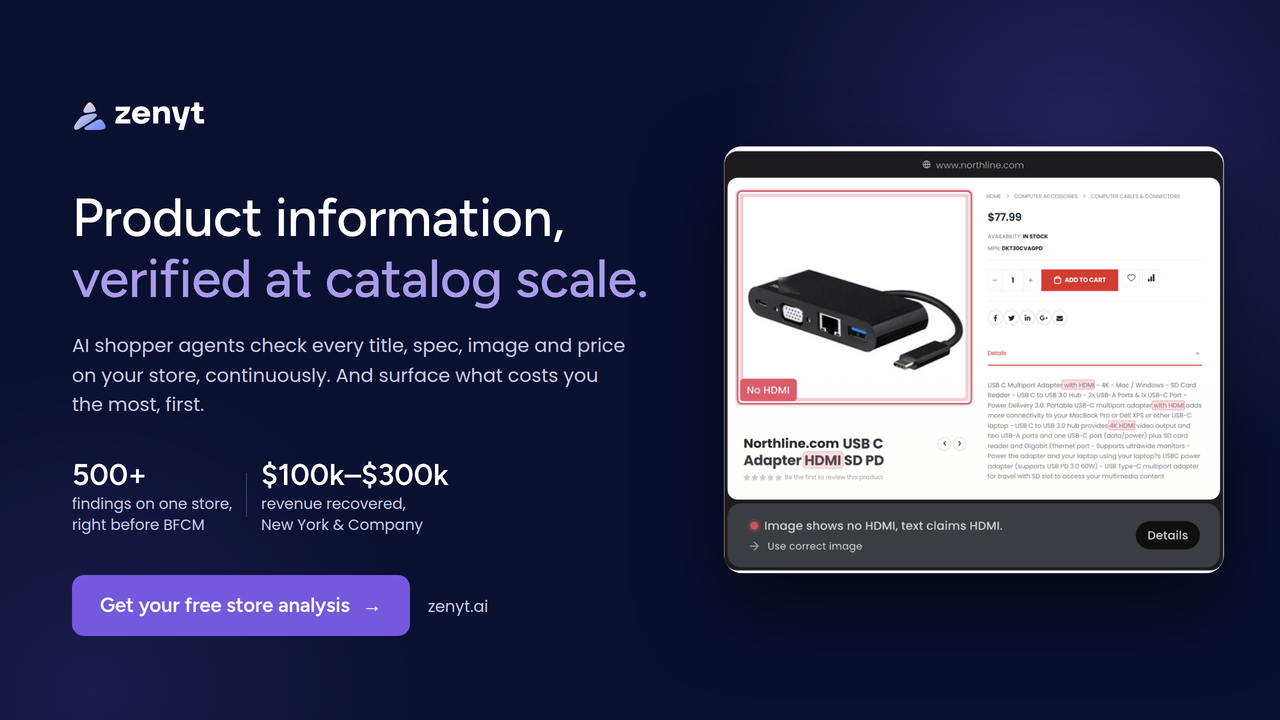
Sending paid traffic to product pages with hidden errors makes every campaign work harder than it should.
Zenyt checks your live store continuously, catching errors your team cannot manually find across thousands of SKUs. Every finding includes visual proof and is ranked by revenue impact, helping your team fix the most expensive problems first.
Instead of reviewing pages one by one, your team gets a prioritized list of fixes backed by screenshots.
Setup takes only your store URL. No code or platform migration.
- shortyLOVE cut manual store checks by 95% and lifted conversion by 35%.
- London Victorian Ring reduced manual store-checking time by 90%.
- Brooklinen uncovered more than $250K in annual opportunity through checks after weekly releases.
That means campaigns land on accurate pages and more paid traffic turns into revenue.
Peak-season updates are moving fast. See what is costing your store before shoppers find it.
⚡ A great hook should qualify, not just stop the scroll
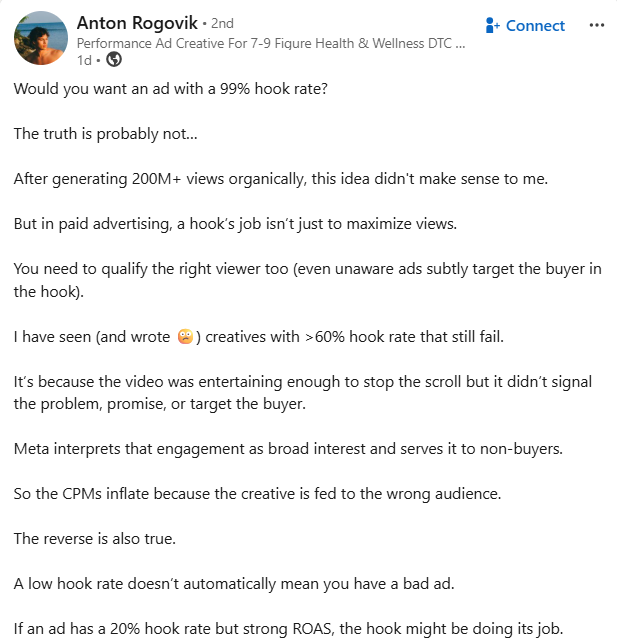
This framework argues that hook rate can be misleading when viewed alone. A highly entertaining opening may attract more viewers while failing to signal the problem, promise, or buyer the product is actually meant for.
Why it works: Starting with CPA, NCPA, or ROAS keeps creative analysis tied to business outcomes. Hook rate, outbound clicks, and click-to-purchase performance can then help diagnose where the journey is breaking.
Where it needs balance: A high hook rate doesn't necessarily cause Meta to find the wrong audience or inflate CPMs. Delivery depends on many signals. Hook metrics are best treated as diagnostic indicators alongside conversion performance, creative context, and landing-page congruency.
🎥 Reel of the Day

What Works:
1. Pet POV Hook - The dog voiceover immediately humanizes the pet, turning a supplement ad into character-led entertainment. That framing lowers ad resistance because viewers follow “Luka’s story,” not a product pitch.
2. Problem-To-Glow Arc - The reel builds a clean transformation narrative: stiff joints, bad breath, low energy, then visible improvement. That before-and-after structure gives the product a reason to exist without overexplaining benefits.
3. Native UGC Texture - Casual home footage, imperfect framing, owner interactions and everyday dog moments make this feel creator-led rather than brand-produced. That native content behavior makes the product integration feel much more believable.
Instead of having the owner explain benefits, let the pet “review” the transformation through humorous first-person voiceover. It creates stronger character recall while making functional claims feel entertaining.
🥳 Events
🔥 How Stripe and OpenAI Built Marketing Teams That Earned More Resources
September 17 | Virtual Event
Krithika Shankarraman, the first marketing hire at Stripe and OpenAI, joins AirOps CMO Christy Roach to unpack findings from 300+ marketing leaders. Learn how high-growth teams make stronger budget asks, protect the work that moves pipeline, and design leaner teams with clearer ownership and more leverage.
Advertise with Us
Wanna put out your message in front of over 40,000 best marketers and decision makers?
Thanks for reading this edition! Keep pushing boundaries, testing ideas, and staying inspired. See you in the next edition with more ways to ignite your marketing success. 🥰