The Sale That Changes Rankings
📊Equal revenue can produce different ranking outcomes, and more!
Welcome to a space where every edition delivers insights, strategies, and inspiration to fuel your advertising brilliance. 🤯
📊The Sale That Changes Rankings
Not every sale on Amazon produces the same ranking contribution. The A10 algorithm assigns different weight to conversions depending on where the purchasing traffic originated.
External converting traffic, traffic sourced from outside Amazon that results in a purchase, receives between 1.5 and 2 times the ranking contribution of native Amazon ad traffic when the conversion rate exceeds the category median.
Products driving 8 to 12 percent of their traffic from external sources rank 20 to 35 percent higher on average than comparable products relying exclusively on internal platform traffic. The same revenue number, in two different traffic mixes, produces two different ranking outcomes.
The mechanism is specific. Amazon's algorithm interprets external converting traffic as a demand signal that exists independently of its own promotional environment. A buyer who discovered your product outside Amazon and chose to purchase on Amazon is sending a signal about organic product-market fit that the algorithm values differently from a buyer who clicked a sponsored placement within the platform.
Both sales register identically in your revenue dashboard. They do not produce the same ranking contribution, and they do not compound the same way over time.
Stack Influence automates the external converting traffic motion through micro-influencer seeding: creators from a network of 11M+ purchase your product on Amazon and generate authentic content for their audiences, driving external traffic at the quality tier A10 weights most heavily. Brands like Martha Stewart and Unilever have used the channel to reach page one in two months. You can sign up this week and save 10% on your first campaign.
The compounding distinction matters more than the per-sale delta. Internal PPC spend produces conversions that support ranking while the campaign is running and depletes when spend pauses.
External converting traffic that becomes a consistent inbound source accumulates into organic rank rather than disappearing with the budget. The difference is between a ranking position that costs money to hold and one that generates organic sales while sustaining itself.
Tag every external traffic source with Amazon Attribution links, run the comparison for 30 days, and measure ranking movement alongside conversion volume. The number your revenue dashboard does not show is the organic rank lift that external traffic produces across that same period. That is the number that determines where you are in six months.
Together with AirOps
Why your best pages get skipped in AI answers

Ranking at the top of Google no longer guarantees you show up in ChatGPT, Perplexity, or AI Overviews. AI search discovers, renders, and cites pages on a different system than traditional SEO, and strong pages are getting left out without a clear signal as to why.
On July 9 at 11am ET, Jairo Guerrero, Founder of Organic Hackers, breaks down exactly where pages fall out of that pipeline. He's spent years inside server logs watching how AI crawlers actually behave, work most SEO tools can't even see.
You'll walk away knowing:
- The first 3 technical checks to run when pages go missing from AI answers
- What server logs reveal about crawler activity that every other tool misses
- Which structured data and template fixes make pages easier to cite
- Exactly where your pages are breaking in the crawl-to-citation pipeline
This is the session that turns "why aren't we showing up" into a checklist you run the same week.
Can't make it live? Register anyway and get the recording in your inbox within 24 hours.
⚡ Conversion Problems Often Come From Confusion, Not Objections
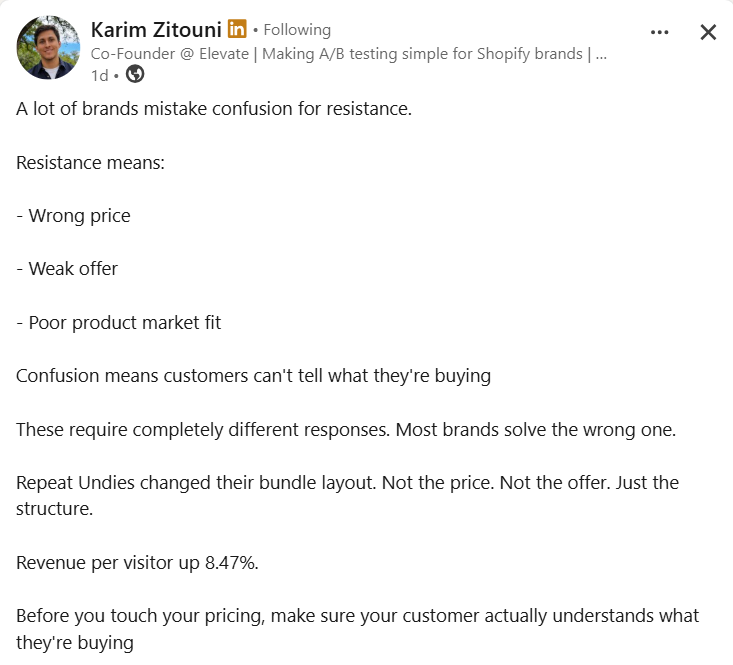
This framework separates two issues that are frequently treated as the same. Resistance means customers understand the offer but choose not to buy. Confusion means they cannot clearly understand what is being offered in the first place. Fixing messaging clarity is often more impactful than changing pricing or discounts.
Why it works: Customers are less likely to purchase when they must interpret bundles, compare options, or mentally piece together the offer. Clear product structure reduces cognitive effort, helping visitors reach a buying decision faster without changing the underlying value proposition.
Where it needs balance: Not every conversion problem is a clarity problem. If customers fully understand the offer but still do not buy, the issue may genuinely be pricing, product-market fit, or perceived value. The strongest optimization process first identifies whether the barrier is comprehension or persuasion before making changes.
🎥 Reel of the Day

What Works:
Participation Incentive - The reward isn't just free cookies. It requires public participation, turning every customer into entertainment that attracts even more customers.
Storefront Theatre - Instead of hiding the experience inside, the challenge starts at the entrance, making every passerby pause, watch, and become curious instantly.
Camera Authenticity - The CCTV perspective removes any polished commercial feeling. It resembles genuine surveillance footage, making reactions feel unscripted, believable, and naturally entertaining.
Create simple public challenges with instant rewards that transform customers into the entertainment, attracting crowds before your product even gets noticed.
Advertise with Us
Wanna put out your message in front of over 40,000 best marketers and decision makers?
Thanks for reading this edition! Keep pushing boundaries, testing ideas, and staying inspired. See you in the next edition with more ways to ignite your marketing success. 🥰