Three rules of compounding growth
🚀This is all you need to avoid the plateau and accelerate the growth, and more!
Welcome to a space where every edition delivers insights, strategies, and inspiration to fuel your advertising brilliance. 🤯
🚀 Three Rules That Separate Accounts That Compound From Accounts That Plateau
Most creative teams treat brief cycles as fresh starts. New ideas, new angles, new hooks, the energy goes toward discovery rather than extraction.
The accounts that compound over time follow a different operating model, and it reduces to three rules.
Rule 1: The ratio is 70/30, not the other way around.
Seventy percent of briefs iterate on what is already working. Thirty percent explore net new angles. Most creative teams are running closer to the inverse, spending the majority of their brief capacity chasing new ideas while the winning creative they just produced sits underexplored.
Every time you move on from a winner without understanding which variable drove it, you lose the ability to replicate it intentionally. You are starting from zero again rather than from a foundation.
Rule 2: When something wins, the first question is why, not what next.
A winning creative contains at minimum four variables: the hook, the format, the angle, and the visual. Any one of them could explain the performance, and moving on without identifying which one means the win produces no transferable intelligence.
Before a single iteration brief gets written, assign the win to a hypothesis. The hypothesis does not need to be correct. It needs to be specific enough to test against.
Rule 3: Change one variable at a time, not the whole creative.
A winning hook gets three new bodies. A winning angle gets tested as a static, a video, and a carousel. A winning testimonial gets recut with a different opening. Each variation changes one thing and holds everything else constant.
This is the only way a test produces a data point rather than another piece of noise. Two variables changed simultaneously means two possible explanations for the result, and neither can be confirmed.
The compounding effect is not immediate, it appears over eight to twelve weeks as the brief process shifts from producing individual winners to producing creative intelligence each new brief builds on.
This week’s audit: pull your last three winning creatives and count how many distinct variations were tested from each before the team moved on. If the number is zero or one, the 70% is not running and the plateau you are experiencing is a brief allocation problem, not a creative quality problem.
Together with Stack Influence
Stop renting Amazon visibility. Start building a rank you keep.
Every dollar of PPC buys you a moment of visibility. Stop bidding, and your rank slides right back. You are renting, not building.
Here is the alternative play: when real shoppers discover your product outside Amazon and buy it, the algorithm reads that external traffic as genuine demand and rewards it with an organic rank that sticks after the campaign ends.
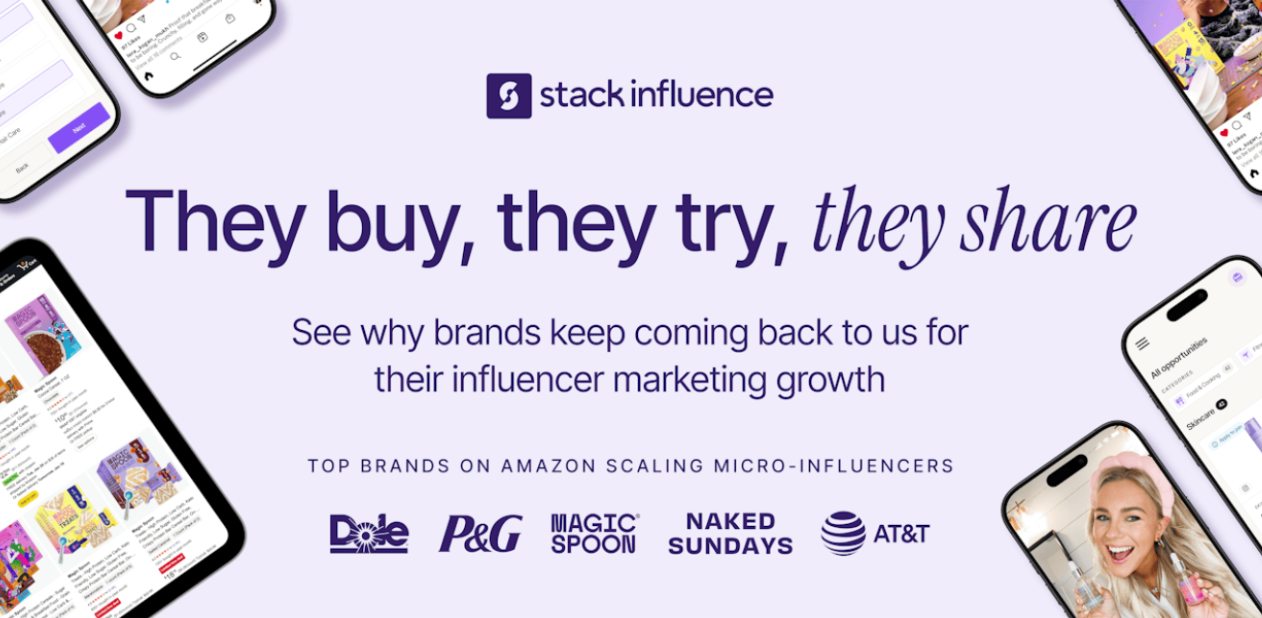
Stack Influence makes that engine repeatable. Send free product to vetted micro-influencers; they buy on Amazon, post authentic content to their own audiences, and drive the outside traffic that moves your listing. No cash fees, no manual outreach.
The results: one product activated 187 influencers and saw BSR improve 11X and recurring sales 8X, worth $342K YoY. Another went from zero to $150K a year and an Amazon's Choice badge on 291 creators. It is the same model behind growth at Magic Spoon, Unilever, and Thrasio.
If you are scaling on Amazon, this belongs in your stack. Sign up this week and save 10% on your first campaign.
⚡Plain-Text Emails Often Win Because They Feel Like Conversations
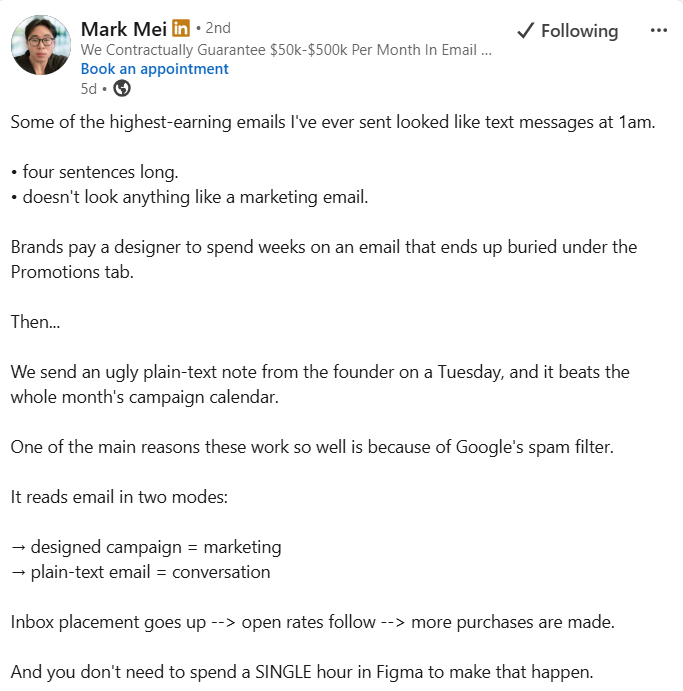
This framework argues that high-performing emails are not always the most visually polished. Simple, founder-style messages can outperform heavily designed campaigns because they feel more personal and conversational, encouraging recipients to engage rather than dismiss them as promotional content.
Why it works: Plain-text emails reduce visual friction and often create a stronger sense of one-to-one communication. They can improve engagement by focusing attention on the message itself rather than the design, making them particularly effective for founder stories, product updates, and objection-handling emails.
Where it needs balance: Plain-text emails are not automatically better for deliverability or inbox placement. Email providers use many signals beyond formatting, including sender reputation, authentication, recipient engagement, and content quality. The best strategy is to match the format to the message, testing plain text alongside branded designs instead of assuming one consistently outperforms the other.
🎥 Reel of the Day

What Works:
Sensory Storytelling - Instead of listing tasting notes, every ingredient visually recreates whiskey's character, making viewers almost experience the flavor before taking a single sip.
Process Satisfaction - Each deliberate preparation step rewards curiosity, encouraging viewers to stay until completion because every action meaningfully transforms the final drinking experience beautifully.
Premium Positioning - Wood textures, cinnamon, smoked aromas, and cinematic lighting collectively signal craftsmanship, elevating an everyday whiskey into an aspirational ritual worth remembering consistently.
Transform product benefits into visual rituals people can watch unfold, making audiences emotionally experience your promise before they ever purchase anything.
Advertise with Us
Wanna put out your message in front of over 40,000 best marketers and decision makers?
Thanks for reading this edition! Keep pushing boundaries, testing ideas, and staying inspired. See you in the next edition with more ways to ignite your marketing success. 🥰